



Use Wozber and land your dream job
Create CV
No registration required
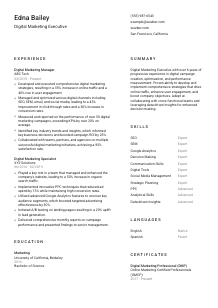
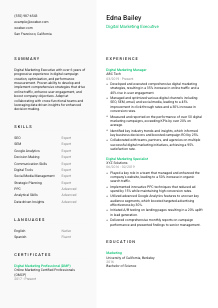
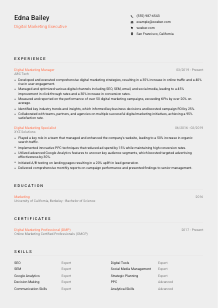
Crafting campaigns, but feeling lost in algorithms? Explore this Digital Marketing Executive CV example, created with Wozber free CV builder. Learn how to present your online prowess clearly to meet job specifications, setting your career strategy to resonate as sharply as your ad targeting!
Digital marketing hiring moves quickly because the work itself is measured quickly. Teams want to see whether you can turn channel strategy into traffic, engagement, leads, and conversion gains, then explain what changed and why. Your CV should make that operational range visible, from campaign planning to optimisation and reporting, rather than reading like a generic marketing profile.
When the CV is tailored well, the difference shows up fast in screening. A hiring team can tell whether your background is centered on channel execution and performance analysis or sits closer to broad communications work. Using Wozber's free CV builder helps you shape an ATS-compliant CV around the job's language, so SEO, PPC, analytics, and cross-functional campaign work are easy to recognize from the first scan.
For a Digital Marketing Executive, the personal details section should remove friction immediately. Hiring teams need to see that you are reachable, professionally presented, and, when the posting calls for it, already based in the required market. Keep this section clean and practical so the attention stays on your campaign results and channel expertise.
Your name should be the most visible line on the page, set apart clearly from the rest of the header. In a field where personal branding matters, a cluttered or hard-to-find name creates the wrong first impression before anyone reaches your SEO, SEM, or reporting experience.
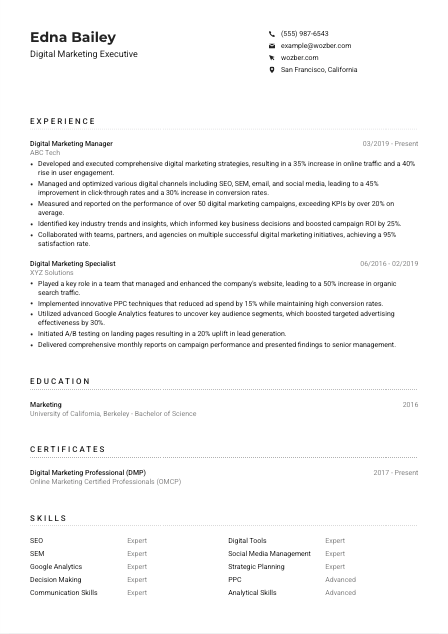
Place "Digital Marketing Executive" beneath your name if that is the role you are pursuing. Matching the target title helps frame your experience around campaign strategy, channel optimisation, and conversion performance from the start. In the example CV, using the exact title creates immediate alignment with the posting.
List a current phone number and a professional email address that you check regularly. Digital marketing roles often move through screening, take-home tasks, and interview scheduling quickly, so accuracy matters. One typo in an email address can cost you momentum.
If a role specifies a location, show it in your header exactly and plainly. Here, listing "San Francisco, California" addresses a stated requirement and saves the employer from guessing about relocation or local availability. Only do this when it is relevant to the target job.
Include a LinkedIn profile or personal website when it supports your candidacy. For digital marketing professionals, this can reinforce your credibility through campaign portfolios, content examples, case studies, or a polished online presence. Make sure the branding, role titles, and dates match your CV.
This section does not need personality flourishes. It needs clean contact details, the right title, and any location requirement handled upfront so the reader can move straight to your marketing track record.




This is the section hiring teams read most closely for digital marketing roles. They want to see which channels you managed, how you measured performance, and whether your work improved traffic quality, lead volume, conversion rate, or return on spend. Strong experience bullets connect action, platform, and outcome in one line of thought.
Start by pulling out the recurring responsibilities from the posting, then map your past roles to them. For this role, that includes building digital strategy, managing SEO and paid channels, tracking KPIs, and working with internal teams or agencies. Prioritise accomplishments that show you have already handled that mix of execution and analysis.
List roles in reverse chronological order with job title, company, and dates in a consistent format. Digital marketing careers often progress from channel execution into broader campaign ownership, so your structure should make that growth obvious. The sample CV does this well by moving from specialist work into manager-level responsibility.
Replace task-only lines with achievement statements that show what improved under your direction. "Managed SEO and email campaigns" is much weaker than a bullet that ties those channels to click-through rate, engagement, or conversion gains. The example CV's traffic, engagement, and ROI increases are useful models because they connect channel work to business results.
Percent lifts, cost reductions, conversion gains, campaign volume, ROI improvement, lead growth, and reporting cadence all carry weight here. If you ran more than 50 campaigns, improved CTR by 45%, or cut PPC spend while protecting conversions, say so. Numbers make it easier to understand scope and performance without overexplaining.
Your experience section should centre on acquisition, engagement, optimisation, analytics, and collaboration tied to campaign delivery. If an older bullet does not reinforce those themes, trim it or reframe it. Space is better used on A/B testing, audience segmentation, dashboard reporting, agency coordination, or channel growth work that mirrors the job's priorities.
A Digital Marketing Executive CV earns attention when the experience section shows real ownership of channels and measurable movement in KPIs. Make it easy to see what you ran, what you improved, and how you worked with others to deliver it.
Education matters most here as a baseline qualification, then as supporting context for your professional work. Hiring teams usually want to confirm that you meet the degree requirement and that your studies relate sensibly to marketing, business, analytics, or digital commerce. Present it clearly, then let your campaign results carry the heavier weight.
If the role asks for a bachelor's degree in Marketing, Business, or a related field, make that qualification easy to find. A degree such as "Bachelor of Science in Marketing" directly supports the requirement and reinforces your grounding in audience strategy, brand communication, and market analysis.
List degree, field of study, school, and graduation date in a clean order. This section should be quick to scan, especially when the recruiter is moving between CVs looking for required qualifications. Simple formatting helps keep the focus on relevance.
Be specific about your major or concentration instead of using vague labels. "Marketing" or "Business Administration" tells the reader more than a generic degree listing. In the example, the Berkeley marketing degree aligns neatly with the role's stated academic requirement.
Most experienced candidates do not need to expand this section much, but relevant coursework can help if it supports your current direction. Classes or projects in digital analytics, consumer behaviour, paid media, content strategy, or market research can be worth mentioning when they connect to the work you now do.
Honors, scholarships, or major capstone projects can add value if they relate to performance, leadership, or analytical ability. Keep them concise and only include them when they support your positioning as a marketing professional rather than distract from your recent experience.
For this role, education should confirm the required academic background without taking space away from campaign performance and channel expertise. If the degree matches well, state it plainly and move on.
Certifications can strengthen a digital marketing CV when they support the channels, tools, and measurement work employers care about. They are especially useful in a field shaped by changing ad platforms, analytics features, and search practices. Use this section to show current professional development, not to pad the page.
Review the job description for required or preferred certifications before deciding what to include. This posting does not require one, which means certificates are supporting material rather than a gatekeeper. Include them only when they reinforce real capability in digital marketing execution or analysis.
Choose credentials that relate directly to campaign management, analytics, search, paid media, email, or platform fluency. A certification such as "Digital Marketing Professional (DMP)" fits because it supports broad digital marketing competence rather than a loosely related topic.
Dates matter when a certification is active, recently earned, or part of an ongoing credential. In digital marketing, recency can matter because tools, interfaces, and best practices shift fast. Showing the timeline helps the employer judge how current your learning is.
This field rewards marketers who keep up with changes in search behaviour, attribution, paid media tactics, and analytics reporting. If you regularly add certifications, it signals that you stay engaged with the operational side of the work and do not rely only on past experience.
Certifications are most useful when they back up your hands-on channel work and analytical range. Keep the section focused on credentials that strengthen your case for running and improving digital campaigns now.
Digital marketing skill lists should do more than drop buzzwords. They should show the channels you can manage, the tools you can interpret, and the working style you bring to optimisation. A hiring team scanning this section should quickly understand whether you can run campaigns, analyse performance, and collaborate across creative, product, and sales teams.
Start with the skills the employer actually names, then add closely related capabilities you genuinely use. For this role, SEO, SEM, PPC, Google Analytics, analytical thinking, and communication are central. That gives you a reliable starting point for deciding what belongs near the top of the section.
Use the same terminology the employer uses when it accurately describes your background. If the posting says "SEO" and "Google Analytics," do not hide those skills behind broader labels like "digital tools" or "marketing platforms." The example CV works best where it names the specific channel and analytics skills directly.
Group or order skills so the most relevant ones stand out quickly. A shorter list of meaningful capabilities is stronger than a crowded inventory of every platform you have touched once. Prioritise channel management, performance analysis, testing, reporting, and collaboration skills that support day-to-day digital marketing execution.
This section should tell the reader, within seconds, whether you have the channel knowledge and analytical discipline the role needs. Lead with the skills that map directly to campaign delivery and performance reporting.
Language ability matters in digital marketing when the role includes content review, stakeholder communication, campaign localization, or customer-facing copy. Even when only one language is required, this section can still clarify whether you can handle reporting, cross-team communication, and market-specific work without friction.
If the posting specifies English proficiency, list English prominently with an accurate level such as "Native" or "Fluent." That is especially relevant in roles involving campaign briefs, reporting updates, agency communication, and written analysis. Here, the job clearly asks for efficient handling of English-language tasks.
Additional languages can support audience targeting, localized content, or collaboration across regions, but they are not automatically essential. Include them when they are relevant to the markets you serve or help broaden your usefulness. Spanish, for example, can be valuable in some audience and content contexts, but it is an added asset rather than a universal requirement.
Choose plain descriptors such as Native, Fluent, Professional, Conversational, or Basic. Hiring teams need a realistic sense of what kind of communication you can handle, from campaign copy review to client calls or market research.
Do not overstate fluency. In marketing roles, language ability often gets tested quickly through writing tasks, stakeholder communication, or content adaptation. Accurate labeling protects your credibility and helps place you on the right type of work.
If your campaigns target multilingual audiences or global markets, language skills can become more than a nice addition. In that case, position them as part of your ability to support segmentation, messaging, or regional campaign execution. If not, keep this section brief and factual.
For most Digital Marketing Executive roles, language skills are a supporting detail unless the target market makes them central. Lead with the required language, add others honestly, and let the section complement your campaign experience.
A Digital Marketing Executive summary should tell the reader, in a few lines, what kind of marketer you are and what results tend to follow your work. This is where strategy, channels, analytics, and collaboration come together. Keep it compact, but make sure it sounds like someone who understands performance marketing, not general promotion.
Start with your title and years of experience so the reader immediately knows your level. "Digital Marketing Executive with 6+ years of experience" is direct and useful because it frames the rest of the CV around channel ownership and progression.
Choose two or three strengths that line up with the role's biggest needs, such as digital strategy, SEO and paid channel management, analytics, or cross-functional execution. Then add one concrete result area, like traffic growth, engagement improvement, conversion lift, or ROI gains, to ground the summary in actual performance.
Aim for 3 to 5 lines that read quickly and carry real substance. You do not need to recap every platform or every campaign. The sample summary works because it covers experience, strategy, measurable outcomes, and data-driven decision making without turning into a paragraph-long biography.
Avoid soft claims that could belong on any CV. Use language that reflects how the role operates, such as optimising campaigns, measuring KPI performance, identifying insights, and collaborating with internal teams or agency partners. That makes the summary sound grounded in the day-to-day work of the job.
When the summary is tailored well, it frames the rest of the CV before the recruiter reaches your first bullet point. With clear positioning, measurable results, and role-specific language, your CV is ready to present you as a marketer who can plan, optimise, and report on digital performance. Keep refining it as your channels, tools, and results evolve.
A well-tailored Digital Marketing Executive CV makes three things easy to spot right away: the channels you know, the metrics you improved, and the teams or partners you worked with to deliver results. That matters in both human review and ATS optimisation, because the strongest CVs use the same language as the role while staying grounded in real campaign work.
Use Wozber's AI CV builder to sharpen phrasing, align your experience with job requirements, and present everything in an ATS-friendly CV format that keeps strategy, channel expertise, and results easy to scan. Once your CV clearly shows how you drive traffic, engagement, conversion, and reporting outcomes, you are in a much stronger position to compete for Digital Marketing Executive roles.