



Use Wozber and land your dream job
Create CV
No registration required
Navigating the digital realm, but your CV feels offline? Browse this Digital Marketer CV example, created with Wozber free CV builder. Learn how to channel your online strengths to match job demands, ensuring your career narrative stays trending, just like your campaign metrics!
Digital marketing work is reviewed through outcomes. Hiring teams want to see how you moved acquisition, conversion, engagement, or return on ad spend, and whether you can connect channel activity to business performance. Your CV should make that link visible fast, with campaign scope, optimisation work, and measurable gains instead of broad claims about being creative or strategic.
A tailored Digital Marketer CV also helps separate channel generalists from candidates who can actually run, measure, and improve performance across SEO, SEM, email, social, and landing pages. Wozber's free CV builder helps you shape that experience into an ATS-friendly CV that mirrors the posting's terminology and surfaces the right metrics first, so recruiters can quickly see where your campaign execution and reporting match the role.
This section is simple, but it still carries useful hiring signals. For digital marketing roles, your header should immediately confirm who you are, what role you do, and how easily a team can contact you, without clutter that distracts from campaign experience or performance data.
Use your full name in a slightly larger font than the rest of the CV so it anchors the page cleanly. You do not need decorative formatting. Clear presentation works best, especially when the rest of the CV needs space for campaign metrics, platforms, and results.
Place "Digital Marketer" under your name when that is the role you are pursuing. This keeps your positioning consistent with the posting and helps both recruiters and ATS tools connect your profile to digital campaign work quickly.
List the phone number and email address you check most often. Use an email that looks business-ready, ideally a simple variation of your name. For a role that depends on clear communication across content, design, product, or sales teams, even basic contact details should feel polished.
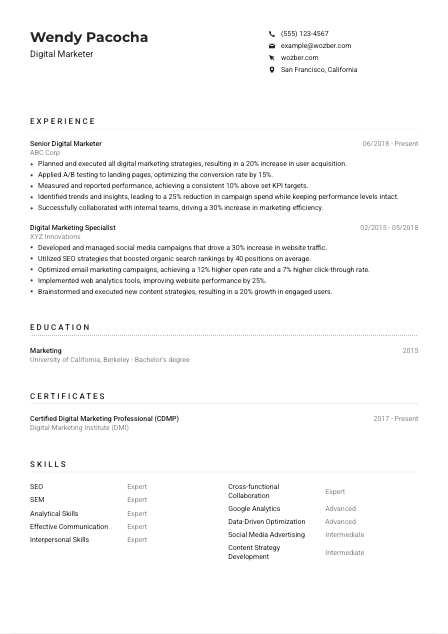
If the employer requires candidates to be based in a certain place, include your city and state. In the example, listing San Francisco, California directly supports a stated location requirement and removes a common screening question early.
Include a LinkedIn profile or personal website if it strengthens your application. For digital marketers, a portfolio with campaign snapshots, landing page tests, content strategy work, dashboards, or channel results can add substance, as long as it matches the claims on the CV.
Skip details such as age, gender, marital status, or a full street address unless an employer explicitly asks for them. Keep the focus on professional information that supports your candidacy and keeps the document clean for both human readers and ATS parsing.
Your personal details should remove friction, not add noise. When the header quickly confirms your role, contact information, and any required location detail, the reader can move straight to the campaign work and results that matter most.




For a Digital Marketer, experience is where the hiring decision usually sharpens. This section should show which channels you managed, how you optimised performance, what tools or testing methods you used, and what changed because of your work. Daily tasks alone will not carry the section.
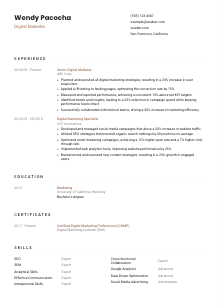
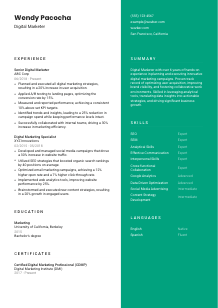
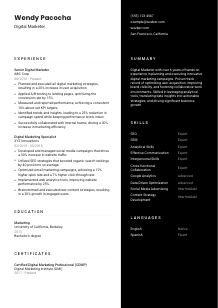
Start by identifying the work most relevant to the role, then bring those positions and bullets to the front of attention. If the employer needs SEO, SEM, email, social media, display, analytics, and conversion work, your experience should clearly show where you handled those areas. In the example, the strongest bullets focus on campaign execution, A/B testing, reporting, spend optimisation, and cross-functional collaboration because those are central to the target role.
Use reverse chronological order and make each entry easy to scan. Include your job title, company name, and employment dates so a recruiter can quickly understand your progression from specialist execution to broader ownership, if applicable.
Replace generic statements like "managed campaigns" with bullets that show what you improved. Strong Digital Marketer bullets usually mention channel, action, and result, such as increasing user acquisition, raising click-through rate, improving rankings, lowering spend, or lifting conversion rate after landing page testing.
Quantified results make your work easier to evaluate. Useful metrics include traffic growth, conversion lift, ROI, CPA reduction, email open and click rates, organic ranking gains, lead volume, engagement growth, or performance against KPI targets. The example does this well with results such as a 20% increase in user acquisition, a 15% conversion improvement from A/B testing, and a 25% reduction in spend without losing performance.
Keep space for the experience that best reflects digital campaign planning, optimisation, reporting, and collaboration. Older or less relevant work can be shortened or removed if it does not help prove channel expertise, analytical ability, or growth impact. Every bullet should reinforce how you contribute to measurable marketing results.
A hiring manager should be able to scan your experience section and understand the channels you know, the metrics you improved, and the scale of the results you delivered. That is what turns past marketing work into a credible case for the next role.
Education rarely carries a Digital Marketer CV on its own, but it still matters when the employer has a degree requirement or when your academic background directly supports your marketing foundation. Keep it clean, factual, and relevant to the level of the role.
Read the posting carefully and mirror the educational baseline when you meet it. Here, the employer asks for a Bachelor's degree in Marketing, Business, or a related field, so that information should appear clearly and without extra wording.
List your degree, field of study, school, and graduation year if you want to include it. Straightforward formatting works best because recruiters usually review education quickly unless the role depends on a specific academic background.
If your degree directly matches the employer's requested field, place that information exactly as they are likely to search for it. In the example, a Bachelor's degree in Marketing aligns cleanly with the stated requirement and supports the candidate's marketing foundation without needing extra explanation.
Relevant coursework can help if you are earlier in your career, changing direction, or applying to a role with a strong analytics or performance marketing focus. Courses in digital analytics, consumer behaviour, paid media, conversion optimisation, or marketing strategy are more useful than generic class lists.
Honors, academic awards, research, or student leadership can be worth adding if they support your candidacy and you do not yet have extensive marketing experience. For experienced marketers, these details usually matter less than campaign results, so use space carefully.
Your education section should confirm that you meet the academic baseline and support the rest of your marketing profile without competing for space with stronger proof like campaign execution, analytics, and growth results.
Certifications can add real value in digital marketing because platforms, analytics practices, and optimisation methods change quickly. They work best when they reinforce tools, channels, or areas of specialization that already show up in your experience.
Choose certifications that support the kind of marketing you want to do. For many Digital Marketer roles, that means analytics, paid search, SEO, email, automation, or platform-specific credentials that show current knowledge in performance-focused work.
Do not overload the section with every short course you have taken. A shorter list of respected, role-aligned certifications is more useful than a long list of loosely connected training items. The example's digital marketing certification works because it supports the broader campaign and optimisation story already shown elsewhere.
Include completion dates and renewal periods when relevant, especially for tools or certifications that change over time. In digital marketing, recency matters because employers often want to know whether your knowledge reflects current reporting standards, ad platforms, and testing practices.
If you are actively working in SEO, paid media, analytics, CRM, or experimentation, keep your certifications updated in those areas. Ongoing learning can reinforce that you stay current with platform changes, attribution questions, and evolving optimisation tactics.
The best certificates add context to the work you have already done. Keep this section focused on credentials that strengthen your credibility in analytics, channel execution, and performance improvement.
The skills section should read like the operating toolkit behind your results. For Digital Marketer roles, that usually means a mix of channel expertise, analytics fluency, testing ability, and collaboration skills that support campaign execution from planning through reporting.
Study the posting and note both the specific platforms or disciplines and the working style behind them. If the employer calls out SEO/SEM, marketing databases, email, social media, display advertising, web analytics, A/B testing, and data-driven thinking, those terms should shape the way you present your own skills, provided they reflect real experience.
List the hard skills that drive performance and the soft skills that make campaign work effective across teams. For this kind of role, that might include SEO, SEM, Google Analytics, email marketing, landing page optimisation, A/B testing, reporting, and budget optimisation alongside communication and cross-functional collaboration. The example strikes that balance by pairing analytics and optimisation skills with interpersonal strengths.
Group your strongest and most relevant skills first so a recruiter can immediately see alignment with the role. Avoid padding the list with vague traits or tools you barely use. A focused skills section gives clearer support to the campaign results described in your experience.
Choose skills that explain how you produced the outcomes on the page. When the listed tools and capabilities line up with your campaign metrics, the CV reads as credible and well targeted.
Language ability matters when the job requires strong communication, content coordination, stakeholder interaction, or audience reach across markets. For Digital Marketers, this section is usually brief, but it can still support your profile when it reflects the communication demands of the role.
If the job description specifies a language requirement, include it clearly. Here, strong verbal and written English is explicitly required, so English should appear first and at an appropriate proficiency level.
Lead with the language most relevant to reporting, campaign coordination, stakeholder communication, and content review. For many roles in this field, that will be English, especially when it is central to team collaboration and campaign execution.
Additional languages can be useful when they support multilingual campaigns, audience segmentation, localization work, or regional growth efforts. They are not mandatory for every Digital Marketer role, but they can broaden your value depending on the employer's markets.
Describe your level accurately with terms such as Native, Fluent, Intermediate, or Basic. Honest labeling matters because language ability may affect copy review, campaign coordination, client communication, or collaboration with regional teams.
If additional languages support the kind of marketing work you do, keep them in. In the example, Spanish adds useful breadth, especially for audience reach or multilingual communication, but English remains the priority because it is the stated requirement.
List languages in a way that supports how you work. When the required business language is clear and any additional languages are relevant to audience or team needs, this section adds useful context without taking up much space.
Your summary should quickly establish the kind of digital marketing work you do best and the results you are known for. A few lines are enough if they combine years of experience, channel scope, analytical strength, and business impact in language that matches the role.
Read the posting closely and identify the main themes that should appear near the top of your CV. For this role, those themes include multi-channel digital marketing, analytics, optimisation, A/B testing, and collaboration around landing pages and growth strategy. Use those priorities to decide what belongs in your summary.
Start by stating who you are professionally and how long you have worked in digital marketing. A line such as "Digital Marketer with 6+ years of experience" gives immediate context and helps the reader place the level of your background before they reach your detailed campaign history.
Use the next sentence or two to name the channels, tools, and outcomes that define your work. Good summary material for this profession includes SEO/SEM, email, social, display, analytics, testing, conversion optimisation, user acquisition, and KPI performance. The example summary works because it links hands-on campaign execution with business growth and data-driven decision making.
Aim for a short paragraph that reads cleanly and avoids generic adjectives. Focus on details that can be backed up elsewhere in the CV, such as years of experience, campaign scope, optimisation methods, and measurable growth. If a claim cannot be supported by your experience bullets, trim it.
A well-written summary tells the reader, within seconds, what kind of Digital Marketer you are and what results usually follow your work. That makes the rest of the CV easier to read through the right lens.
When each section of your CV reflects campaign ownership, optimisation skill, reporting discipline, and measurable business results, your application becomes much easier to evaluate. Wozber's free CV builder helps organise that information in an ATS-friendly CV format, so your channel expertise and performance metrics stay clear from the first scan to the final review.
Use Wozber to tailor wording to the job description, strengthen ATS optimisation, and present your experience in a clean structure that supports real marketing credibility. The final CV should make one thing obvious: you know how to plan, measure, and improve digital campaigns in ways that drive growth.




