



Use Wozber and land your dream job
Create CV
No registration required
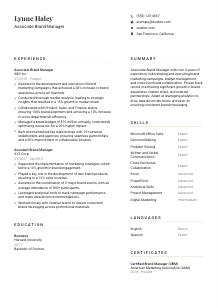
Crafting brand stories, but your CV feels like a generic tagline? Check out this Associate Brand Manager CV example, created with Wozber free CV builder. It shows how to tailor your branding brilliance to match job requirements, positioning your career narrative as distinct and memorable as your favorite advertising campaigns!
Associate Brand Managers sit close to the commercial engine of a brand. The work usually blends campaign execution, market analysis, budget tracking, and constant coordination with Product, Sales, Finance, and agency partners. A CV for this role needs to show that you can move from insight to action, keep messaging aligned across channels, and support growth with data rather than broad marketing claims.
That becomes much easier to read when your CV mirrors the language of the target role and keeps the most relevant brand work visible early. Wozber's free CV builder helps you shape an ATS-compliant CV around the posting's priorities, so terms like brand campaigns, competitive analysis, budget management, and cross-functional collaboration are easy to pick up in both ATS screening and human review. The hiring team should quickly see where you've already done this work and what results followed.
For Associate Brand Manager roles, the header does more than identify you. It confirms basic logistics fast, especially when the employer has a location requirement or expects polished external communication. Keep this section clean, complete, and easy to scan.
Use your full name as the visual anchor of the CV. Keep it slightly larger than the body text so it reads like a clear professional identifier, not a design element. In brand and marketing hiring, presentation matters, and a tidy header sets that tone immediately.
If you are applying for an Associate Brand Manager job and your background supports that level, place "Associate Brand Manager" directly under your name. This creates immediate alignment with the posting and helps both recruiters and ATS systems connect your profile to the role without guessing whether you sit in brand, product marketing, or general marketing.
List a reliable phone number and a professional email address. Brand roles often involve agency communication, stakeholder updates, and polished written correspondence, so even small details in your contact line should reflect professionalism and care.
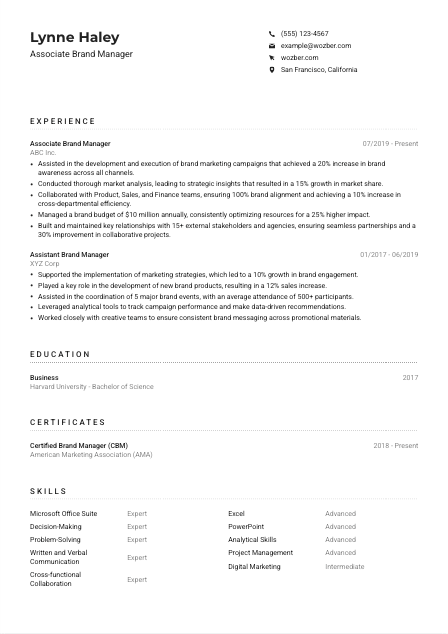
If the employer specifies a city or region, show that clearly in your header. Here, listing "San Francisco, California" directly addresses the location requirement and removes a practical hiring question before it slows your application down. Only do this when it is true and relevant to the role you are targeting.
A LinkedIn profile or personal website can help if it supports your brand work with campaign examples, product launches, category experience, or consistent career history. Make sure the information matches your CV. Any mismatch in titles, dates, or achievements can weaken credibility quickly.
Your personal details should confirm that you are reachable, professionally presented, and logistically aligned with the opening. When this section is clear, the reader can move straight to your campaign work, analytical range, and brand results.




Experience is where Associate Brand Manager CVs usually win or lose attention. Hiring teams want to see how you contributed to campaigns, what business outcomes followed, how you worked across functions, and whether you can manage both analysis and execution. Generic marketing bullets will not do much here.
Start by marking the responsibilities and requirements that define the role. For this opening, that includes campaign execution across channels, market and competitive analysis, collaboration with Product, Sales, and Finance, budget management, and external partner relationships. Those themes should shape which achievements you feature and the language you use in your bullets.
List your most recent position first and make each entry easy to scan with company name, title, and dates. For brand management roles, career progression matters. Moving from an Assistant Brand Manager position into an Associate Brand Manager role, as the example does, signals growing ownership over campaigns, planning, and decision support.
Do not stop at "assisted with marketing campaigns" or "worked with cross-functional teams." Show what moved because of your work. A bullet like "assisted in the development and execution of brand marketing campaigns that achieved a 20% increase in brand awareness" works because it ties activity to a measurable result. Use the same pattern for market share, engagement, sales lift, launch support, or channel performance whenever you can back it up.
Metrics carry weight when they reflect how brand work is judged. Useful figures include brand awareness growth, market share change, sales impact, campaign reach, event attendance, budget size, stakeholder count, or efficiency gains from better cross-functional coordination. The sample CV's "$10 million annually" budget and "15+ external stakeholders" are good examples because they show scope as well as execution.
Every bullet should support your case for this kind of role. Prioritise campaign execution, analytical insight, budget stewardship, messaging consistency, agency coordination, and partnership with commercial teams. Leave out accomplishments that do not help explain how you contribute to brand growth or operational alignment.
A hiring manager should be able to trace your impact from insight to execution to result. If your experience section makes campaign performance, collaboration, and budget responsibility easy to see, you are speaking the language of Associate Brand Manager hiring.
Education will rarely outrank hands-on brand experience at this level, but it still matters because many Associate Brand Manager openings require a business or marketing foundation. Present it clearly, then let your experience carry the heavier argument.
If the job asks for a Bachelor's degree in Business, Marketing, or a related field, show that qualification directly. A Bachelor of Science in Business, like the one in the example, checks the box cleanly and supports the commercial side of brand work, from market analysis to budget planning.
List your school, degree, field of study, and graduation year. That is usually enough for an Associate Brand Manager CV. Hiring teams want to confirm the educational requirement quickly, not work through unnecessary formatting or extra academic detail.
Your major can help frame your early professional foundation. Business, Marketing, Communications, Economics, or similar fields all connect naturally to consumer insight, brand positioning, pricing logic, and go-to-market thinking. If your degree is in a related field, naming it clearly helps the recruiter make that connection.
Relevant coursework can help if you are earlier in your career, changing functions, or do not yet have much direct brand management experience. Courses in consumer behaviour, marketing analytics, market research, finance, or strategic marketing can support the transition. If you already have several years of brand work, this is usually optional.
Academic honors, case competitions, marketing clubs, or leadership roles are worth adding when they support your brand or business profile. Keep them only if they add substance, such as showing analytical strength, presentation skill, or early exposure to brand strategy and campaign planning.
This section needs to answer the degree requirement quickly and support the business side of your profile. Once that is clear, your campaign results and market experience should stay in the foreground.
Certifications are not always required for Associate Brand Manager roles, but the right ones can strengthen your positioning. They are most useful when they reinforce practical brand, marketing, analytics, or category knowledge that the employer already values.
List certifications that connect clearly to branding, marketing, market research, digital channels, analytics, or project delivery. A credential such as Certified Brand Manager is relevant because it supports the strategic and operational side of brand work rather than adding a generic learning badge.
A short list of well-matched certifications is stronger than a long list of loosely related courses. Prioritise credentials that help explain your ability to support campaign execution, interpret market data, or work effectively across commercial teams and agency partners.
Certification dates show recency and continuity. They tell the reader whether your learning is current and whether you have continued building expertise alongside your work experience. That matters in marketing environments where channels, tools, and reporting expectations keep shifting.
Update certifications as your responsibilities expand. If your work is moving deeper into analytics, digital performance, shopper marketing, or innovation, newer credentials in those areas can help sharpen your profile for the next step up in brand management.
Certifications work best when they support the same story told in your experience section. Keep them relevant, current, and tied to the kind of brand work you want to do next.
The skills section should help the reader confirm core capability fast. For an Associate Brand Manager, that usually means a mix of analytical skill, communication, planning discipline, and the tools used to report, present, and coordinate brand activity across teams.
Start with the exact skills and capability areas the employer has made important. In this case, that includes Microsoft Office Suite, especially Excel and PowerPoint, along with analytical ability, decision-making, problem-solving, and written and verbal communication. If you genuinely have them, mirror that wording so the match is clear in both ATS screening and recruiter review.
Lead with the skills that matter most in day-to-day brand management work. Strong examples include market analysis, cross-functional collaboration, budget management, campaign performance tracking, brand positioning support, Excel, PowerPoint, and stakeholder communication. The sample skills list works well because it mixes software proficiency with decision-making and collaboration rather than listing only generic traits.
Avoid padding this section with every tool or soft skill you have ever used. Focus on the capabilities that support campaign planning, insight generation, reporting, presentation building, and coordination across departments or external agencies. A concise list is easier to trust and easier to scan.
Your skills section should confirm that you can analyse performance, build clear materials, and work effectively with cross-functional teams. That combination matters more than a long inventory of broad marketing buzzwords.
Language ability matters differently depending on the brand, market, and stakeholder mix. Even when a role only requires English, listing languages clearly can support your profile if they relate to audience coverage, regional collaboration, or external partnerships.
If the posting requires professional English communication, make that visible. Listing English with an accurate proficiency level directly addresses the requirement and supports a role that relies on presentations, written briefs, agency feedback, and cross-functional communication.
Use plain labels such as Native, Fluent, Advanced, or Conversational so the reader can interpret your level quickly. For brand management roles, clarity matters because communication often affects reporting quality, stakeholder trust, and campaign execution speed.
A second language can strengthen your profile when the brand serves multilingual audiences, works with regional teams, or partners with international agencies or vendors. Spanish, for example, may be useful in some consumer markets, but it should be listed as an added asset rather than forced into the profile if it is not relevant to the target role.
Do not overstate fluency. If you can manage meetings, presentations, or business writing in a language, say so accurately. If not, choose a lower proficiency label. Honest language ratings are especially important in marketing roles where wording, tone, and audience nuance matter.
If a language has helped you support regional campaigns, work with local agencies, or interpret audience nuance, that context can strengthen its value. Keep it brief and relevant. The language section itself should stay simple, with the fuller story saved for experience bullets if it truly affected results.
For this kind of role, languages are most persuasive when they support communication quality or market reach. Present them clearly, and let them complement your broader brand management profile.
The summary sets the frame for everything that follows. For an Associate Brand Manager, it should quickly establish your level, your core strengths, and the kind of commercial or brand outcomes you have supported. Keep it specific enough to feel credible and broad enough to fit more than one opening.
Read the posting and identify the few themes it returns to most often. Here, the core is campaign execution, market analysis, cross-functional collaboration, budget oversight, and professional communication. Your summary should reflect that mix rather than drifting into generic marketing language.
A clean opening line gives the reader immediate context. Something like "Associate Brand Manager with 4+ years of experience in brand marketing, campaign execution, and market analysis" works because it establishes level and specialization in one sentence.
Use one or two concrete performance points that support the role you want. The sample summary references growth in brand awareness, market share, and partnerships, which fits the responsibilities well. You can also mention budget ownership, cross-functional planning, or reporting-driven decision support if those are stronger in your own background.
Aim for a short paragraph that a hiring manager can absorb quickly. Around three to five lines is usually enough. If you are using Wozber's AI CV builder, it can help tighten phrasing around the job description so your summary stays aligned, readable, and relevant instead of sounding broad.
When this section is done well, the reader immediately understands your level, your brand-management range, and the business outcomes you tend to influence. That gives the rest of the CV a clear direction.
An effective Associate Brand Manager CV makes a few things easy to see fast: you can support campaigns across channels, interpret market data, work smoothly with Product, Sales, and Finance, and manage budgets and partners with care. Those are the patterns hiring teams look for when deciding who can step into the day-to-day realities of the role.
Use Wozber's free CV builder and ATS CV scanner to align your wording with the target posting, surface missing requirements, and present your experience in an ATS-friendly CV format that stays easy for people to review. When your CV is tailored this way, the hiring team can quickly judge your readiness to contribute to brand growth.




