



Use Wozber and land your dream job
Create CV
No registration required
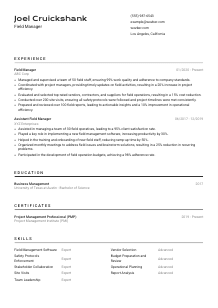
Organising projects but feeling disarrayed by your CV? Bring it back into sync with this Field Manager CV example, created with Wozber free CV builder. It shows how to match your on-site leadership with job specifics, conducting a career crescendo that's as structured as your workflows!
Field Managers are trusted to keep work moving outside the office, where staffing gaps, vendor issues, safety risks, and schedule pressure show up in real time. Your CV needs to make that operating control visible quickly through team supervision, site oversight, reporting discipline, and the kind of decisions that keep field work on standard and on schedule.
When those details are tailored to the posting, hiring teams can separate hands-on field leadership from broader project support or office-based operations experience. Wozber's free CV builder helps you shape that experience into an ATS-compliant CV with the right field operations language, so your application clearly shows who has managed crews, site visits, vendors, and reporting at the level the role requires.
Field work depends on clear communication and fast coordination, so your contact details should be direct, accurate, and aligned with any stated logistics. This section is simple, but it can still reinforce that you already match the practical setup of the job.
Use your full name in the largest text on the page so it is easy to find in a CV database, email thread, or printed shortlist. Keep the styling clean and professional. For a Field Manager role, the focus should stay on the operational experience attached to your name, not on design flourishes.
Place "Field Manager" directly under your name when that is the role you are targeting. It helps recruiters and ATS tools connect your CV to the opening immediately. If your current title differs slightly, such as Assistant Field Manager or Field Operations Supervisor, use the target title only when your experience genuinely supports that level.
List a reliable phone number and a professional email address you check often. Field leadership hiring often moves through quick calls about site coverage, interview timing, or travel expectations, so any typo here can cost you momentum. If your email still looks casual, update it before applying.
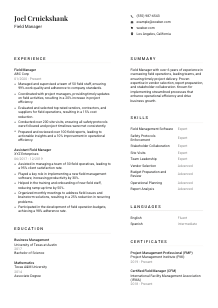
If the posting calls for a specific location, show that match clearly in your city and state. Here, Los Angeles, California is part of the requirement, so stating it in the personal details removes an avoidable question early. Do this when location is relevant to the job, not as a rule for every CV.
Include LinkedIn or a professional site only if it supports your application with consistent job history, project scope, certifications, or field leadership context. For Field Managers, that might mean a profile showing team size, multi-site work, safety exposure, or vendor coordination history. Make sure it matches the CV exactly.
This section should answer the basics without friction: who you are, how to reach you, and whether you meet practical requirements like location. That leaves the rest of the CV to focus on field execution, team oversight, and operational results.




This is where a Field Manager CV earns credibility. Hiring teams look for signs that you have supervised crews, handled site realities, coordinated with project leadership, and kept quality, safety, and timing under control across active operations.
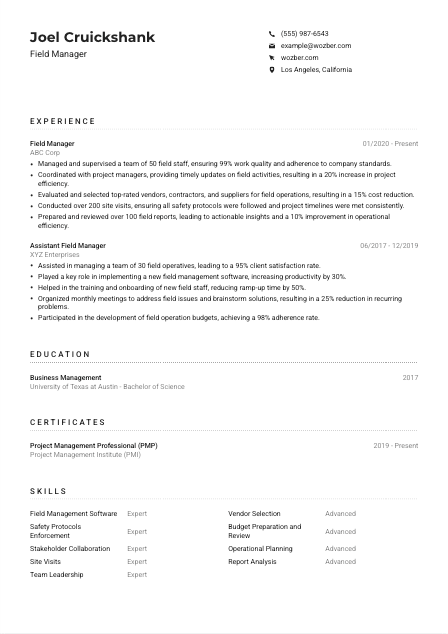
Start by pulling out the core demands from the posting and checking whether your bullets speak to them directly. For this role, that means field staff supervision, site visits, vendor selection, coordination with project managers, reporting, budgets, and operational planning. The sample CV does this well by matching those responsibilities to concrete actions instead of vague management language.
List positions in reverse chronological order, and make sure each entry includes title, employer, and dates. For Field Manager candidates, progression matters. A move from Assistant Field Manager to Field Manager tells a useful story about increasing responsibility for crew oversight, field performance, and decision-making in live project environments.
Do not stop at describing what you were assigned to do. Show what changed because of your work. "Managed field staff" is basic. "Managed and supervised a team of 50 field staff, ensuring 99% work quality" tells the reader about team scale and execution standard. The same applies to vendor selection, reporting, and coordination with project managers. Tie the task to efficiency, cost control, safety compliance, or schedule performance.
Field management is measured through practical results, so quantify wherever you can. Team size, number of site visits, budget adherence, cost reduction, project efficiency, client satisfaction, safety compliance, and report volume are all relevant signals. The example's 200+ site visits and 15% cost reduction work because they reflect daily operating reality, not generic impact claims.
Prioritise experience that supports field leadership. If an older role does not connect to site operations, contractor oversight, scheduling, reporting, or team management, reduce it or leave it out. Space is better used on bullets that show how you handled crews, vendors, operational planning, or field software adoption, such as the sample bullet about implementing a new field management system and improving productivity by 30%.
Your experience section should show that you can run field activity with structure and accountability, not simply participate in it. If the bullets make team scope, site control, vendor judgment, and measurable results easy to spot, the section is doing its job. Wozber's ATS-friendly CV templates help keep that experience readable while supporting solid ATS optimisation.
Education matters here as a baseline qualification, especially when the posting calls for a bachelor's degree or equivalent experience. Keep this section straightforward, then let your experience carry the heavier proof of field management capability.
When a role asks for a bachelor's degree in a relevant field or equivalent practical experience, place that credential where it is easy to find. In the example, a Bachelor of Science in Business Management supports the oversight, coordination, and planning side of field operations. If your degree is in construction management, engineering, operations, business, or a similar area, make that visible.
List degree, school, and graduation year in a simple structure. Start with the highest completed education first. This section does not need extra design or long explanations. Hiring teams want to confirm qualification level quickly and move back to your field leadership record.
If your degree connects directly to operations, logistics, construction, business management, or another field tied to coordination and oversight, make sure the field of study is included. That relevance matters more than decorative details. In this case, Business Management supports budgeting, reporting, team coordination, and vendor decisions.
Honors, coursework, or projects belong here only if they strengthen your case for the target role. For a Field Manager, that could include coursework in operations management, project management, safety, logistics, or budgeting. If you already have 5+ years of strong field experience, keep this part brief.
If you are actively pursuing a degree, extension program, or role-relevant training, include it when it adds clear value. Ongoing study can support applications where the employer values operational leadership with formal business or project training. Just present it accurately, with expected completion if appropriate.
This section should confirm that you meet the academic bar and, where relevant, show training that supports budgeting, coordination, and operational decision-making. Once that is clear, let your field results carry the application.
Certifications can sharpen your profile when they speak directly to project execution, safety, or field leadership. For this role, they are especially useful because the posting names PMP as a preferred qualification rather than a strict requirement.
Start with credentials that line up with the posting. Here, PMP is called out as preferred, so it deserves top placement if you hold it. That credential supports planning, coordination, stakeholder communication, and schedule control, all of which matter in field-facing leadership roles.
Choose certifications that reinforce site operations, project delivery, safety, facilities, construction, or vendor oversight. In the example, PMP and Certified Field Manager work because they relate directly to managing work in the field. A short, relevant list is stronger than a crowded section full of marginal certificates.
Include the issue date, renewal period, or active status when relevant. For certifications that require maintenance, current standing matters. It tells employers that your project management or field leadership training is up to date rather than historical.
Field operations change with new safety standards, software, reporting requirements, and project controls. If you have recent training in those areas, include it when it supports the role. This is especially helpful when you want to show current capability with modern field processes, not just years served.
The right certifications strengthen your CV when they support how you run work in the field, communicate across teams, or manage project execution. Keep the section focused on credentials that add practical value to the role.
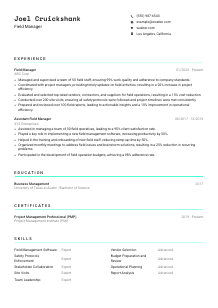
A Field Manager skills section should read like a working toolkit, not a catch-all list. Prioritise the abilities that keep field teams productive, safe, informed, and aligned with schedule and budget expectations.
Read the job description closely and extract the skills tied to actual work. In this case, field management software, stakeholder communication, team supervision, vendor selection, site visits, safety enforcement, reporting, budgeting, and operational planning all belong near the top. Those are stronger than generic entries like "hardworking" or "problem-solving."
Only list skills you can back up in your work history. If your experience bullets show large-team supervision, regular site inspections, and coordination with project managers, then skills like Team Leadership, Safety Protocols Enforcement, and Stakeholder Collaboration make sense. The best skill lists echo what the experience section has already proven.
A shorter, targeted list is easier to scan and stronger for ATS alignment than an oversized skills dump. Group your top strengths around field execution, operational oversight, and coordination. The example works because it stays close to the job itself, with entries such as Field Management Software, Site Visits, Vendor Selection, Budget Preparation and Review, and Report Analysis.
This section should make it easy to see how you manage crews, sites, vendors, reporting, and operational tools. Keep every skill relevant to the field environment you are applying to, and back it up elsewhere on the page.
Language ability matters in field management when instructions need to be clear, updates need to be understood, and teams or vendors come from different backgrounds. Keep this section honest and useful to the actual communication demands of the role.
If the posting specifies English communication, list English clearly with an accurate proficiency level. This role explicitly asks for the ability to articulate effectively in English, so that should appear first. Use terms like Fluent or Native only when they are true in day-to-day professional communication.
Place the language most important to the job first, then any additional languages that could help with crews, contractors, clients, or community-facing work. In many field settings, another language such as Spanish can be useful for on-site coordination, even when it is not required.
Extra languages can strengthen your profile if the work involves diverse teams, vendor communication, or public-facing operations. The sample CV includes intermediate Spanish, which can be a practical asset in some field environments. Include that kind of detail when it reflects real working ability.
Do not overstate your level. If you can handle basic site conversation but not technical reporting or conflict resolution, choose a level that reflects that reality. Accuracy matters more than ambition here because field communication often affects safety, timelines, and team coordination.
Not every Field Manager job needs more than strong English, but some roles benefit from broader communication coverage across crews, vendors, or local stakeholders. Include additional languages when they genuinely support the kind of field environment you are targeting.
For a Field Manager, language skills are valuable when they improve site communication, reporting, and coordination across teams. Keep this section credible and tied to the demands of the work.
Your summary should quickly establish the level of field responsibility you have handled and the results you tend to deliver. This is where you connect operations scope, leadership style, and practical outcomes in a short, focused opening statement.
Before writing the summary, identify the few themes the CV needs to foreground. For a Field Manager, those usually include team oversight, site execution, coordination with project leadership, safety and quality control, and operational reporting. Build the summary around the parts you have actually done at a meaningful level.
Lead with your years of experience and the type of field work you manage. The example summary does this effectively by stating over 6 years in field operations, team leadership, and project delivery. That opening gives the reader immediate context about seniority and function.
Use the next line or two to highlight the strengths most relevant to the target job. Good options include supervising field teams, improving project efficiency, reducing vendor costs, strengthening reporting, or implementing software that improved productivity. Pick two or three, not everything.
Aim for a compact summary that can be absorbed in a few seconds. Four to five lines is usually enough. The point is to frame the rest of the CV, not repeat it. If each sentence adds role-specific information about operations, leadership, or measurable results, you are on the right track.
Your summary should quickly tell a hiring team what scale of field operation you have managed and what kind of control you bring to crews, sites, vendors, and reporting. Wozber's free CV builder can help shape that opening into an ATS-compliant CV that reads clearly for both software and people.
A Field Manager CV works when it makes operational leadership easy to recognize. Team size, site oversight, vendor decisions, safety follow-through, reporting volume, budget awareness, and measurable improvements all help hiring teams understand how you run work in the field.
Tailor each section to the posting, keep the language close to your real responsibilities, and use metrics that reflect field performance rather than generic business claims. With Wozber's ATS-friendly CV template and ATS CV scanner, you can tighten alignment, strengthen ATS optimisation, and present your experience in a format that shows clear readiness for the role.