




Use Wozber and land your dream job
Create CV
No registration required
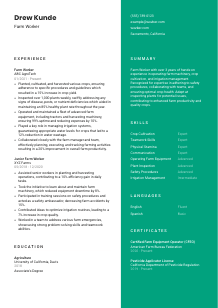
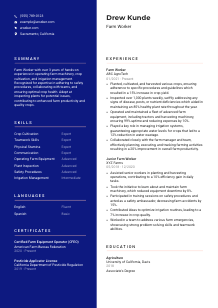
Tilling soil, but your CV seems root-bound? Harvest some inspiration from this Farm Worker CV example, created with Wozber free CV builder. Learn how to sow your agricultural prowess to match job requirements, and plow a career path as fruitful as a bumper crop!
Farm work gets judged in practical terms. Can you keep up through long shifts, handle repetitive field tasks safely, spot plant issues early, and keep equipment running without slowing the operation down? Your CV should make that visible fast, especially when the role combines crop work, machinery use, irrigation support, and day-to-day teamwork with a farm manager or crew lead.
The first scan often separates general labour experience from actual agricultural experience. A targeted CV that uses the language of planting, harvesting, irrigation, equipment upkeep, and crop inspection is easier to sort in both human review and ATS screening. Wozber's free CV builder helps you shape that language into an ATS-compliant CV so hiring teams can quickly see whether you have the field experience and reliability the job calls for.
This section is simple, but it still does real work. For a Farm Worker role, your contact details should immediately remove avoidable concerns such as whether you are reachable, professionally presented, or available in the required area. Keep it clean and accurate.
Place your full name at the top in the clearest text on the page. Farm hiring often moves quickly during planting or harvest periods, so your CV should be easy to identify at a glance.
If you are applying for a Farm Worker position, use "Farm Worker" under your name. Matching the title from the posting helps frame your experience correctly, especially when your background includes related work such as field labour, crop production, or equipment support.
Include a working phone number and a professional email address. If a farm manager wants to schedule an interview around shift timing, early starts, or seasonal urgency, they should not have to guess how to reach you.
If the posting requires local availability or relocation, state your city and state clearly. Here, Sacramento, California matters because the employer specifically asks for candidates who are based there or willing to move.
A LinkedIn profile or personal site can be useful if it supports your application with relevant agricultural training, equipment certifications, or a consistent work history. Skip it if it is empty or unrelated. For this role, direct and job-relevant information matters more than extra links.
Your personal details should tell the employer you are reachable, professional, and available for the job as posted. That keeps the focus on your field experience instead of basic logistics.




This is the section most likely to decide whether you move forward. Farm employers want to see hands-on agricultural work, not broad statements about being hardworking. Show what you did in the field, what equipment you handled, how you supported crop health, and what results followed.
Read the posting closely and pull out the operational work it emphasizes. For this Farm Worker role, that includes planting, cultivating, harvesting, plant inspection, irrigation support, equipment operation, equipment maintenance, and team coordination. Build your bullets around that work so your experience speaks directly to the role.
For every position, include your job title, employer, and dates in reverse chronological order. Keep the structure consistent so the reader can quickly track your progression from entry-level field work to broader responsibilities such as machinery upkeep or productivity support.
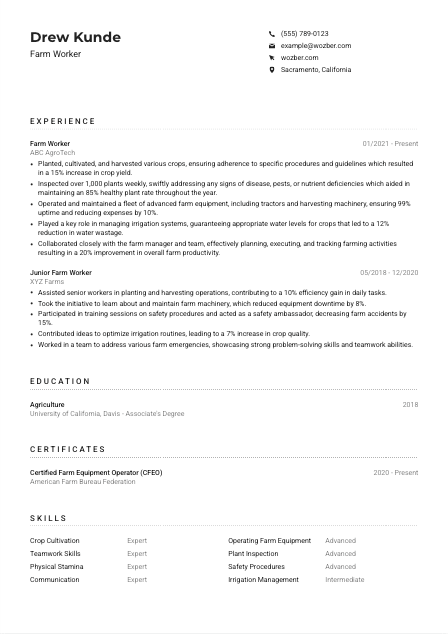
Write accomplishment bullets that show the kind of work a farm depends on every day. Good examples include improving crop yield, spotting disease or pest issues early, reducing equipment downtime, supporting irrigation schedules, or helping the crew complete planting and harvest on time. In the sample CV, inspecting more than 1,000 plants weekly and maintaining an 85% healthy plant rate gives the employer a clear picture of crop-monitoring experience.
Metrics make physical and operational work easier to trust. If you increased yield, reduced water waste, improved machinery uptime, lowered accident rates, or helped raise daily productivity, say so. The sample CV does this well with figures like 15% yield growth, 99% equipment uptime, and a 12% reduction in water wastage.
Leave out duties and achievements that do not strengthen your case for agricultural work. If space is limited, prioritise crop handling, equipment use, safety, stamina, irrigation, and team-based field work over generic labour claims. Every bullet should help the employer picture you on the farm, doing the job.
Your experience section should make one thing easy to judge: whether you have already done the kind of physical, equipment-based, crop-focused work this farm needs. The clearer that picture is, the stronger your application becomes.
Education usually plays a supporting role in Farm Worker hiring, but it can still strengthen your CV. A relevant program can show familiarity with crop science, soil management, irrigation basics, or agricultural operations, especially if you are earlier in your career.
Some farm jobs do not require a degree, so do not overbuild this section. Include education that supports the work, especially if it relates to agriculture, farm operations, horticulture, or equipment handling. In the example, an Associate's Degree in Agriculture adds useful background even though the posting focuses more heavily on experience.
List your degree, field of study, school name, and graduation year. This section should be easy to scan, with no extra wording unless a specific course, project, or training directly strengthens your fit for the role.
If your education connects directly to crop production or farm work, make that connection obvious through the field of study itself. Agriculture, agronomy, horticulture, and similar programs can reinforce your hands-on experience when they appear clearly on the page.
If you have limited experience, a few relevant courses can help. Topics such as plant science, irrigation systems, soil management, pest control, or equipment safety can support your case. If you already have several years of direct farm work, this level of detail is usually unnecessary.
Honors, field projects, or leadership roles can be worth mentioning if they connect to agricultural work or practical responsibility. Otherwise, keep the section compact and let your experience carry more weight.
Education should reinforce your agricultural background, not distract from it. Keep it concise, relevant, and supportive of the work you have already shown in the field.
Certificates matter most when they strengthen trust in your ability to work safely, handle regulated tasks, or operate farm equipment correctly. For a Farm Worker CV, relevant certifications can help distinguish you from applicants with only general labour experience.
Start with the job description. If the employer mentions equipment operation, chemical handling, food safety, or other regulated work, check whether you hold credentials that support those tasks. This posting does not require a certification outright, but equipment and safety responsibilities make related credentials useful.
Choose certificates that reflect real agricultural tasks, such as equipment operation, pesticide application, irrigation, livestock handling, or safety training. In the example, the Certified Farm Equipment Operator credential and a Pesticide Applicator License both strengthen alignment with machinery use and crop care.
Many agricultural credentials need renewal or show stronger value when they are current. Include the issue date and, if relevant, the active period so an employer can quickly see that the certification still applies.
If you want to move into roles with more equipment, crop treatment, or crew support responsibilities, updated certifications can help. They show you are prepared for work that affects safety, compliance, and day-to-day farm efficiency.
Relevant certifications tell the employer you can step into specialised farm tasks with less ramp-up. Use this section to back up claims about equipment, safety, and regulated field work.
A farm skills section should reflect the job as it is actually done. That means physical field work, machinery operation, crop care, safety awareness, irrigation support, and communication with the rest of the crew. Keep the list specific and tied to your real experience.
Start with the language in the posting, then compare it with what you have actually done. For this role, terms such as crop cultivation, operating farm equipment, plant inspection, safety procedures, physical stamina, teamwork, and communication are all directly relevant.
Your skills section should reinforce the experience bullets above it. If your work history shows tractor use, harvesting machinery maintenance, irrigation support, and crop monitoring, feature those abilities clearly. The sample CV does this by pairing equipment operation and plant inspection with measurable field results.
Do not overload this section with every ability you have picked up over time. A shorter list of targeted skills is more useful than a long catalogue. For Farm Worker roles, practical technical skills and reliable work habits usually matter more than broad buzzwords.
Your skills list should echo the actual demands of the farm, from machinery and crop care to safety and teamwork. When it aligns with your experience, it strengthens both ATS optimisation and human review.
Language ability matters on farms for safety, coordination, and day-to-day instructions. If a posting names a required language, treat that as a must-have. Additional languages can still add value, especially in diverse crews or customer-facing agricultural operations.
Check the posting before you list anything. Here, English proficiency is required, so it should appear clearly on the CV. If a job depends on understanding safety instructions, equipment guidance, or supervisor communication, language accuracy matters.
Place English first if it is the required language and label your level honestly, such as Fluent or Native. That removes doubt about your ability to follow instructions, report issues, and work effectively with the team.
Use clear levels such as Fluent, Conversational, Intermediate, or Basic. Avoid vague labels. Straightforward proficiency terms help the employer understand how you can contribute on the job.
Extra languages can help in multilingual crews, community-facing farm businesses, or roles where daily coordination happens across different language backgrounds. They are a plus, but they should not overshadow the required language.
Even basic ability in another language can be worth listing when it helps with team communication in the field. In the example, basic Spanish adds context without overstating fluency.
Language skills should show that you can understand instructions, communicate clearly, and work safely with others. For farm roles, that is practical value, not filler.
Your summary should tell the employer, in a few lines, what kind of farm worker you are. This is where you connect your years of experience with the kind of field work, equipment use, crop care, and team contribution the role requires.
Before writing your summary, pull out the main demands from the posting. In this case, the strongest points are agricultural experience, machinery handling, crop inspection, irrigation support, safety, stamina, and teamwork. Use those themes to decide what belongs in your opening lines.
Begin with a direct statement that names your role and years of experience. For example, "Farm Worker with 3+ years of hands-on experience in crop cultivation, farm equipment operation, and irrigation support" immediately gives hiring teams the right frame.
Follow with the abilities that matter most for the target role. Mention areas such as operating tractors and harvesting machinery, monitoring plant health, following safety procedures, or improving farm productivity. The example summary works because it ties machinery use, crop health, and teamwork directly to farm output.
Aim for three to five lines with no vague claims. Skip generic wording about being passionate or hardworking unless you immediately connect it to real farm responsibilities. A compact summary reads better and gives more room to the experience section, where the proof belongs.
A good summary gives the employer a fast read on your agricultural background and the kind of work you can step into right away. If those first lines clearly connect your experience to the farm's needs, the rest of the CV has a much easier job.
A Farm Worker CV works best when it stays close to the actual job. Show your experience with planting, harvesting, crop inspection, irrigation, machinery, safety, and long-hour field work in language that matches the posting.
Use Wozber's free CV builder to shape that experience into an ATS-friendly CV format, refine role-specific wording, and strengthen ATS optimisation with clearer alignment to the job description. The final result should make it easy to see that you can contribute from day one on the farm.




