



Use Wozber and land your dream job
Create CV
No registration required
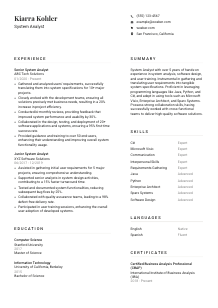
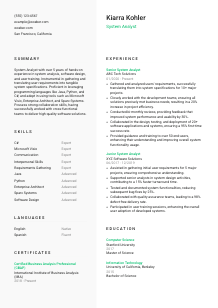
Decoding systems, but your CV seems encrypted? Check out this System Analyst CV example, created with Wozber free CV builder. It shows how to present your analytical prowess to match job expectations, making your career path as straightforward as a well-optimised algorithm!
System Analysts sit at the point where business needs become system behaviour. Hiring teams want to see how you turn messy user input into workable specifications, how you support developers through design and testing, and whether your recommendations actually improve performance, usability, or rollout success.
When that translation work is easy to spot on the page, your CV is far easier to shortlist for interviews. Wozber's free CV builder helps you shape an ATS-compliant CV around the language of the job description, so requirement gathering, analysis tools, programming exposure, and cross-functional delivery come through clearly from the first scan.
For a System Analyst, the header should do one practical job well: confirm who you are, what role you are targeting, and whether any immediate logistics could slow the process. Keep it clean, professional, and aligned with the position you want.
Use your full name as the most visible text in the header. Hiring teams often review many technically similar profiles, so make your name easy to find when they return to compare candidates after a screening call or hiring panel discussion.
Place "System Analyst" directly beneath your name if that is the role you are applying for. This keeps your positioning consistent with the vacancy and avoids looking scattered across business analysis, QA, support, or software development titles.
Your phone number and email should be accurate and professional. Missed callbacks happen over small errors, and technical hiring cycles often move quickly once a candidate with the right requirements background is identified.
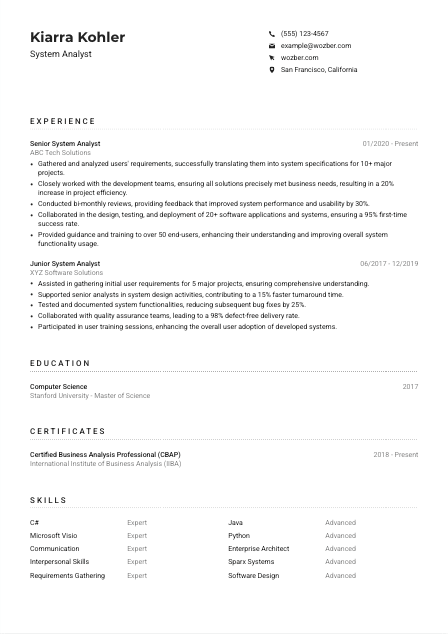
If the employer asks for a candidate based in San Francisco or open to relocation, state that clearly in your personal details. In the example CV, listing San Francisco, California removes an obvious question before the reader gets into your project work.
Include LinkedIn, a professional website, or a portfolio only if it supports your Systems Analyst profile. Useful additions might include process diagrams, systems documentation samples, project summaries, or certifications that reinforce your experience with analysis and delivery work.
Your header should remove friction, not create it. When your title, contact details, and location are clear, the reader can move straight to your system analysis experience instead of pausing on avoidable questions. Wozber's free CV builder helps keep this section clean and ATS-friendly from the start.




This is the section that carries the most weight for a System Analyst. Employers want to see the kinds of systems you worked on, how you gathered and translated requirements, how closely you worked with developers and users, and what improved because of your analysis.
Read the posting closely and mark the work patterns it emphasizes. For this role, that includes gathering user requirements, translating them into specifications, collaborating with development teams, reviewing system performance, supporting testing and deployment, and guiding end-users. Those are the themes your bullets should reflect if they match your background.
List your positions in reverse chronological order with title, company, and dates. For System Analyst hiring, a clear timeline helps reviewers quickly understand whether your experience progressed from support work or junior analysis into broader ownership of requirements, systems review, and implementation support.
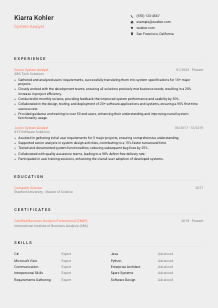
Describe what you analysed, documented, improved, or launched. Strong bullets for this profession often reference system specifications, process improvements, testing support, stakeholder collaboration, user training, or deployment quality. The example CV does this well by tying requirement gathering to 10+ major projects instead of leaving it as a generic duty.
Quantify where the numbers reflect how your work was measured. Efficiency gains, defect reduction, first-time deployment success, adoption rates, review cadence, number of projects, or user groups supported all make sense here. A bullet such as improving system performance and usability by 30% gives the reader a concrete result of your analysis and feedback loop.
Move the most applicable work to the top of each role and trim details that belong more to unrelated support or general IT positions. If the employer mentions tools like Microsoft Visio or Enterprise Architect, or programming exposure in Java, Python, or C#, bring those details into your bullets where they were actually part of requirements, design, or implementation work.
Your experience section should make it clear that you can translate needs into system decisions and stay involved through review, testing, and user adoption. Tailor the language to the posting, then use Wozber's ATS CV scanner to check that the role's terminology appears naturally across your project and outcome bullets.
Education matters in System Analyst hiring because it helps establish your technical base. It is usually not the deciding factor once you have relevant experience, but it still needs to confirm that you have the academic grounding to work across systems, software, and business requirements.
If the posting asks for a bachelor's degree in Computer Science, Information Technology, or a related field, make sure that qualification is easy to find. In the example, the bachelor's in Information Technology directly covers the stated requirement, while the master's in Computer Science adds depth.
List degree, field of study, school, and graduation year in a consistent order. Recruiters and hiring managers often scan this section quickly, so a straightforward structure works better than extra formatting or long descriptions.
Do not bury the subject area. For System Analyst roles, the field matters because it signals exposure to software development, data structures, systems design, or information systems concepts that connect to requirements and solution work.
If you are early in your career, relevant courses can help fill out the picture. Modules in systems analysis, software engineering, database design, UML, application development, or human-computer interaction can reinforce your fit, especially when your professional experience is still growing.
Honors, capstone projects, or research are worth adding only when they support the role. A systems design project, process modeling work, or a software implementation case study can be useful. Skip extras that do not connect to analysis, applications, or technical collaboration.
This section should confirm the formal background the employer asked for and support your technical credibility without taking attention away from your experience. Wozber helps present it in an ATS-friendly CV format that keeps degree requirements easy to identify.
Certifications can strengthen a System Analyst CV when they reflect structured analysis work, business process understanding, systems documentation, or related technical practice. They are especially useful when the posting does not require them but the credential adds extra professional weight.
Choose certificates that connect clearly to systems analysis, business analysis, software delivery, process modeling, or relevant technical tools. The CBAP in the example works well because it supports requirement gathering, stakeholder communication, and analysis discipline.
A short list of relevant certifications is stronger than a long collection of loosely related courses. For this profession, quality matters more than quantity. Prioritise credentials that strengthen your work with specifications, workflows, system design, or implementation coordination.
Show the issue date and renewal status when applicable. For active certifications, that timing signals that your methods and terminology are current, which matters in roles that bridge evolving tools, delivery practices, and user expectations.
System Analysts often deepen into process improvement, enterprise architecture, product delivery, or domain-specific systems work. Refresh this section as your responsibilities change so the credentials continue to support the kind of analysis roles you are targeting now.
Relevant certifications can reinforce your credibility, especially when they line up with the way you gather requirements, document systems, or support delivery. Keep them current, keep them relevant, and present them clearly in an ATS-friendly CV template.
A System Analyst skills section should quickly show both your technical toolkit and the collaboration skills that make analysis useful in practice. Employers are looking for more than software familiarity. They want to know whether you can move between users, developers, documentation, and system behaviour without losing accuracy.
Start with the skills named in the posting that you genuinely have. Here, that includes programming exposure in Java, Python, or C#, analysis and diagramming tools such as Microsoft Visio, Enterprise Architect, or Sparx Systems, plus communication and cross-functional collaboration.
Order matters. Lead with the skills most tied to day-to-day System Analyst work for the target role. If the opening emphasizes requirements and documentation, prioritise analysis tools and requirement gathering. If it leans closer to technical implementation, programming languages and software design may deserve earlier placement.
Avoid padding the section with broad terms that say little on their own. Specific entries like "Requirements Gathering," "Microsoft Visio," "Enterprise Architect," "C#," or "Software Design" tell a clearer story than vague labels such as "tech-savvy" or "problem solving."
By the time someone finishes this section, they should understand the tools, technical languages, and collaboration strengths you bring to systems work. Wozber's ATS CV scanner is useful here for checking whether your skill language lines up with the terms used in the posting without slipping into keyword stuffing.
Language skills matter on a System Analyst CV when they affect how you gather requirements, run workshops, document system behaviour, or support end-users. In many roles, English proficiency is essential because so much of the work depends on precise communication across technical and non-technical groups.
If the job description names a language requirement, list it first with your proficiency level. In this case, English should be prominent because the role depends on clear requirement discussions, documentation, and collaboration with cross-functional teams.
Additional languages can be valuable when you work with global teams, multilingual user groups, or region-specific implementations. They are not always central to hiring, but they can strengthen your profile when communication breadth is part of the environment.
Terms like "Native," "Fluent," "Intermediate," and "Basic" are easy to understand and easier to trust than inflated descriptions. Keep the labels honest, especially if the role may involve workshops, user interviews, training sessions, or support conversations.
If you have used a second language in training, user support, documentation review, or stakeholder communication, that can be worth reinforcing elsewhere in the CV. For example, fluent Spanish may be useful in user-facing environments or distributed teams, but it should support the CV rather than distract from your systems experience.
For some System Analyst openings, languages are a minor detail. For others, they are operationally important because of user adoption, cross-border teams, or client-facing analysis work. Keep the section proportional to the actual demands of the position you are targeting.
List language skills when they improve how your candidacy is understood, especially where communication with users, teams, or stakeholders is part of the job. Wozber's free CV builder helps keep this section tidy and consistent with the rest of your ATS-friendly CV.
Your summary should tell the reader, in a few lines, what kind of System Analyst you are and where your value shows up. This section works best when it combines experience level, technical range, and the kind of outcomes you help deliver, rather than repeating generic traits.
Start by identifying the few themes the employer is hiring for most urgently. In this case, that is likely requirement analysis, system specification work, collaboration with developers, system review, and user support. Let those priorities shape the summary instead of trying to describe your whole career.
A direct first line such as "System Analyst with 5+ years of experience" gives immediate context. It tells the reader both your professional identity and your level of exposure to systems work before they reach the detailed sections below.
Use the next lines to cover the tools, methods, or programming exposure that matter most for the role. The example summary works because it combines requirement translation, languages like Java, Python, and C#, and collaboration with cross-functional teams instead of leaning on vague claims.
Aim for a compact paragraph with real content in every line. Three to five lines is usually enough to show your analysis background, technical scope, and contribution to software delivery without repeating bullets from the experience section.
When your summary is tailored well, the rest of the CV reads through the right lens. It should immediately position you as someone who can gather requirements, translate them into system work, and support delivery with developers and users. As you finalize the document, use Wozber's ATS-friendly CV format and ATS optimisation tools to keep that message clear, searchable, and easy to evaluate.
A System Analyst CV should show how you move from user needs to system outcomes. If your sections clearly cover requirements work, tools, technical fluency, collaboration, and measurable delivery results, hiring teams can quickly see where you add value.
Use Wozber to organise that experience into a focused, ATS-compliant CV, then tailor the wording to each opening so the right projects, tools, and outcomes rise to the top. The finished CV should make one thing easy to judge: you can analyse, translate, and support systems work that holds up in production.