




Use Wozber and land your dream job
Create CV
No registration required
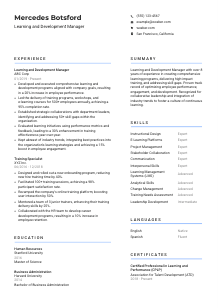
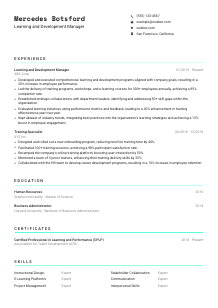
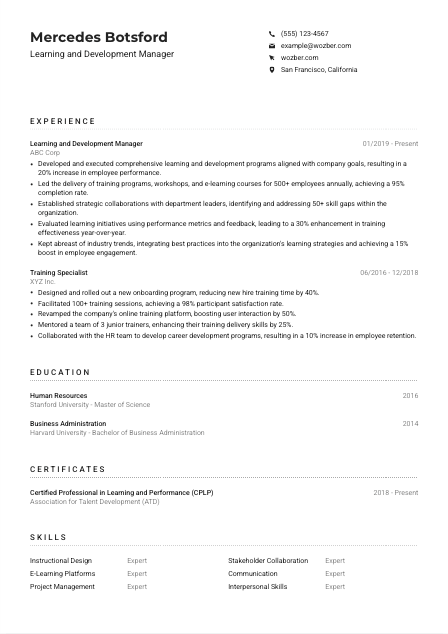
Shaping training plans, but feel untrained in CV design? Stretch your career muscles with this Learning and Development Manager CV example, created with Wozber free CV builder. It shows how to map out your professional development expertise to match job needs, making your career growth as impactful as a well-crafted workshop!
Learning and Development Manager hiring usually turns on one practical question fast: can you build learning programs that change performance, not just deliver training. CVs in this field often blur together because they talk broadly about facilitation, people skills, and development culture without showing program scope, stakeholder partnership, or how learning outcomes were measured.
When the CV is tailored well, the reader can quickly connect your background to the company's actual learning needs, whether that means instructional design, LMS ownership, manager enablement, or closing skill gaps across teams. Wozber's free CV builder helps shape that story into an ATS-friendly CV format, so the right terms and achievements surface clearly and make your training strategy, delivery range, and business impact easier to recognize.
For a Learning and Development Manager, the header should establish professional credibility in seconds. Keep it clean, accurate, and aligned with the role so the reader can move straight into your experience delivering training programs, leading learning initiatives, and partnering across the business.
Use your full name as the most visible line on the page. A simple, professional format works best. This role depends on clear communication and polished presentation, so your header should reflect the same standard you would bring to a training deck, facilitator guide, or leadership workshop.
Place "Learning and Development Manager" directly under your name if that is the role you are pursuing. This immediately frames your background around learning strategy, program delivery, and capability building rather than broader HR or training support work.
Include a current phone number and a professional email address. If your email or website looks informal, change it. In a role that often works with executives, people managers, and cross-functional stakeholders, even small presentation details shape first impressions.
If the employer asks for a candidate in a specific place, include your city and state. Here, San Francisco, California is relevant because the posting names that requirement directly. If you are relocating, state that clearly instead of leaving the employer to guess.
Include LinkedIn or a professional site if it supports your candidacy. For Learning and Development professionals, this can be especially useful when it reinforces your CV with learning portfolio material, training philosophy, program highlights, or a consistent career history.
Your personal details should remove friction, confirm key logistics, and set a professional tone. Once this section is in place, the hiring team should be able to move straight to the real question: how well you build and improve learning at scale.




This is the section that carries the most weight for a Learning and Development Manager. Hiring teams want to see the programs you built, the audiences you served, the business problems you addressed, and how you measured whether the learning actually worked.
Start by marking the responsibilities that define the role. In this posting, the clearest themes are program development, training delivery, skill-gap analysis, metrics, and staying current on L&D practice. Those themes should guide which bullets you highlight and how you describe your work.
List positions in reverse chronological order with title, employer, and dates. For this field, titles matter because they show your level of ownership. "Learning and Development Manager" suggests strategy, budget, and program oversight, while titles like "Training Specialist" or "Instructional Designer" can still be strong when the bullets show progression into broader responsibility.
Focus on what changed because of your work. Good Learning and Development bullets show that you launched a program, improved onboarding, increased completion rates, strengthened manager capability, or closed a recurring performance gap. The sample CV does this well by tying program design and stakeholder collaboration to measurable changes in employee performance and engagement.
Quantify scope and results wherever you can. Useful numbers in this profession include learner volume, completion rates, satisfaction scores, time-to-productivity, retention impact, engagement lift, adoption of e-learning content, or year-over-year training effectiveness. Examples like "500+ employees annually," "95% completion rate," and "30% enhancement in training effectiveness" help the reader understand both scale and quality.
Prioritise experience that shows instructional design, facilitation, LMS or e-learning ownership, cross-functional collaboration, and program evaluation. If an older role is less relevant, keep it brief. The aim is to show a career narrative that points toward enterprise learning leadership, not a broad catalogue of unrelated responsibilities.
By the end of your experience section, the employer should understand the size of the audiences you trained, the programs you owned, and the business results your learning initiatives produced. That is what separates an L&D manager profile from a CV that only shows training activity.
Education matters here because it supports your foundation in business, people development, and organizational practice. Keep the section straightforward, but make sure it reflects the level and field relevance the employer asked for.
If you have a bachelor's degree in Human Resources, Business Administration, Education, Organizational Development, or a related field, list it clearly. This posting asks for that foundation directly, so there is no reason to make the reviewer search for it.
Include degree, field of study, school, and graduation year. Clean structure is enough. For most Learning and Development Manager CVs, recruiters are checking degree relevance and level, not looking for a long academic narrative.
If you hold a master's degree, place it prominently because it can support your candidacy for more strategic L&D roles. In the example, a Master of Science in Human Resources aligns well with leadership-level development work and matches the posting's note that a master's degree is a plus.
Early-career candidates can include relevant coursework, capstones, or research in areas like instructional design, adult learning, talent development, or organizational behaviour. For experienced professionals, your program outcomes, facilitation scope, and learning metrics usually matter far more than course lists.
Honors, leadership roles, or academic projects can stay if they reinforce your professional direction. Include them only when they connect to communication, leadership, training design, or business acumen. If they do not support your L&D narrative, leave them out.
Your education section should quickly confirm that you meet the role's academic baseline and, where applicable, exceed it. Keep it brief, relevant, and clearly connected to your progression into learning leadership.
Certifications can strengthen an L&D CV because they show continued development in a field shaped by changing learning methods, platforms, and workforce expectations. They are most useful when they reinforce the kind of work you want to own next.
Choose certifications that support your credibility in training, instructional design, facilitation, coaching, or talent development. A credential such as CPLP, now often recognized under updated ATD naming, works because it maps directly to professional learning practice.
Do not list every certificate you have completed. A short list of credentials connected to L&D strategy, digital learning, change management, or leadership development is more persuasive than a long list of unrelated courses.
Add issue dates and, when relevant, active status. Learning technology and training practice evolve quickly, so date context helps the employer see whether your knowledge is current. That matters more when the role includes e-learning platforms, LMS tools, and modern program design.
This role expects someone who keeps up with best practices, so your certifications can reinforce that expectation. Use them to show continued investment in areas such as learning analytics, program evaluation, digital facilitation, or organizational capability building.
Certificates should sharpen your profile, not pad it. When selected well, they reinforce that you stay current in learning strategy and bring recognized expertise to program design, delivery, and improvement.
The skills section should reflect how Learning and Development Managers actually operate. That means balancing learning expertise with execution skills such as project management, stakeholder partnership, and analysis, not listing a generic mix of soft skills.
Use the job description to identify the skills the employer will likely search for first. Here, that includes instructional design, e-learning platforms, LMS knowledge, analytical ability, project management, communication, leadership, and interpersonal effectiveness. Mirror that language when it matches your real background.
Lead with the capabilities that sit closest to the role's core work. For this type of position, skills like instructional design, training needs assessment, LMS administration, facilitation, stakeholder collaboration, and learning analytics usually deserve more space than broad terms like "team player" or "organised."
Choose skills you can support elsewhere in the CV through projects, tools, or outcomes. The example works because capabilities such as instructional design, e-learning platforms, project management, and collaboration are reinforced by bullets about enterprise programs, training delivery, and measured improvements. That consistency is what makes a skills section believable.
A recruiter should be able to scan your skills and immediately recognize the operating toolkit of an L&D leader. If the list matches the role's language and is backed up by your experience, it is doing its job.
Language skills matter in Learning and Development when the work involves facilitation, written learning content, manager communication, or support for a multilingual workforce. Keep this section factual and tie it to communication demands that are relevant to the role.
If the posting calls for strong English communication, list English clearly with an accurate proficiency level. For a role that writes training materials, leads workshops, and works across departments, that requirement is operational, not cosmetic.
Start with the language most important to the job, then add others in descending order of proficiency. If you support a diverse employee base or deliver training across regions, additional languages can add practical value beyond the core requirement.
Additional languages are worth listing when they help with facilitation, onboarding, or communication across employee populations. In some organizations, being able to support learning in another language can improve reach and learner engagement, even when the posting only names English.
Stick with straightforward terms such as Native, Fluent, Advanced, Intermediate, or Basic. Ambiguous wording does not help hiring teams plan for workshop delivery, written communication, or cross-cultural training support.
If the role supports a global company, a distributed workforce, or multilingual frontline teams, language capability can strengthen your value as a facilitator and communicator. Include it when it helps explain the range of learners and stakeholders you can work with effectively.
Your language section should confirm that you can communicate at the level the role requires and, if relevant, support learning across a wider employee audience. Keep it accurate, practical, and tied to how training work gets done.
Your summary should quickly establish the kind of Learning and Development leader you are. In a few lines, show your level of experience, your core specialty, and the business outcomes your programs have influenced.
Before writing, identify the two or three themes that matter most in the target job. For this posting, those are building comprehensive L&D programs, delivering training across levels, and using metrics to improve outcomes. Your summary should reflect that mix rather than trying to cover every capability you have.
State your title or specialty and your years of relevant experience. For example, "Learning and Development Manager with 8+ years of experience" gives immediate context, then lets you move into areas like instructional design, enterprise training delivery, or workforce capability building.
Use one or two concrete strengths tied to results. That might be improving employee performance, raising completion rates, redesigning onboarding, increasing engagement, or building scalable e-learning programs. The sample summary works because it combines program design, skill-gap work, and performance improvement in a compact way.
Aim for three to five lines. Avoid broad claims about passion or generic leadership. A strong L&D summary reads like the headline version of your operating strengths, giving the employer a quick picture of what kind of learning strategy, delivery scope, and organizational impact you bring.
After reading your summary, the employer should already understand your level, your learning focus, and the kinds of workforce outcomes you influence. That clarity sets up the rest of the CV to prove it.
A Learning and Development Manager CV should make three things obvious fast: the programs you have led, the audiences you have supported, and the results your learning strategy produced. If those points are easy to spot, your CV is already working harder for you.
Use Wozber's AI CV builder to refine wording, align your content with the job description, and strengthen ATS optimisation without losing the substance of your work. An ATS-compliant CV that clearly shows program ownership, instructional design expertise, and measurable learning outcomes gives hiring teams a much sharper read on your readiness for the role.




