



Use Wozber and land your dream job
Create CV
No registration required
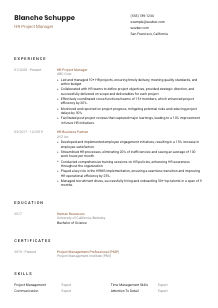
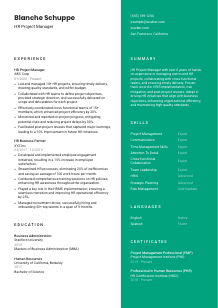
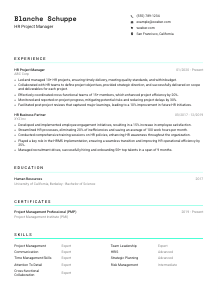
Reshaping teams, but your CV feels out of alignment? Check out this HR Project Manager CV example, created with Wozber free CV builder. It shows how to capture your strategic HR vision to match job objectives, leading your career projects to resounding success!
HR project work sits at the intersection of people operations and disciplined execution. Hiring teams want to see that you can move an HR initiative from scope to rollout without losing control of timelines, budget, stakeholder alignment, or adoption. Your CV needs to make that operating range visible, especially on projects like HRIS implementations, process redesigns, policy rollouts, or enterprise-wide employee programs.
When the CV is tailored well, screening gets much easier for a recruiter or HR leader comparing broad HR backgrounds against true project ownership. Wozber's free CV builder helps you align your language with the posting, keep the structure ATS-friendly, and surface the right HR and project management keywords early, so your application reads clearly as someone who can lead delivery, manage risk, and improve future HR initiatives.
This section is simple, but it still affects how quickly your application moves. For an HR Project Manager, clear contact details help confirm practical requirements up front, including title alignment and, when stated in the posting, location.
Use your full name as the clearest identifier on the page. Keep it larger than the body text and easy to scan. In a role where coordination, reporting, and documentation matter, even basic formatting choices should show control and professionalism.
Place "HR Project Manager" under your name if that is the role you are pursuing. This immediately frames the rest of the CV around project delivery in an HR environment, rather than leaving the reader to interpret whether your background is generalist HR, operations, or pure project management.
Include a reliable phone number and a professional email address. Errors here create unnecessary friction, especially for roles that depend on responsiveness, stakeholder communication, and follow-through. If your email still looks casual, replace it with a simple first-name-last-name format.
If the employer requires candidates to be based in a specific city or state, show that clearly in your header. In the example, listing San Francisco, California directly supports a stated requirement and removes doubt about availability for local collaboration or onsite expectations.
A LinkedIn profile or professional website can reinforce your HR and project background, especially if it reflects HR systems work, transformation initiatives, or program leadership. Make sure the content matches your CV titles, dates, and scope before you include it.
Your header should confirm who you are, what role you are targeting, and whether you meet any basic application requirements. For HR project work, clarity here supports the same impression your experience section should continue: organised, dependable, and ready to lead structured initiatives.




For this role, experience carries the most weight when it shows ownership of delivery. Hiring teams look for signs that you have scoped HR initiatives, coordinated stakeholders, managed risk, tracked progress, and improved outcomes, not simply supported HR activity around the edges.
Read the job description like a project brief. Mark the repeated themes: leading HR projects, defining scope and deliverables, coordinating cross-functional teams, tracking progress, staying on time and within budget, and running post-project reviews. Those are the priorities your bullet points should echo in natural, specific language.
List positions in reverse chronological order and make each one easy to read with title, employer, and dates. Then use bullets to show what kind of HR work you managed. For this profession, context matters. Mention whether the work involved HRIS implementation, employee programs, process improvement, policy rollout, or enterprise HR operations so the reader can judge project complexity quickly.
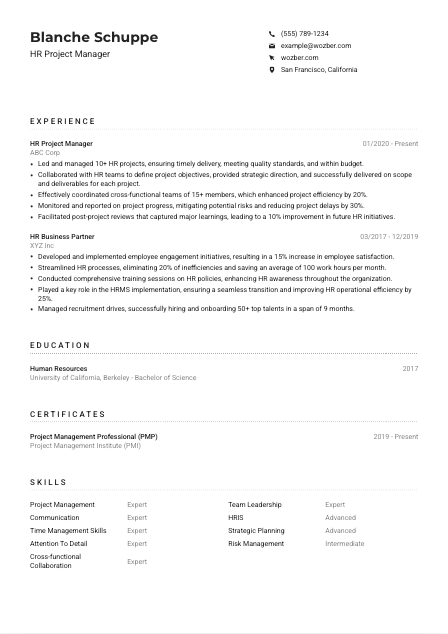
Numbers work especially well here because HR project management is measured through execution. Include project count, team size, cycle-time improvement, delay reduction, adoption gains, hours saved, or efficiency improvements when you have them. The sample CV does this well by citing 10+ HR projects, 15+ cross-functional team members, a 20% efficiency increase, and a 30% reduction in delays.
Choose bullets that show both HR understanding and project control. Strong examples include partnering with HR leaders to define objectives, supporting an HRMS or HRIS rollout, standardising workflows, improving employee-facing processes, or capturing lessons learned after launch. If your background includes HR Business Partner or generalist work, pull forward the parts tied to implementation, change management, and measurable operational improvement.
Adjust wording so your experience mirrors the employer's language without forcing keywords. If the posting stresses quality standards, budget control, and corrective action, make those points visible where they reflect your real work. A bullet about "managing HR initiatives" is weaker than one that shows you monitored progress, flagged risks early, and kept an HR project on scope through cross-functional coordination.
The strongest experience sections read like a record of shipped HR initiatives. When your bullets show project ownership, stakeholder coordination, and measurable operational results, employers can picture you running their next HR rollout with far less guesswork.
Education matters here because the role usually sits close to HR leadership, systems work, and business operations. Keep this section straightforward and aligned with the degree background the employer asked for.
If you have a Bachelor's degree in Human Resources, Business Administration, or a related field, make it easy to find. That requirement is often used as an early screening filter. If you also hold an MBA or another advanced degree, include it because it can strengthen your profile for larger-scale HR transformation or cross-functional program work.
List school, degree, field of study, and graduation year or date in a clean format. Keep the section easy to parse for both people and ATS systems. For a role with multiple moving parts, your CV should never make basic qualifications harder to confirm than they need to be.
Match your wording to the posting when it fits your background. In this case, degrees in Human Resources and Business Administration line up directly with the requirement. The example CV uses both, which helps reinforce HR foundation plus business perspective. Use that approach only when it is true for you.
If your early-career experience is lighter, coursework or academic projects tied to HR operations, organizational development, data analysis, or project management can add context. For more experienced candidates, this is usually optional unless the detail directly supports the type of HR projects you want to lead.
Honors, leadership roles, or relevant student organizations can stay if they connect to workforce leadership, business analysis, or structured project work. If they do not add anything to your HR project profile, keep the section lean and let your experience carry the weight.
This section should quickly confirm that you meet the educational baseline and, where applicable, show added business or HR depth. Once that is clear, the reader can move back to the stronger proof in your project and operational experience.
Certifications can sharpen your positioning because this role blends formal project management discipline with HR expertise. When a posting mentions PMP or HR credentials, that is a clear invitation to feature the certifications most relevant to governance, delivery, and people operations.
If you hold PMP, PHR, SPHR, SHRM-CP, or SHRM-SCP, move them high in this section. These credentials directly support how employers read your background, especially when they want someone who can manage project structure while understanding HR policy, systems, and process implications.
List the credentials most connected to the target role first. For an HR Project Manager, project and HR certifications usually matter more than broad professional development courses. The sample CV places PMP and PHR first, which makes sense because both map directly to the employer's stated preferences.
Show the issue date, active range, or renewal status when appropriate. This helps employers understand whether your credential is current, which matters in fields shaped by updated project frameworks, compliance considerations, and evolving HR practice standards.
If you are aiming for larger HR transformations, enterprise system rollouts, or PMO-linked HR work, adding or maintaining certifications can strengthen your profile. Choose credentials that deepen your ability to manage change, systems adoption, reporting discipline, or HR governance, rather than collecting unrelated badges.
Handled well, this section tells the reader that your HR project experience is backed by formal training. That combination is especially useful when employers want someone who can run structured initiatives inside a people-focused function.
An HR Project Manager skills section should sound like someone who can run execution inside an HR function. That means combining project discipline, systems comfort, and stakeholder communication instead of listing broad strengths with no operational context.
Start with the capabilities the employer explicitly called out, such as HRIS proficiency, project management software, communication, time management, attention to detail, and multitasking. These are likely to matter in both ATS matching and first-pass review, so they belong near the top when they reflect your actual background.
Then include skills that make HR projects succeed in practice, such as cross-functional collaboration, team leadership, risk management, change support, stakeholder communication, process improvement, or strategic planning. In the sample CV, skills like cross-functional collaboration and team leadership reinforce the experience bullets instead of repeating generic HR terms.
Avoid turning this section into a master inventory. Prioritise the skills that support planning, coordination, reporting, systems work, and execution inside HR. If you use proficiency labels, keep them believable and consistent with your experience. A shorter, better-targeted list is more convincing than a long catalogue of vague strengths.
By the time someone finishes this section, they should see a professional who can manage moving parts, work across teams, and handle HR systems and timelines without losing detail. That is the profile this role is built around.
Language matters in HR because project work often depends on training, policy communication, stakeholder updates, and employee-facing rollout. If a posting names a language requirement, address it directly and keep the rest of the section factual.
When English fluency is specifically requested, list English first and indicate your level clearly, such as "Native" or "Fluent." This removes ambiguity for a role that depends on written updates, meeting facilitation, and clear communication across HR and business stakeholders.
Other languages can add value, especially in organizations with multilingual employee populations or international teams. They are not always central to the role, but they can strengthen your profile if communication across groups is part of the work.
Choose clear terms such as "Fluent," "Intermediate," or "Basic." In HR project settings, overstating language ability can create real problems once facilitation, documentation, or employee communication enters the picture.
Feature a second language more prominently when it supports the employee base, region, or stakeholder mix of the employer. That is a tailoring choice, not a universal rule. In some HR environments it matters a lot, while in others it is simply a useful bonus.
This section does not need philosophy. Just state the languages you can use in business settings and your proficiency level. If those skills help you support training, rollout communication, or employee engagement across groups, your experience section should carry that context.
For this role, the main purpose of the language section is to confirm communication capability without confusion. If English fluency is required and additional languages support your HR work, make both easy to read in a few lines.
Your summary should quickly answer a practical question: why are you a credible HR Project Manager for this opening? A few lines can do that well if they combine years of experience, project scope, and the kinds of HR outcomes you have already delivered.
Before writing, identify the themes the posting repeats. Here, that includes HR project leadership, cross-functional coordination, progress tracking, risk management, and post-project improvement. Build your summary around those ideas rather than generic statements about being driven or detail-oriented.
State who you are and how much related experience you bring. A line such as "HR Project Manager with 6+ years of experience leading HR initiatives" gives the reader immediate context and aligns with a requirement like five or more years in HR project management or related HR roles.
Mention the types of work that matter most for the target role, such as HRIS implementation, process improvement, stakeholder coordination, risk mitigation, or successful project delivery across HR teams. The sample summary works because it combines end-to-end project management with HRIS experience and measurable operational impact.
Aim for a short paragraph of three to five lines. Every phrase should earn its place by clarifying your project scope, HR depth, or delivery record. If a sentence could apply to almost any manager, replace it with language tied to HR programs, systems, teams, or outcomes.
A good summary gives the hiring team an immediate read on your level, your HR project range, and the business value you bring. When those lines are tailored well, the rest of the CV lands with much more force.
An effective HR Project Manager CV makes three things easy to see: you understand HR operations, you can run structured delivery, and your work improves outcomes people can measure. Keep every section pointed toward those facts, from the title you use to the metrics in your project bullets.
Wozber's free CV builder can help you organise that story in an ATS-friendly CV format, refine wording with AI support, and check alignment with an ATS CV scanner before you apply. The result should be a CV that shows you can lead HR initiatives with control, clarity, and follow-through.




