



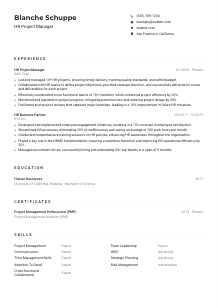
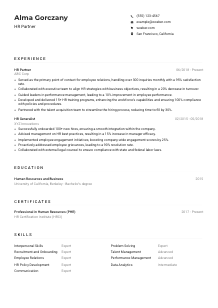
Use Wozber and land your dream job
Create CV
No registration required
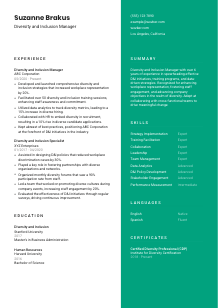
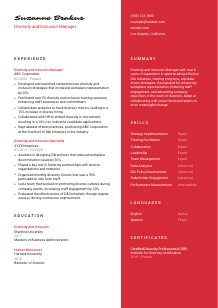
Championing diversity, but your CV feels monochrome? Take a peek at this Diversity and Inclusion Manager CV example, created with Wozber free CV builder. Learn how to align your inclusion insights with job criteria, paving a career narrative as rich and varied as the communities you uplift!
Diversity and Inclusion Managers are hired to move inclusion from stated values into daily systems. That means your CV needs to show how you shaped strategy, influenced leaders, improved representation or engagement, and turned workforce data into decisions that changed hiring, retention, development, or culture.
When that scope is tailored clearly, your CV is easier to rank in an ATS and easier for a hiring team to read as operational D&I leadership rather than general HR support. Wozber's free CV builder helps you align your language with the role, organise metrics cleanly, and build an ATS-compliant CV that makes your strategy, facilitation, and analytics work visible from the first scan.
For a Diversity and Inclusion Manager, the header should present you as a credible business-facing leader from the start. Keep it clean, current, and aligned with any practical filters in the posting.
Put your name first, then use a professional title that matches the job you want. If you are applying for a Diversity and Inclusion Manager opening, say that directly beneath your name. This immediately frames your background around inclusion strategy, training, workforce metrics, and cross-functional leadership instead of leaving your focus open to interpretation.
List a working phone number and a professional email address that you check regularly. Accuracy matters here because these roles often involve several interview stages with HR, business leaders, and executive stakeholders. One typo can interrupt that process before your D&I experience is even reviewed.
If you include LinkedIn or a professional website, make sure it reinforces the same message as your CV. Your profile should echo your focus on inclusion programs, employee training, DEI reporting, partnerships with HR, and measurable outcomes. A half-updated profile can weaken an otherwise strong application.
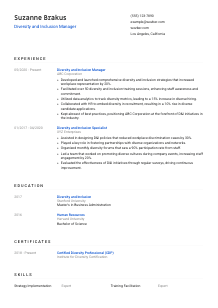
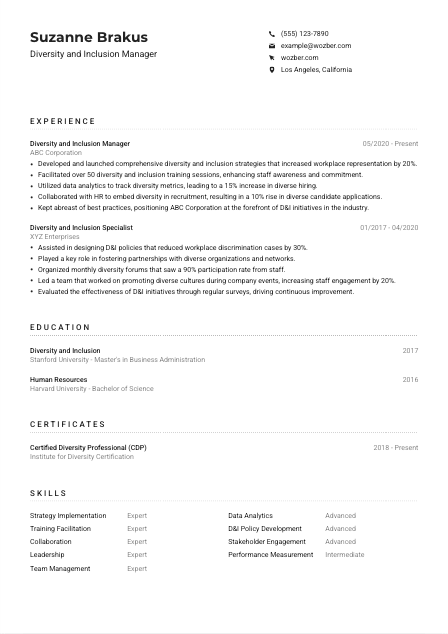
Some roles have a location requirement, and this example does. Listing "Los Angeles, California" in the header answers that filter immediately and prevents unnecessary doubt about availability. Use location this way when it is relevant to the target job, not as a default rule for every application.
Skip information such as age, marital status, gender, or a photo unless a market specifically requires it. A D&I CV should keep attention on your program leadership, stakeholder credibility, and business outcomes, not on details unrelated to your ability to lead inclusive workplace initiatives.
Your personal details section should confirm who you are, what role you do, and whether you meet any practical requirements such as location. Then the rest of the CV can stay focused on your D&I leadership.




This is the section where D&I hiring teams look for proof that you can do more than advocate. They want to see strategy execution, partnership with HR and leadership, training delivery, and measurable movement in representation, participation, retention, or culture indicators.
Review the posting and pull out the work that matters most, such as building D&I strategy, facilitating workshops, tracking metrics, advising leaders, and improving recruitment or retention processes. Then choose examples from your background that match those responsibilities closely. In the sample CV, that alignment is clear through strategy development, training delivery, analytics, and collaboration with HR.
List roles in reverse chronological order and include job title, organisation, and dates for each one. For this profession, that timeline helps employers see whether you progressed from specialist or program work into broader ownership of enterprise initiatives, executive partnership, or people-process integration.
Replace generic duties with outcome-driven statements. "Facilitated over 50 diversity and inclusion training sessions" is stronger than "responsible for training," because it shows scope. "Developed and launched comprehensive diversity and inclusion strategies that increased workplace representation by 20%" shows both ownership and business effect. Use that same pattern in your own CV: action, scope, and result.
D&I work is often evaluated through metrics, so include numbers where they are real and relevant. Representation gains, diverse hiring increases, employee participation rates, survey results, retention improvements, reduced complaints, or program adoption rates all help. The sample uses a 15% increase in diverse hiring and 90% participation in monthly forums, which gives hiring teams a concrete read on impact.
Prioritise work that shows inclusive talent practices, policy development, facilitation, analytics, stakeholder influence, and change management. Cut bullets that do not support that story. If you have broader HR experience, keep the parts tied to recruiting, employee development, engagement, or process design that connect directly to D&I leadership.
The best experience sections make it easy to see where you influenced policy, process, leadership behaviour, and workforce outcomes. That is the level of contribution employers look for in a Diversity and Inclusion Manager.
Education matters here because the role often sits at the intersection of HR, business operations, organizational development, and culture strategy. Your degrees should be presented in a way that quickly confirms that foundation.
If you hold a bachelor's degree in Human Resources, Business, or a related field, make sure it is easy to spot because many postings list it as a baseline requirement. In the example, a Bachelor of Science in Human Resources aligns directly, while the MBA adds leadership and organizational context that supports a management-level role.
List degree, field of study, school, and graduation year in a consistent order. Hiring teams reviewing HR and D&I CVs often scan quickly for education requirements before moving into your program work and leadership experience, so straightforward formatting helps.
When you have multiple degrees, let the most relevant ones reinforce the kind of D&I work you want to do. A background in HR, business, psychology, organizational leadership, or related disciplines can support work in inclusive hiring, employee development, policy design, and culture change.
You do not need to list coursework unless it strengthens your case. If you are earlier in your career or have relevant distinctions, include honors, research, leadership roles, or coursework tied to organizational behaviour, labour relations, equity, or analytics. Keep it practical and connected to the job.
D&I strategy evolves with employment practices, analytics methods, accessibility standards, and broader workplace expectations. Even if ongoing learning appears elsewhere on the CV, your education section should fit into a larger profile of someone who stays current on inclusive leadership and people strategy.
Your education section does not need extra decoration. It should show that you have the academic base to handle people strategy, organizational change, and data-informed D&I work.
Certifications can strengthen a D&I CV when they add current, role-relevant expertise. They are especially useful for showing continued development in inclusion practice, facilitation, compliance awareness, or people analytics.
Choose certifications tied to diversity, equity and inclusion, HR, facilitation, coaching, or related organizational work. The example includes Certified Diversity Professional, which directly supports the candidate's specialization. Use certifications this way to reinforce expertise, not to pad the page.
If you have several credentials, lead with the ones that connect most directly to the role's responsibilities. A hiring team will care more about certifications that strengthen your ability to design initiatives, guide leaders, run training, or measure outcomes than about unrelated general-interest courses.
Certification dates can show that your knowledge is current, especially in a field shaped by evolving workplace standards, inclusive hiring practices, and reporting expectations. If the credential is active or renewed, make that visible in a simple format.
D&I managers are often expected to stay informed on emerging practices, legal considerations, employee experience trends, and measurement approaches. Ongoing certification work supports that picture and can complement your experience with a visible record of professional development.
A concise certification section can strengthen your profile by showing specialization and continued learning. Keep it tightly tied to the kind of D&I leadership the role requires.
A D&I skills section should read like the operating toolkit behind your results. Focus on the capabilities that support program design, facilitation, stakeholder partnership, measurement, and sustained organizational change.
Start with the language used in the job description. Here, that includes strategy development, training facilitation, data analytics, collaboration, and leadership. Mirroring that language where it matches your real background improves alignment and helps position you correctly in ATS and recruiter review.
Lead with the skills most central to the target role. For a Diversity and Inclusion Manager, that often means D&I strategy, workshop facilitation, stakeholder engagement, policy development, inclusive recruitment, data analysis, and leadership. In the sample, "Strategy Implementation," "Training Facilitation," and "Data Analytics" support the job well because they connect directly to stated responsibilities.
Group related skills together or order them from strategic to operational. For example, leadership and strategy can sit near analytics and performance measurement, followed by collaboration and team management. That structure helps the employer see both your executive-facing strengths and your ability to run programs day to day.
When the skills list reflects how you actually deliver D&I outcomes, it supports every other section of the CV. The result is a profile that reads as capable, specific, and ready to operate at manager level.
Communication is central to D&I work. You may be leading training, discussing sensitive workplace issues, advising leaders, or building trust across employee groups, so your language section should support that picture accurately.
If the posting specifies English proficiency, list it clearly. In this case, strong English communication is a stated requirement, which makes it worth confirming directly in the languages section if you speak it fluently or natively.
Extra languages can be valuable when the workforce, community, or stakeholder group is multilingual. The sample CV lists Spanish alongside English, which can support communication across broader employee populations. Use additional languages when they are real strengths and relevant to the environment you serve.
For D&I leaders, additional languages can support employee listening sessions, resource-group engagement, training participation, and relationship building across cultures. They are not required for every role, but when relevant, they can strengthen your ability to work across different employee communities.
Use clear levels such as Native, Fluent, Advanced, or Conversational. Overstating proficiency can create problems quickly in interviews or on the job, especially in roles that depend on trust, clarity, and sensitive communication.
If the role supports a global, regional, or highly diverse workforce, language capabilities may carry more weight. If not, keep the section brief. Either way, present languages as a practical communication asset, not as filler.
For D&I roles, language skills matter most when they support training, employee connection, and cross-cultural communication. Keep the section factual and relevant to the audience you would serve.
Your summary should quickly establish the level at which you work. In this field, that usually means a combination of strategy, facilitation, analytics, and partnership with HR and leadership.
Read the posting closely and decide what kind of D&I leader it is seeking. Is the emphasis on enterprise strategy, training delivery, data reporting, inclusive recruiting, or culture change? Use those priorities to shape your opening lines so the summary reflects the real role rather than a generic mission statement.
State your title or specialty, then your years of experience, then the core areas where you deliver results. The sample does this well by establishing more than 6 years in D&I work and pointing to initiatives, training programs, and data-driven strategy. That gives immediate context for the rest of the CV.
Choose achievements or strengths that reflect how D&I performance is judged. That may include improving representation, increasing diverse hiring, strengthening engagement, reducing employee issues, or embedding inclusion into recruiting and development processes. Keep the examples brief but concrete, with numbers where they add credibility.
Aim for a short paragraph that reads with focus and authority. Avoid broad statements about passion or commitment unless they are backed by specifics. Hiring teams already expect D&I candidates to care about inclusion. What they need to see quickly is that you can lead programs, influence stakeholders, and produce measurable results.
When your summary names your D&I scope, leadership level, and measurable impact, the rest of the document lands faster. It should make clear that you can build inclusion strategy into the business, not just talk about it.
A tailored Diversity and Inclusion Manager CV should show how you translate inclusion goals into programs, metrics, training, and process change. That means aligning your title, experience, skills, and summary with the actual work the employer needs done.
Use Wozber's free CV builder to shape that story in an ATS-friendly CV format, strengthen wording with targeted role language, and check alignment with an ATS CV scanner before you apply. The finished CV should make it easy to see your ability to lead D&I strategy, influence stakeholders, and deliver measurable organizational progress.