



Use Wozber and land your dream job
Create CV
No registration required
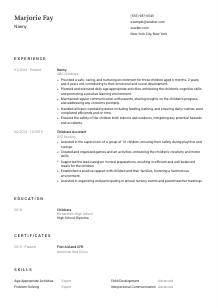
Molding young hearts, but your CV feels lost in a daycare? Check out this Nanny CV example, created with Wozber free CV builder. Learn how to present your nurturing spirit in a way that aligns with family needs, leading your career journey to be as rewarding as a kid's giggle.
Families hiring a nanny are making a daily trust decision. They need to see that you can keep children safe, manage routines calmly, and create age-appropriate activities that support development rather than simply supervise the day. Your CV should make that judgment easy by showing how you handle care, communication, and consistency in real childcare settings.
A tailored nanny CV helps hiring teams and applicant tracking systems quickly connect your background to the work that matters most, such as child safety, developmental activities, parent communication, and hands-on caregiving. Wozber's free CV builder helps organise that experience into an ATS-friendly CV format, so your application clearly shows where you've cared for children, how you've supported growth, and whether you match practical requirements such as certifications, communication skills, and location.
In nanny hiring, the personal details section does more than identify you. It confirms that you are reachable, local when required, and presenting yourself with the same reliability families expect in daily childcare.
Place your full name at the top in a clear, readable format. In childcare, families often remember names from referrals, interviews, or agency shortlists, so make it easy to recognize and professional at a glance.
Add "Nanny" directly below your name when that is the role you are pursuing. This keeps your CV aligned with the posting and helps distinguish you from adjacent childcare profiles such as babysitter, childcare assistant, or daycare worker.
Families and agencies need fast, direct ways to reach you for interviews, schedule discussions, and follow-up questions.
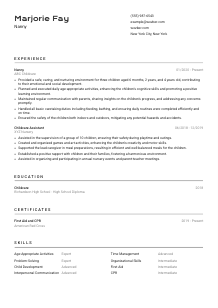
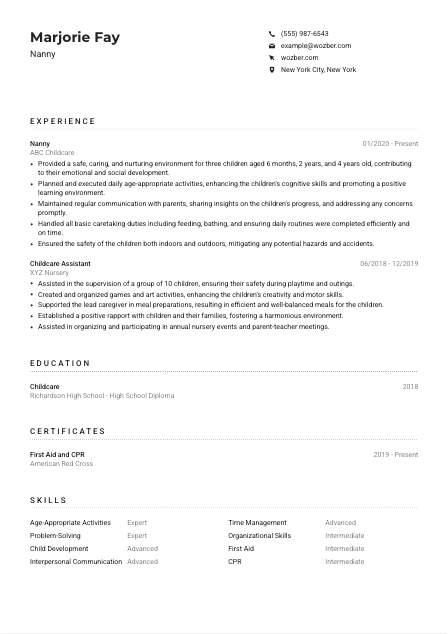
If the employer needs someone based in a specific area, list your city and state clearly. In the example job, New York City is a stated requirement, so showing "New York City, New York" in the header removes an immediate screening question.
Include a LinkedIn profile or personal site only if it adds useful childcare context, such as recommendations, credentials, or a polished background summary. If you link to anything, make sure the tone and information match the care-focused professionalism on your CV.
This section should quietly confirm that you are available, professional, and easy to contact. For nanny roles, that practical clarity matters because families are hiring for daily dependability, not just interest in childcare.




Experience carries the most weight on a nanny CV because it shows how you handle real routines, real children, and real family expectations. Hiring teams look for childcare scope, developmental awareness, and the kind of judgment that keeps a home environment safe and steady.
Read the posting and underline the recurring childcare themes. For this role, the clearest priorities are safety, nurturing care, age-appropriate activities, parent communication, and basic daily duties such as feeding and bathing. Those should shape the examples you choose and the wording of your bullet points.
Start with your most recent childcare work so employers see your current level of responsibility first.
Your bullets should describe what you actually managed in the household or childcare setting. Focus on supervision, routines, activity planning, emotional support, behaviour guidance, safety practices, and communication with parents. The strongest bullet points help a family picture you handling breakfast, transitions, play, outings, and end-of-day updates without needing extra explanation.
Numbers work well when they describe the scale and complexity of care. Mention how many children you supported, their age ranges, schedule coverage, or the setting you worked in. In the example, caring for three children aged 6 months, 2 years, and 4 years old gives immediate context about multitasking across very different developmental stages.
Prioritise roles and bullets that show direct childcare judgment. If you have broader service experience, keep only the parts that translate clearly, such as managing routines, communicating with families, organising activities, or maintaining a safe environment. Every bullet should reinforce that you can step into a family's daily rhythm and handle it responsibly.
A family should be able to read your experience section and understand the ages you have worked with, the routines you managed, and the kind of care you delivered. That practical picture is what moves a nanny CV forward.
Education is usually a supporting section on a nanny CV, but it still matters. It confirms that you meet stated requirements and can also reinforce your foundation in child development, learning, or care-related training.
When a posting asks for a high school diploma or equivalent, make sure that information is easy to find. Do not bury it beneath unrelated coursework or extra detail. Meet the stated baseline cleanly and directly.
List your diploma or degree, school name, and graduation year or completion date. If your education included a childcare emphasis, mention it, but keep the section straightforward. In the example, the high school diploma is easy to identify, which helps the employer confirm the requirement quickly.
If you have completed workshops in early childhood development, behaviour support, child nutrition, sleep routines, or similar areas, include them when they add practical value. These details can help if your formal education is basic but your childcare training is stronger.
You do not need to turn this section into a transcript. Add courses, honors, or school programs only when they clearly support nanny work, such as early childhood education, family studies, or child safety training. Relevance matters more than volume.
Families often value caregivers who keep learning about child development, routines, and safety. If you are currently taking a CPR renewal, child development class, or similar training, listing it can show active professional growth without overstating your credentials.
This section does not need to carry the CV, but it should confirm the basics and support your childcare credibility. Clear education details help employers move on to what matters most, your hands-on care experience.
Certifications matter in nanny hiring because they speak directly to safety and preparedness. A current First Aid or CPR credential can influence decisions quickly, especially when families are comparing candidates with similar childcare experience.
Lead with certifications that affect day-to-day childcare readiness. First Aid and CPR are especially important because they relate directly to emergencies, supervision, and parental peace of mind. In the provided example, listing "First Aid and CPR" from the American Red Cross is highly relevant to the role.
Keep this section focused on certifications that support nanny responsibilities. Along with CPR and First Aid, that might include newborn care, child development, early childhood education, special needs care, or sleep training if they reflect your actual experience and the target job.
Outdated certifications weaken the section, particularly for safety-related credentials. If a posting says certification is preferred or asks for willingness to become certified, current dates or renewal status show that you take childcare standards seriously.
If you are building your CV and do not yet have many certifications, start with the ones that matter most in home-based childcare. A planned CPR course or recent child safety training can be worth mentioning if it is scheduled and accurate. Keep the focus on practical qualifications that improve your ability to care for children well.
For nanny roles, certifications are not decorative. They help employers see that you are prepared for the safety, health, and day-to-day responsibility that comes with caring for children in a home setting.
A nanny skills section should read like a snapshot of how you work with children and parents, not a list of vague personality traits. Choose skills that support supervision, development, routines, safety, and communication.
Pull skill language from the job description and match it to your real experience. For this role, that includes child development knowledge, age-appropriate activities, interpersonal communication, English communication, and safety-related competence. This kind of alignment helps both employers and ATS screening connect your background to the role.
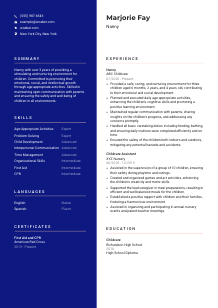
A strong nanny skills section usually includes more than one category. Combine child-focused skills such as activity planning or developmental support with practical strengths such as time management, organisation, and problem-solving, plus parent-facing communication skills. The example CV handles this well by pairing child development and age-appropriate activities with interpersonal communication and time management.
Do not crowd the section with every soft skill you can think of. Choose the abilities that are most useful in a family's daily routine and most likely to appear in nanny postings. A shorter, more targeted list is easier to trust and much easier to scan.
Your skills section should support the rest of the CV with concrete childcare strengths. If the list matches your experience bullets and summary, employers can quickly see how you would operate in their home.
Language ability can matter in nanny roles because the work depends on clear communication with children, parents, and sometimes teachers or other caregivers. Present language skills in a practical way, especially when the posting names one language as essential.
If the employer asks for strong English communication, list English prominently and label your proficiency accurately. For nanny work, this affects safety instructions, parent updates, schedule coordination, and the ability to communicate clearly during stressful moments.
Additional languages can be useful in multilingual households or diverse communities. If you speak another language well enough to use it with children or parents, include it. In the sample CV, Spanish adds useful range without distracting from the English requirement.
Use clear levels such as Native, Fluent, Conversational, or Basic. Avoid overstating ability. Families may rely on language skills for daily updates, emotional reassurance, and household coordination, so accuracy matters.
In some markets, multilingual ability can broaden the kinds of families or childcare settings you can work in. That said, only emphasize extra languages when they genuinely support the job you are targeting. The required language should always remain easiest to spot.
Language skills are most useful when they improve understanding, comfort, and consistency. On a nanny CV, they are strongest when presented as part of clear daily communication, not as a decorative extra.
For nanny positions, language skills should help an employer understand how well you can communicate in real care situations. Lead with the required language, then add others that genuinely strengthen your profile.
The summary is often the first section that communicates what kind of nanny you are. In a few lines, it should establish your experience level, your approach to care, and the responsibilities you handle well.
Before writing the summary, identify the two or three responsibilities the employer is likely to care about first. For this posting, those are safe care, development-focused activities, and communication with parents. Build your opening around those priorities rather than using a generic statement about loving children.
Begin with your title and years of relevant experience. A line such as "Nanny with 3+ years of professional childcare experience" works because it quickly establishes your level. If your background includes related roles like Childcare Assistant, count them only when they are truly relevant to hands-on child supervision and care.
Use the next lines to show what you actually do well. Mention areas such as creating age-appropriate activities, supporting emotional and social development, managing routines, or maintaining a safe environment. The sample summary is effective because it connects nurturing care with developmental activities and parent communication instead of relying on broad personal traits.
Aim for three to five lines with clear childcare language. Skip filler and focus on what a family or recruiter should know first. A concise summary with direct wording usually performs better in both human review and ATS optimisation than a longer paragraph full of general warmth.
A well-written summary gives immediate context for the rest of the CV. When it names your experience, care style, and strongest childcare responsibilities clearly, employers can quickly see whether you belong in the interview pool.
A nanny CV works best when it shows practical care, not just caring intent. Safety, routines, developmental activities, parent communication, and current certifications should all be easy to find and supported by real examples from your experience.
Use Wozber's free CV builder to organise your background into an ATS-compliant CV, refine role-specific wording, and check alignment with the posting through the ATS CV scanner. The final result should make one thing clear immediately: you can step into a family's day, care for children responsibly, and support their growth with confidence.