




Use Wozber and land your dream job
Create CV
No registration required
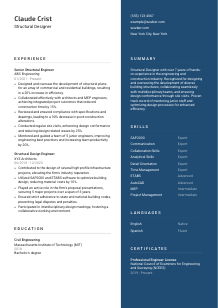
Drafting blueprints, but your CV feels sketchy? Check out this Structural Designer CV example, created with Wozber free CV builder. It shows how to fortify your design prowess to match job frameworks, making sure your career blueprint is solid as steel!
Structural design work is reviewed through the quality of decisions behind the drawings. Hiring teams want to see whether you can translate loads, codes, site conditions, and coordination constraints into structural plans that hold up in the real world. Your CV should make that engineering judgment visible, not just list software and project titles.
When a CV is tailored well, the reader can quickly connect your project work to the actual demands of the opening, from building-code compliance to multidisciplinary coordination and site review. Wozber's free CV builder helps organise that content into an ATS-friendly CV format, so tools and teams alike can read your background as relevant structural design experience rather than general engineering work.
This section handles the basics, but for a Structural Designer, the basics still carry screening value. Contact details, title alignment, and location can affect whether your CV moves forward before anyone reaches your project work.
Use your full name in a clean, readable format at the top of the page. Keep it more prominent than the rest of the header so the document feels professional and easy to reference during interviews, project-team reviews, and internal hiring discussions.
Place "Structural Designer" directly beneath your name if that is the role you are targeting. This immediately frames your background around structural plans, calculations, and coordination work instead of leaving the reader to guess whether you are coming from a broader civil or engineering track.
Include a current phone number and a professional email address, ideally one based on your name. Check every character carefully. If a hiring manager wants to discuss your experience with building design, code review, or software such as SAP2000, they should be able to reach you without friction.
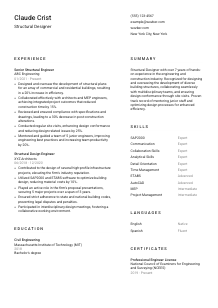
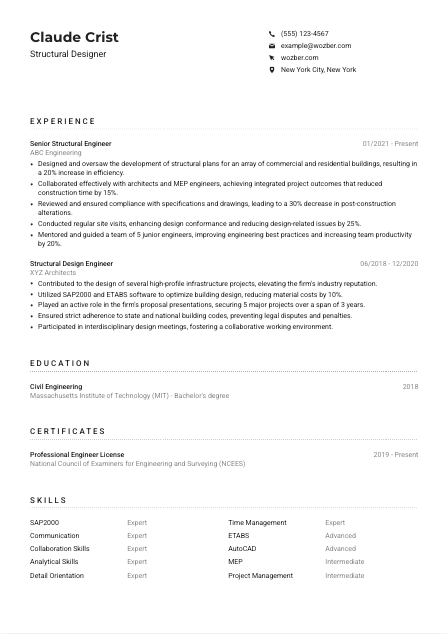
If the employer specifies a city or region, include it clearly in your header. In the example, listing "New York City, New York" answers a stated requirement right away and removes a practical question before it slows the application down. Use location this way when it matters for the job, not as filler.
A LinkedIn profile or portfolio can strengthen your application when it adds project depth, technical scope, or publication history. If you include one, make sure it matches your CV on titles, dates, and major project claims, especially if you describe structural design work across buildings or infrastructure.
Keep the header simple, accurate, and aligned to the opening. It should confirm who you are, where you are based when relevant, and that you are applying as a Structural Designer without creating extra questions.




For Structural Designer hiring, experience carries the most weight when it shows what you designed, how you coordinated the work, and what changed because of your decisions. Project scope, code compliance, software use, and measurable outcomes matter far more than generic duty lists.
Read the posting closely before rewriting your experience bullets. If the role emphasizes structural plans, specifications, calculations, code compliance, site inspections, and collaboration with architects and MEP engineers, those themes should appear in your strongest examples. The sample CV does this well by covering design delivery, coordination, inspections, and mentoring instead of only listing engineering tasks.
List your most recent position first, then work backward. For each role, include your job title, company name, and employment dates in a format that is easy to scan. This helps the reader quickly track your progression from design support into more responsible work such as oversight, coordination, or mentoring junior staff.
Focus each bullet on a meaningful result tied to structural design work. Strong bullets mention the type of project, the design action, the coordination involved, and the outcome, such as fewer post-construction changes, improved construction efficiency, or better conformance in the field. In the example, bullets about reducing alterations by 30% and shortening construction time through architect and MEP coordination show the kind of project impact hiring teams recognize.
Use numbers when they reflect real project results. Structural design work can often be measured through efficiency gains, material savings, issue reduction, schedule improvement, number of projects delivered, or team size mentored. The sample's 10% material-cost reduction and 25% drop in design-related issues are strong models because the figures connect directly to engineering and construction performance.
Keep the section centered on structural design, code interpretation, technical review, site presence, and multidisciplinary teamwork. If an older role does not contribute much to that story, reduce it to fewer bullets or remove lower-value details. Space is better used on work that shows you can design and review building or infrastructure projects with the level of judgment the role requires.
Your experience section should read like a record of structural decisions, coordination work, and project results. When the bullets show scope, tools, compliance, and outcomes clearly, the hiring team can picture you contributing on live projects.
Structural Designer roles often start with a firm academic requirement because the work depends on engineering fundamentals. Your education section should confirm that foundation quickly, then add detail only when it strengthens your case for the level of design work you are targeting.
If the posting requires a Bachelor's degree in Civil or Structural Engineering, make sure that degree is easy to find. In this case, a Bachelor's in Civil Engineering directly supports eligibility. When your degree title differs slightly, use the exact official wording and let the field of study clarify the structural relevance.
List the degree, school, field of study, and graduation year in a simple structure. Hiring teams reviewing technical CVs do not need decorative formatting here. They need to confirm your educational background quickly and move on to your project and design experience.
If you are earlier in your career, include structural analysis, steel or concrete design, finite element methods, seismic design, or capstone projects that involved calculations and design software. For a more experienced candidate, this detail is optional unless it adds something distinctive, such as a thesis or major design project tied to buildings or infrastructure.
Student design teams, research assistance, competition projects, or leadership in engineering societies can help when they show technical depth or collaboration. Choose activities that relate to structural systems, construction, or design problem-solving rather than listing unrelated campus involvement.
Academic honors, scholarships, or notable distinctions can strengthen this section, especially for early-career candidates or graduates from demanding engineering programs. Keep them brief. They should support your technical foundation, not distract from your applied design work.
Education needs to confirm that you meet the engineering requirement and have the training behind your design work. Keep it concise, credible, and relevant to structural practice.
Certifications can strengthen a Structural Designer CV when they reflect licensure, code knowledge, or continued technical development. They are especially useful when the role involves oversight, review responsibility, or mentoring more junior designers.
Start with the job ad. Some openings require specific licenses or certifications, while others treat them as a plus. Even when not mandatory, a credential such as a Professional Engineer License can reinforce your level of responsibility and technical credibility, especially on building projects subject to close code review.
List certifications that support design authority, analysis expertise, or regulatory knowledge. A PE license is highly relevant. General certificates should only stay if they connect clearly to engineering software, building systems, safety, or project delivery in the construction environment.
Dates show whether the credential is current. This matters for licenses, code-related training, and any certification tied to ongoing professional standing. The sample's "2019 - Present" format works because it shows active status without overcomplicating the section.
Structural design changes with code updates, software capabilities, and construction methods. If you complete continuing education in seismic design, steel detailing, rehabilitation, BIM coordination, or updated code standards, add the most relevant items so your CV reflects active professional growth.
Use certifications to show current standing and technical seriousness. For this field, the best credentials support your ability to design responsibly, review work accurately, and contribute at a higher level on projects.
The skills section should mirror how Structural Designers actually work. That means balancing analysis tools, drafting or modeling platforms, code knowledge, and the communication needed to coordinate with architects, MEP teams, contractors, and junior staff.
Pull the most relevant requirements from the job description and reflect them in your skills list if you genuinely have them. Here, SAP2000, ETABS, and building-code knowledge are central. If you also use AutoCAD, Revit, RAM, or other common structural tools, include them when they support the target role.
A Structural Designer needs more than software proficiency. Add communication, interdisciplinary coordination, analytical problem-solving, and drawing or specification review where those skills are backed by your experience. The sample list works because it combines analysis tools with collaboration strengths that matter on live design teams.
Do not turn this section into an inventory of every tool you have touched once. Prioritise skills that support the job's core work, then group or order them so the reader can quickly understand your technical profile. A shorter, better-targeted list is more convincing than a long one filled with low-relevance items.
Choose skills that support the kind of structural work the employer needs done. When the list reflects the software, engineering judgment, and coordination demands of the role, it reinforces the rest of your CV instead of repeating it.
Language skills matter in structural design when they affect coordination, documentation, and site communication. If a posting names a required language, treat that as a clear qualification rather than a minor extra.
Check the posting for explicit language expectations. In this example, the employer states that the candidate must be able to operate effectively in English, so English should appear clearly in the section if you are including languages at all.
Place the required language prominently and label your level honestly, such as Native, Fluent, or Professional. Structural Designers often need to discuss drawings, respond to RFIs, review specifications, and coordinate with multiple disciplines, so accuracy matters more than optimistic phrasing.
Additional languages can be useful when projects involve multilingual teams, clients, communities, or site conditions where communication range matters. They are a bonus, not a substitute for structural expertise, so keep them secondary to the required language and core qualifications.
Choose labels you can support in professional situations. If you can handle meetings, technical explanations, and written coordination in a language, say so. If your ability is conversational only, mark it accordingly. This helps set the right expectations for team communication and documentation.
For firms working across diverse stakeholders or international teams, extra language capability can improve coordination and client communication. It will not outweigh engineering experience, but it can strengthen your profile when all else is comparable.
Treat languages as a practical communication qualifier. Show the required language clearly, then include additional languages only when they add genuine value to the kind of project environment you are targeting.
A Structural Designer summary should quickly establish your level, your type of project experience, and the technical strengths most relevant to the opening. Skip generic claims and use the space to frame the reader's understanding of your design background before they reach the detailed bullets.
Before writing, pull out the priorities from the posting. If the employer needs someone with 5+ years in structural design, building-industry experience, software proficiency, code knowledge, and multidisciplinary coordination, those are the points to shape around. Your summary should reflect the role's centre of gravity, not a generic engineering profile.
Start with a direct line that states who you are and how long you have been doing relevant work. The sample summary uses "over 7 years of hands-on experience" to establish seniority immediately, which is useful because the opening asks for a candidate with at least 5 years of structural design experience.
Choose strengths that match the work, such as designing building structures, coordinating with architects and MEP engineers, conducting site visits, mentoring junior staff, or using analysis software effectively. Keep the language grounded in actual practice. Mention strengths you can support elsewhere in the CV with projects, tools, or measurable results.
Aim for three to five lines. That is enough space to establish your professional identity without repeating the full experience section. A tight summary with software, project, and coordination relevance will do more for a Structural Designer application than a long paragraph full of broad adjectives.
Your summary should give the reader an accurate first read on your structural design scope, experience level, and technical focus. When it is tailored well, the rest of the CV feels consistent from the first line onward.
A Structural Designer CV should show more than software familiarity. It should connect your engineering background to actual design delivery, code compliance, cross-discipline coordination, site involvement, and project results.
Use Wozber's free CV builder to shape that experience into an ATS-compliant CV, then refine it with the ATS CV scanner so the language of the posting maps naturally to your projects, tools, and qualifications. The finished document should make it easy to judge whether you can step into structural design work with confidence from day one.