



Use Wozber and land your dream job
Create CV
No registration required
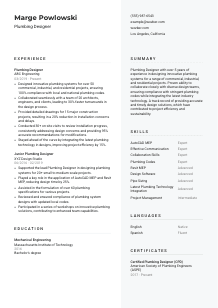
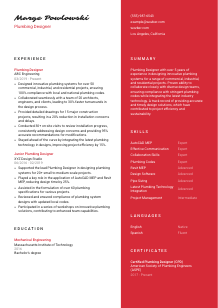
Navigating pipe paths, but your CV is clogging up? Check out this Plumbing Designer CV example, created with Wozber free CV builder. It shows how to lay out your plumbing prowess to match job specifications, fitting all the right pieces together in your career pipeline!
Plumbing design work is reviewed through the lens of constructability. A hiring team wants to see whether you can turn code requirements, fixture loads, and coordination constraints into drawings and specifications that actually work in the field. Your CV should make that visible early, especially through project type, design scope, software fluency, and the quality of outcomes tied to your work.
When plumbing CVs are tailored well, the difference shows up quickly in both ATS screening and human review. Wozber's free CV builder helps organise job-specific language into an ATS-compliant CV, so terms like Revit MEP, plumbing codes, pipe sizing, and construction coordination appear where they belong. That makes it much easier to see whether your background matches the design demands of the role.
Before anyone studies your project work, they check whether they can contact you, whether your title matches the opening, and whether you meet any immediate practical requirements. In plumbing design, that first scan is brief, so your personal details need to answer those points without clutter.
Place your name at the top in a clean, readable format. Keep it slightly more prominent than the rest of the header so it anchors the page immediately. For a technical role where drawings, markups, and specification sets already demand precision, a tidy header sets the right tone.
If you are applying for a Plumbing Designer position, state "Plumbing Designer" directly under your name. This helps ATS matching and removes any doubt about your target discipline, especially if your background includes adjacent titles such as MEP Designer, Mechanical Designer, or Junior Plumbing Designer.
List a current phone number and a professional email address, then verify both before sending the CV. One digit off in a phone number is the CV version of a coordination error. Keep the format simple and businesslike, such as firstname.lastname@email.com.
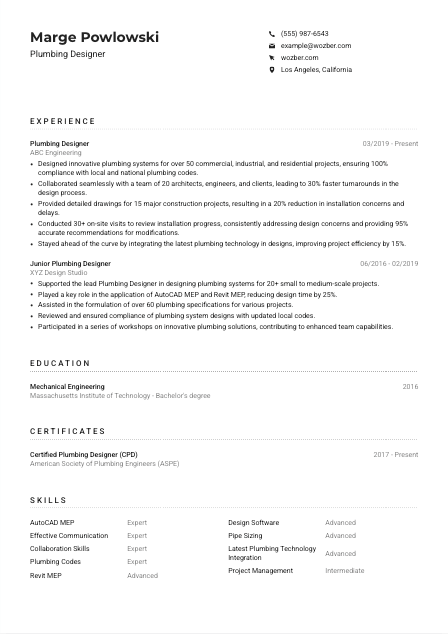
Some employers screen for local availability early, particularly when the work includes site visits, coordination meetings, or region-specific code familiarity. In the example posting, Los Angeles, California is a stated requirement, so listing Los Angeles, California in the header helps remove that question immediately. Treat location this way when it is relevant to the opening, not as a universal rule for every application.
Include a LinkedIn profile or professional website if it supports your application. For a Plumbing Designer, the most useful link usually adds context such as project experience, engineering background, certifications, or portfolio material rather than generic personal branding. Make sure the content is current and consistent with the CV.
Your contact section should confirm the basics in seconds: who you are, what role you do, how to reach you, and any practical requirement the employer flagged upfront. That keeps attention on your design work rather than avoidable questions.




Experience carries the most weight in a Plumbing Designer CV because it shows how you apply codes, software, and coordination in real project settings. Hiring teams look for signs that you can produce workable system layouts, collaborate across disciplines, and support construction without creating downstream issues.
Start by identifying the experience signals the posting emphasizes. Here, that includes 3+ years in plumbing system design, commercial or residential project work, AutoCAD MEP and Revit MEP, code compliance, drawing production, collaboration with architects and engineers, and site involvement. Those points should shape which bullets you keep, rewrite, or move higher in your experience section.
List your most recent role first, followed by earlier positions, with job title, employer, and dates easy to scan. Plumbing design careers often show growth from production support into fuller design ownership, so the sequence should make that progression obvious. Clear structure also helps ATS parsing and gives context for the level of responsibility behind each project.
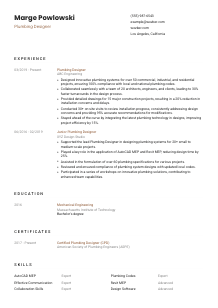
Focus each bullet on work that matters in plumbing design: system layouts, fixture and equipment selection, pipe sizing, code compliance, specification development, coordination, or construction support. The example CV does this well with bullets like designing plumbing systems for more than 50 projects and producing detailed drawings for major construction work. That tells the reader what was designed and what business or project result followed.
Numbers help translate technical work into hiring value. Strong metrics in this field include project count, team size, turnaround time, reduction in installation issues, number of site visits, accuracy of design revisions, or compliance rates. For instance, a bullet showing 30 percent faster design turnaround or a 20 percent drop in installation concerns gives much more hiring context than saying you "supported design efforts."
Prioritise accomplishments that strengthen your case for the target role. If you have experience from broader engineering, drafting, or facilities work, keep only the parts that relate to plumbing systems, construction documents, code review, BIM coordination, or client collaboration. Every bullet should help answer the same question: can this candidate handle the technical and coordination demands of plumbing design work?
A strong experience section shows that you can move from design intent to buildable documents and informed field support. When your bullets cover project scope, tools, code compliance, and measurable results, your CV starts sounding like someone who has already done the job.
Education matters here because many Plumbing Designer openings still screen for an engineering foundation or a closely related technical degree. It will not outweigh hands-on design experience, but it does support your grasp of building systems, calculations, and technical documentation.
If the posting asks for a Bachelor's degree in Mechanical Engineering or a related field, make sure that information is easy to find. Do not bury the field of study. In the example CV, "Bachelor's degree, Mechanical Engineering" lines up directly with the requirement, which helps the employer clear an early qualification check.
List degree, field of study, school, and graduation year or date in a clean structure. That is usually enough for an experienced Plumbing Designer. Keep the format consistent with the rest of the CV so the section is easy to parse by both ATS software and a reviewer scanning quickly.
When your education matches the role closely, do not undersell it. A Mechanical Engineering degree, architectural engineering degree, or similar technical background reinforces your ability to work with building systems, codes, and design calculations. If the match is less direct, your experience bullets need to do more of the heavy lifting.
Early-career candidates can strengthen this section by naming coursework or projects tied to fluid systems, building services, CAD, BIM, or construction documentation. For someone with several years of plumbing design experience, this is optional and only worth adding if it fills a gap or supports a target niche such as commercial or industrial work.
Honors, design competitions, or standout senior projects can help if they relate to engineering performance or system design. Keep them brief. Once you have meaningful project experience, the education section should stay compact and let your work history carry the more detailed proof.
This section does its job when it quickly shows that you have the academic background to support code-based design, technical drawings, and system planning. After that, let experience take the lead.
Certifications matter in plumbing design because they show commitment to the discipline and, in some settings, a higher level of technical trust. They are especially useful when the employer mentions plumbing design certification or a PE license directly, as this posting does.
Start with any credential that directly supports the role, such as Certified Plumbing Designer or a Professional Engineer license where applicable. When a job description calls this out, it is a clear signal that the employer values recognized standards and formal qualification, not just software familiarity.
List the credential with the strongest connection to plumbing system design first. In the example CV, Certified Plumbing Designer is the right lead because it speaks directly to the discipline. If you hold multiple credentials, order them by relevance to the target job rather than by prestige alone.
Add the year earned, active range, or expiration date when that helps show the certification is current. For roles involving codes, standards, and regulated design work, recency can matter. It shows the credential is still active and not a historical footnote.
If you are pursuing additional credentials or completing training tied to plumbing codes, BIM workflows, sustainable water systems, or related engineering standards, include that when it adds value. Employers want designers who stay current with evolving requirements, materials, and design practices.
A concise certifications section can support your case fast, especially when it confirms recognized plumbing design knowledge or licensure. Keep it focused on qualifications that help an employer trust your technical judgment.
The skills section should reflect how plumbing design actually gets done. Software matters, but so do code knowledge, coordination ability, and the technical tasks behind producing usable drawings and specifications.
Use the job description as a filter, then cross-check it against the tools and tasks you have actually used. For this role, that includes AutoCAD MEP, Revit MEP, plumbing codes and standards, communication with clients and design teams, and drawing-related work such as pipe sizing or fixture selection. Only include skills you can support elsewhere in the CV.
Order the list by hiring value. A Plumbing Designer CV should usually lead with design software, code knowledge, and core technical capabilities before more general strengths. The sample CV follows that pattern well by placing AutoCAD MEP, plumbing codes, Revit MEP, and pipe sizing ahead of broader items.
Group skills in a way that reads quickly and avoids duplication. You can separate technical tools, code or design knowledge, and collaboration strengths if your format supports it. The goal is to help a reviewer instantly find the capabilities needed to produce compliant drawings, coordinate with architects, and respond to field issues.
When this section is well ordered, it shows more than general competence. It points to the exact software, technical knowledge, and coordination strengths that support plumbing design work from concept through construction.
Language skills are worth including when they affect documentation, coordination, client communication, or field interaction. For Plumbing Designers, the main requirement is usually professional English, since drawings, specifications, meetings, and review comments all depend on clear communication.
If the posting specifies English proficiency, list English first and label your level clearly. That is especially important in roles involving client coordination, consultant communication, and construction documentation. In the example CV, English is listed as Native, which answers the requirement directly.
After English, list any additional languages you can use in professional settings. Keep the sequence straightforward and avoid overexplaining. Hiring teams should be able to scan the section in seconds and understand where you can communicate confidently.
Use standard proficiency labels such as Native, Fluent, Intermediate, or Basic. Avoid vague wording. Clear levels help employers judge whether the language is useful for meetings, site discussions, client communication, or reading technical materials.
Extra languages can be useful in project environments with diverse contractors, clients, or local communities. They are not usually a deciding factor for plumbing design roles, but they can strengthen your profile when communication across groups matters.
In some regions and project settings, additional language ability can support smoother coordination or client interaction. The example CV includes Spanish alongside English, which may be helpful in a market like Los Angeles. Treat that as a context-based advantage, not a universal requirement for every Plumbing Designer position.
This section works best when it quickly confirms that you can communicate professionally in the environments the job requires. For most plumbing roles, that starts with strong English and any additional language value that fits the project context.
The summary sits at the top of the CV, so it should establish your discipline, your experience level, and the kind of design work you can handle. In a Plumbing Designer CV, that usually means project type, software environment, code awareness, and the outcomes your work supports.
Before writing, identify what the employer needs confirmed in the first few lines. For this opening, that includes plumbing system design experience, project variety, software proficiency, code compliance, and collaboration across architects, engineers, and clients. Those are the themes your summary should reflect.
Start with a direct statement of who you are and how long you have worked in the field. The example CV opens with "Plumbing Designer with over 5 years of experience," which works because it immediately establishes discipline and seniority without wasting space.
Use the next lines to mention the environments or strengths that matter most, such as commercial and residential project experience, code-compliant system design, BIM or CAD proficiency, or close coordination with multidisciplinary teams. Include one concrete accomplishment or operating strength if it sharpens the picture, such as improving project efficiency or reducing installation issues.
Aim for a short paragraph of 3 to 5 lines. Avoid vague adjectives and generic statements about being hardworking or motivated. The summary should read like a compressed version of your actual design record, giving the employer a fast sense of the systems, tools, and project demands you handle well.
When your summary is focused, a reviewer can quickly place you at the right level and in the right type of plumbing design work. That creates the right context for everything that follows in the CV.
A Plumbing Designer CV needs to show more than drafting familiarity. It should connect your software skills, code knowledge, project coordination, and field-aware decisions in a way that makes your design work feel reliable and buildable.
Use Wozber's free CV builder to shape that content into an ATS-friendly CV format, then refine it with Wozber's ATS CV scanner so the language matches the role accurately. The final result should make it easy to judge your readiness for real plumbing design work, from drawing production to on-site coordination.