



Use Wozber and land your dream job
Create CV
No registration required
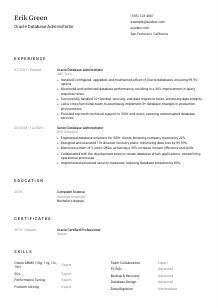
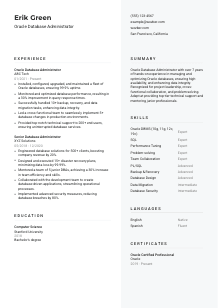
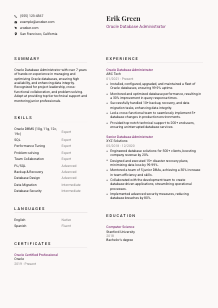
Harnessing SQL sorcery, but your CV feels buried in query results? Check out this Oracle Database Administrator CV example, created with Wozber free CV builder. Learn how to present your data domain fluency in line with job needs, conjuring a career story as powerful as an Oracle's prophecy!
Oracle Database Administration is operational work with very little room for ambiguity. Teams rely on DBAs to keep production systems stable during upgrades, recover cleanly from failures, tune slow workloads before users feel them, and protect data integrity while changes move into live environments. Your CV should make that operating standard visible through uptime, recovery work, performance results, version depth, and the way you support developers and end users.
Screening for this role often starts with a fast scan for Oracle version coverage, SQL and PL/SQL strength, backup and recovery experience, and production support scope. Wozber's free CV builder helps you shape that experience into an ATS-compliant CV that matches the language of the posting without sounding stuffed with keywords. The point is to make it immediately clear that you can run Oracle environments reliably, not just that you have worked around databases.
This section is simple, but it still carries useful hiring information. For an Oracle Database Administrator, the header should confirm who you are, how to reach you, and whether you meet any practical requirement such as location without making the top of the CV feel crowded.
Use your full name as the most visible text on the page. Keep the formatting clean and professional so the CV opens with a stable, enterprise-ready tone that fits infrastructure and database work.
Place "Oracle Database Administrator" under your name when that is the role you are pursuing. It aligns your CV with the posting immediately and helps frame the rest of your experience around Oracle operations, performance tuning, recovery, and production support.
Include a phone number and a professional email address that hiring teams can use without friction. Add LinkedIn or a relevant professional site only if it supports your candidacy with consistent information, such as Oracle administration projects, certifications, or infrastructure experience.
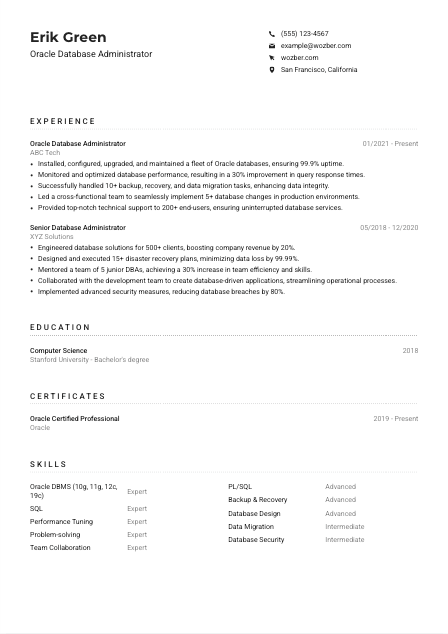
If the posting names a location requirement, address it clearly in your header. Here, listing San Francisco, California works because the employer asks for local presence or relocation readiness. For other Oracle DBA roles, only include location details that help remove a real logistical question.
A LinkedIn profile, portfolio, or technical profile should extend the same story your CV tells. If it highlights Oracle database work, production migrations, certification history, or collaboration with engineering teams, it adds value. If not, leave it out.
Your personal details should answer the practical questions fast and stay out of the way. Once this section is done, the reader should be ready to focus on your Oracle environment scope, production reliability, and hands-on database work.




For Oracle DBAs, the Experience section carries the most weight. Hiring teams look here for proof that you have handled live databases, supported releases, tuned performance, protected recoverability, and worked across both technical and business-facing support needs.
Start by pulling out the responsibilities that define the job. In this case, that means installing and upgrading Oracle databases, monitoring performance, maintaining availability and security, handling backup and recovery, supporting migrations, and partnering with development teams. Your bullets should reflect those same workstreams using the language you have genuinely earned.
List your positions in reverse chronological order with title, employer, and dates. For database roles, that structure helps reviewers quickly trace the scale and progression of your responsibility, from administration and support to architecture input, disaster recovery ownership, or team leadership.
Describe what changed because of your work. Instead of saying you monitored databases, show what the monitoring led to, such as better query response, improved uptime, cleaner releases, or stronger recovery preparedness. The sample CV does this well by pairing Oracle administration work with results like 99.9% uptime and a 30% improvement in query response times.
Numbers make infrastructure work easier to trust. Use metrics tied to database administration such as uptime, response-time improvement, recovery success, number of migrations completed, incident volume handled, end users supported, or percentage reduction in data loss risk. Even a few grounded metrics can turn routine maintenance into clear production impact.
Prioritise bullets that show direct relevance to the role you want now. Database tuning, PL/SQL support, version upgrades, security controls, backup strategy, and production change support belong near the top. Broader IT wins can stay only if they strengthen your case, such as mentoring junior DBAs or coordinating cross-functional release work.
By the end of your Experience section, a hiring manager should be able to see the environments you have supported, the Oracle work you have owned, and the business impact of your administration decisions. That is the level of detail that moves a DBA CV forward.
Education matters most here as a qualification check and a context signal. For Oracle Database Administrator roles, it confirms formal grounding in computer science, information technology, or related systems work, then lets your hands-on database experience do the heavier lifting.
When a posting asks for a Bachelor's degree in Computer Science, Information Technology, or a related field, make that match easy to find. A degree such as a Bachelor's in Computer Science directly supports the requirement and removes doubt early in the review.
List degree, field of study, school, and graduation year or date in a consistent format. This section does not need extra decoration. Clear structure is enough, especially for experienced DBAs whose production work carries more hiring weight than long academic detail.
Use the formal wording of your degree rather than shortening it too aggressively. If the employer asks for a Bachelor's degree and your education matches, say so plainly. That helps both human reviewers and ATS parsing connect your background to the requirement.
For early-career candidates or people moving into database administration from adjacent infrastructure roles, coursework in databases, operating systems, data structures, or information systems can help. If you already have 5+ years of Oracle DBA experience, this detail is usually optional.
Honors, projects, or technical extracurriculars are worth adding if they strengthen your database or systems profile. For example, a capstone involving database design or performance analysis can support an early DBA CV. For experienced professionals, keep the focus on production accomplishments first.
Your education section should confirm that you meet the stated academic requirement and then step aside for your Oracle administration record. If it is clear, accurate, and easy to scan, it has done its job.
Certifications carry real weight in database administration when they sharpen the picture of your platform knowledge. They are especially useful for Oracle roles because they help distinguish broad database experience from hands-on Oracle specialization.
If the posting does not require a certification, choose ones that still deepen your credibility for Oracle administration. Oracle-specific credentials are especially relevant because they point to tested knowledge of the platform, its tooling, and administration practices.
Prioritise credentials that support the responsibilities in the role, such as Oracle database administration, performance management, backup and recovery, or related infrastructure expertise. In the example CV, "Oracle Certified Professional" works well because it directly supports the target title.
Database platforms evolve across versions, patching standards, and operational practices, so dates help the reader understand how current your certification is. Include earned dates or active validity details when available, especially for technical credentials.
Oracle environments rarely stay frozen. If you keep certifications current or continue training in newer versions, migration practices, security controls, or automation workflows, that tells employers you stay effective as the platform changes.
A well-chosen certification section supports your claim to Oracle expertise without overstating it. It should reinforce the technical depth already visible in your experience, especially around Oracle versions, administration scope, and current platform knowledge.
This section should read like the toolkit of someone who can keep Oracle systems healthy in production. That means prioritising platform depth, scripting capability, tuning, recovery, security, and the collaboration skills that matter when changes move between DBA, development, and support teams.
Review the posting and identify the tools, platform versions, and working methods it emphasizes. Here, Oracle DBMS across 10g, 11g, 12c, and 19c, along with SQL, PL/SQL, and performance tuning, are core requirements. Those belong near the top if they reflect your real background.
Lead with the abilities that map to production database administration: Oracle installation and maintenance, backup and recovery, performance tuning, data migration, database security, and production support. Add collaboration and problem-solving after the technical core, since this role also works closely with developers and end users.
Do not dilute the section with every tool you have ever touched. A tighter list of relevant Oracle DBA skills is more persuasive than a broad catalogue. If you use proficiency levels, keep them honest. The sample CV handles this well by distinguishing Expert, Advanced, and Intermediate levels across Oracle DBMS, SQL, PL/SQL, recovery, and security.
Your skills section should confirm that you can manage Oracle environments with the technical control the job requires. When the right terms appear in the right order, both ATS filtering and human review become much easier.
Language skills matter here less for international flair and more for operational communication. Oracle Database Administrators write updates, explain incidents, support users, and coordinate with developers during changes, so the language section should reflect any communication requirement stated in the posting.
If the posting asks for fluent English, list English at the top and state your level clearly. For this role, strong spoken and written English matters because production issues, support requests, and coordination with development teams all depend on precise communication.
Additional languages can be useful when teams, users, or stakeholders operate across regions. They are usually a secondary advantage for Oracle DBA hiring, so include them when they are genuine and professionally usable, not just conversational.
A second or third language can help in global companies or support-heavy environments, but it should not crowd out more important Oracle credentials. Keep the emphasis on the languages that help you communicate clearly in incidents, documentation, and team collaboration.
Choose straightforward levels such as Native, Fluent, Advanced, or Conversational. Accuracy matters. Hiring teams may infer how well you can document procedures, explain outage impact, or handle end-user support from this section.
If the role involves distributed teams, offshore coordination, or customer-facing support across regions, multiple languages can be more relevant. If not, a short, accurate language section is enough. In the example CV, English and Spanish are listed cleanly without taking attention away from the database work.
For an Oracle DBA, language skills should support the communication side of the job: clear status updates, reliable documentation, and effective support. List them accurately and keep the section proportional to the role.
The summary should give a hiring manager an immediate read on your Oracle background. In a few lines, it needs to cover your level of experience, the kind of database environments you have managed, and the outcomes you are known for delivering.
Start with the priorities that appear repeatedly in the posting. For an Oracle DBA, that often means years of Oracle administration, version familiarity, performance tuning, backup and recovery, database security, and support for production changes. Build your summary around the themes that match your real record most closely.
Lead with a direct statement such as your title and years of experience. "Oracle Database Administrator with 7+ years of experience" gives immediate context and works well when followed by the type of environments or responsibilities you have handled.
Choose the strengths that best position you for the target role. That could be Oracle version coverage, query and performance optimisation, high-availability support, recovery planning, production migration support, or cross-functional work with application teams. The sample summary is effective because it combines database optimisation, availability, data integrity, and collaboration without becoming a keyword list.
Aim for a short paragraph with real substance. Skip vague claims and focus on what you administer, improve, or support. If the rest of your CV backs it up, a compact summary can quickly frame you as someone who can own Oracle database reliability and operational performance.
A good Oracle DBA summary gives the reader a fast, accurate sense of your platform depth and production value. Once it is in place, the rest of the CV should simply prove the claims you made there.
A strong Oracle Database Administrator CV makes your production value easy to read. It shows which Oracle environments you have supported, how you improved performance and recoverability, what versions and tools you know, and how you work with developers and users when systems change.
Use Wozber's free CV builder to organise that experience into an ATS-friendly CV format, then refine it with targeted language that matches the posting. Wozber's ATS CV scanner and AI CV builder can help surface missing requirements, strengthen Oracle-specific phrasing, and improve ATS optimisation across sections.
Before you send it, check one more time that the CV clearly answers the real hiring question: can you keep Oracle databases stable, secure, and performant in production? That is what the final version should make easy to judge.