



Use Wozber and land your dream job
Create CV
No registration required
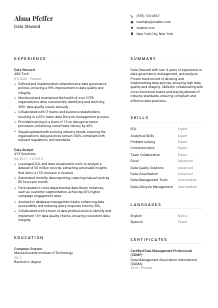
Guarding data realms, but your CV lacks that custodial touch? Check out this Data Steward CV example, built with Wozber free CV builder. Learn how to link your data governance expertise with job needs, keeping your career journey as pristine as your datasets!
Data Steward hiring usually turns on one practical question fast: can you keep business-critical data accurate, governed, and usable across teams? A CV for this work needs to show more than general data experience. It should make your governance work visible through policy ownership, data quality monitoring, issue resolution, and the way you work with IT and business stakeholders to improve data lifecycle practices.
When that detail is missing, your background can blur into data analyst or general data management work. Wozber's free CV builder helps you shape a cleaner, ATS-friendly CV by matching your wording to the posting's data governance language and surfacing terms like data quality, stewardship, SQL, and lifecycle management in the right sections. That makes it easier for reviewers to see where you've owned data standards and improved data health, not just reported on it.
This section is brief, but it still does real screening work. For a Data Steward opening, it should immediately confirm who you are, where you're based when location matters, and how to reach you without forcing the reader to hunt for basics.
Put your name at the top in the most visible text on the page, then follow it with a concise professional title. For this kind of role, using "Data Steward" directly helps frame the rest of the CV around governance, data quality, and stewardship work instead of broader analytics or operations experience.
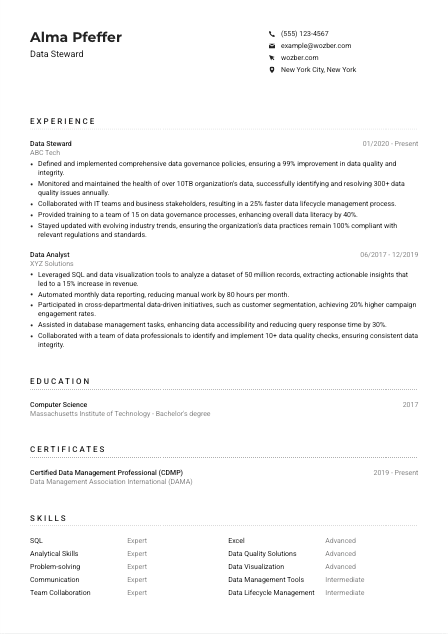
If you already work in stewardship, governance, or closely related data management roles, place "Data Steward" under your name. It aligns your CV with the posting right away. In the example, that direct title match supports the experience section, which already includes governance policy work and data quality oversight.
Include a reliable phone number and a professional email address in a simple format. If a hiring team wants to move quickly after seeing relevant SQL, governance, or data quality experience, your contact details should never slow that down.
Some Data Steward roles are flexible, but this posting specifically requires New York City, New York. In that case, list your city and state clearly in Personal Details. This is a tailoring move tied to the job ad, not a universal rule for every Data Steward CV.
Include LinkedIn or a personal site if it supports your candidacy with consistent job history, governance projects, dashboard work, or data management credentials. Skip any link that is outdated or unrelated. Every item here should reinforce your data stewardship profile, not dilute it.
A clean Personal Details section removes friction and confirms key requirements early, including location when the posting asks for it. That lets the rest of the CV stay focused on your governance and data quality work.




For Data Steward roles, experience is where hiring teams look for substance. They want to see how you handled data quality issues, shaped governance practices, supported compliance, and worked across departments to keep data reliable enough for reporting, operations, and decision-making.
Read the posting and mark the responsibilities that define the role. Here, that includes implementing governance policies, maintaining data health, resolving quality issues, collaborating across functions, and training others on stewardship processes. Then mirror those themes with your own work. The example does this well by echoing the posting's language around defining governance policies and improving data integrity.
List roles in reverse chronological order with job title, employer, and dates. That straightforward structure matters in ATS parsing and also helps hiring teams track how your data work evolved, whether you moved from analysis into stewardship, or from reporting support into governance ownership.
Your bullets should show the work, the scope, and the result. For Data Steward positions, that often means policy creation, data quality monitoring, exception handling, lifecycle improvements, metadata or governance process support, and stakeholder training. In the sample CV, "Monitored and maintained the health of over 10TB organisation's data" is strong because it ties stewardship responsibility to real operational scale.
Metrics carry weight when they reflect how data teams are measured. Use volumes of data, number of issues resolved, reduction in process time, compliance rates, improvement in quality scores, or training reach. Examples like resolving 300+ data quality issues annually or speeding lifecycle management by 25% tell a hiring manager what changed because of your work.
Data-adjacent experience can still help, but frame it through stewardship value. If you previously worked as a Data Analyst, emphasize data quality checks, database management, reporting accuracy, governance support, or cross-functional initiatives rather than only business insight generation. That is exactly how the sample's earlier analyst role stays relevant to a Data Steward opening.
A strong Experience section makes your stewardship work easy to trace through actions, tools, and outcomes. By the end of it, a reviewer should be able to see the data environments you supported, the problems you solved, and the standards you helped maintain.
Education usually will not outweigh your governance experience, but it still matters for Data Steward roles because employers often want a formal foundation in systems, databases, or information management. Present it clearly so the requirement is easy to confirm.
This posting asks for a bachelor's degree in Computer Science, Information Systems, or a related field. If you have that match, state it plainly. The sample CV benefits from listing a Bachelor's degree in Computer Science, which lines up cleanly with the employer's requirement.
Use a straightforward order: degree, field of study, school, and graduation year or date. Avoid over-formatting. In data-focused hiring, this section is usually checked quickly for baseline qualifications, so clarity beats extra detail.
If your degree is in Computer Science, Information Systems, Data Management, or another related discipline, do not bury that field name. Put it in standard wording so both ATS filters and human readers can recognize the match immediately.
Most experienced Data Stewards do not need a course list. Add coursework only if it helps explain relevant background in databases, information governance, data architecture, or analytics, especially if you are earlier in your career or changing into stewardship from another path.
If you have limited work experience, you can mention a capstone, research project, or academic work tied to data quality, database design, governance frameworks, or information systems. For more experienced candidates, professional accomplishments usually carry more weight than campus activities.
Your Education section should quickly confirm that you meet the academic baseline and have studied material relevant to structured data work. Then the rest of the CV can do the heavier lifting around governance results and stewardship scope.
Certifications are not always required for Data Steward roles, but the right one can strengthen your profile, especially when it connects directly to governance standards, data management practices, or quality control.
This job description does not require a certification, so treat certificates as supporting proof rather than the centre of the application. Use them to reinforce your knowledge of governance frameworks, compliance standards, or data management disciplines.
Choose credentials that relate to data governance, master data, data quality, privacy, information management, or metadata practices. The sample CV includes the Certified Data Management Professional, which is a strong fit because it supports the candidate's governance and stewardship positioning.
List the issue date and, if relevant, renewal period or active status. That helps hiring teams see whether your credential is current, especially in areas connected to evolving governance standards and regulatory expectations.
Data stewardship changes with tooling, compliance expectations, and governance maturity. If you recently completed training in data quality tools, governance frameworks, or data privacy topics, include it to show that your knowledge is active rather than dated.
Relevant certificates strengthen a Data Steward CV when they connect to the work you already show in experience. They are most effective when they reinforce governance knowledge, data quality discipline, and continued professional development.
The Skills section should read like the toolkit of someone who can maintain trusted data, work through quality issues, and collaborate with technical and business teams. For Data Steward roles, that usually means a mix of data tools, governance knowledge, analysis, and communication.
Start with the job description and extract the capabilities it names directly. Here that includes SQL, Excel, data management tools, data quality solutions, analytical thinking, problem-solving, communication, and collaboration. Those terms should appear naturally on your CV if they reflect your real background.
Lead with skills that speak to stewardship work before broader or secondary tools. For this opening, SQL, Excel, data quality solutions, data lifecycle management, and cross-functional collaboration matter more than a long list of general software. The sample CV handles this well by combining technical tools with governance-adjacent strengths like communication and team collaboration.
Do not overload the section with every platform or soft skill you have touched. A shorter, sharper list is stronger, especially when the same skills also show up in your bullets. If you claim SQL, data quality, and lifecycle management here, your experience section should show where you used them to improve data accuracy or process reliability.
The best skills list for a Data Steward role feels consistent with the work history above it. It should point clearly toward governance execution, data quality control, and cross-functional data ownership.
Data Steward work often involves explaining data standards, resolving quality issues with business teams, and documenting governance practices clearly. If a posting names a language requirement, treat it as a practical qualification, not a minor detail.
This posting specifically asks for strong English communication, so English should appear first in your Languages section with an accurate proficiency level. That makes it easy to confirm that you can handle training, documentation, and stakeholder conversations in the language the role requires.
List the language most relevant to the role first, then any additional languages after it. For this CV, English belongs at the top because it is explicitly required by the employer.
Additional languages can be valuable when you support diverse stakeholder groups, global data operations, or multilingual documentation. They are a helpful addition, but they should not crowd out the core stewardship qualifications on the page.
Use clear labels such as Native, Fluent, Intermediate, or Basic. Data Steward roles involve training, issue escalation, and policy communication, so language claims should be realistic enough to support those responsibilities.
If another language has helped you work with regional teams, support cross-border data processes, or improve communication on data definitions and quality standards, keep it. In the sample, Spanish adds breadth, but English remains the primary requirement to satisfy for this specific opening.
For this role, the important point is clear communication in English across governance and data quality work. Extra languages are a bonus when they support collaboration, but the required language should be impossible to miss.
Your summary should quickly position you as someone who can govern data, improve quality, and work across teams to keep information usable and compliant. For this role, a vague data CV summary is rarely enough.
Start from the real shape of the job. A Data Steward summary should mention governance, data quality, integrity, lifecycle management, or stewardship operations if those are central to your background. That helps distinguish you from candidates whose experience is mainly reporting or analytics.
Open with your title or closest equivalent and your years of experience. Then narrow the focus to the work that matters here, such as data governance, data management, quality control, or cross-functional stewardship. The sample summary does this effectively by naming both years of experience and governance-oriented strengths.
Use the summary to highlight what you repeatedly deliver. That might be implementing governance policies, improving data integrity, resolving quality issues at scale, supporting compliance, or training teams on stewardship processes. If you include a metric, choose one that reflects data work naturally rather than forcing numbers into every line.
Aim for a short paragraph that can be read in seconds. Three to five lines is usually enough. Every phrase should earn its place by clarifying your stewardship scope, your tools, or the business value of cleaner, more governed data.
A focused summary gives hiring teams an immediate read on your governance experience and data quality ownership. It should leave little doubt that your CV belongs in the Data Steward pile, not a broader data catch-all stack.
A Data Steward CV works when it makes governance work concrete. Policies you defined, data quality issues you resolved, teams you trained, and processes you improved should all be visible in language that matches the posting naturally.
Use Wozber's free CV builder to shape that content into an ATS-compliant CV, refine role-specific phrasing with AI support, and present it in an ATS-friendly CV format that keeps your stewardship experience easy to read. The final result should make one thing clear fast: you can be trusted with the quality, integrity, and governance of critical data.




