



Use Wozber and land your dream job
Create CV
No registration required
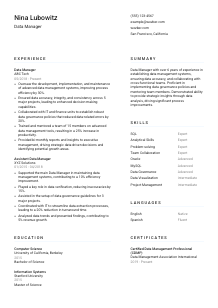
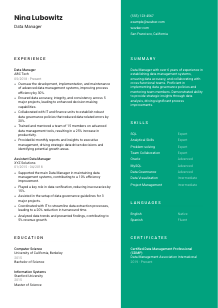
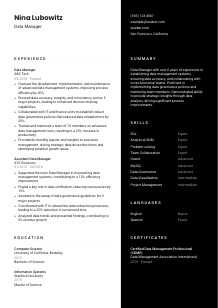
Managing vast datasets, but your CV feels cluttered? Check out this Data Manager CV example, created with Wozber free CV builder. It shows how to align your data oversight prowess with job nuances, making sure your career trajectory stays on a streamlined path!
Data management work gets judged in the details. Hiring teams look for people who can keep records accurate across systems, build durable governance practices, and turn messy source data into reporting leaders can trust. Your CV should make that operational control visible, not just say that you are analytical or organised.
When a CV is tailored well, it quickly separates data governance leadership from general analyst or database support experience. Using Wozber's free CV builder to shape an ATS-compliant CV helps you mirror the language of data quality, SQL, governance, reporting, and cross-functional ownership so reviewers can immediately see where you have managed standards, systems, and decision-ready insights.
For a Data Manager, the top of the CV should read like clean metadata. Hiring teams want direct contact details, a role title that matches the target position, and any location requirement handled without friction.
Use your full name as the most visible text on the page, in a clean professional format. It should be easy to find at a glance, just like a well-labeled field in a reliable data system.
Place "Data Manager" directly under your name when that matches the role you are pursuing. This keeps your positioning clear and helps align your CV with the title used in the posting and by the ATS.
Recruiters should be able to reach you without hunting for information or second-guessing whether it is current. Keep this section simple and accurate.
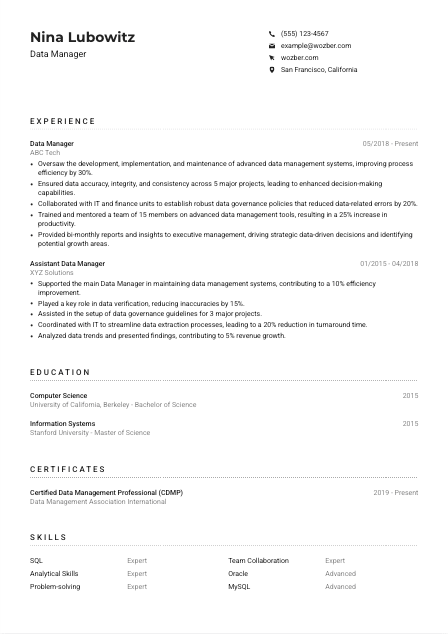
If a posting specifies a city, show that you meet it when you do. In the example, listing "San Francisco, California" instantly addresses the employer's stated location requirement and removes a common screening question.
Include LinkedIn or a professional website if it supports your candidacy with matching titles, dates, and project scope. For Data Managers, this can reinforce your work across governance, reporting, database environments, or team leadership.
This section should answer the basics in seconds. Clear identity, accurate contact details, and any location match let the reader move straight to your data management experience.




This is the section that carries the most weight for a Data Manager. Employers want to see how you improved data quality, maintained systems, partnered with business teams, and translated trends or anomalies into actions leaders could use.
Before writing bullets, mark the responsibilities that define the role. For this opening, that includes maintaining data management systems, preserving accuracy across sources, building governance policies, mentoring others, and reporting findings to senior management. Those are the themes your experience section should answer clearly.
Start with your current or most recent position and work backward. Include job title, employer, and dates in a consistent format so both people and ATS systems can follow the progression from hands-on data work into broader ownership or leadership.
Focus each bullet on a concrete contribution tied to data operations. Strong Data Manager bullets usually show the system or process you managed, the business function you supported, and the result. The example does this well with lines about improving process efficiency by 30%, reducing governance-related errors, and supporting five major projects.
Numbers matter here because data management is measured through accuracy, consistency, turnaround time, reporting cadence, productivity, and adoption of standards. Metrics such as reduced data errors by 20%, faster extraction turnaround, or training 15 team members tell a hiring team how large your impact was and where you operated effectively.
Keep the emphasis on governance, database work, process maintenance, quality control, stakeholder collaboration, and reporting. If an older bullet does not help explain your readiness to oversee data systems or standards, trim it. Space is better used on work that shows ownership of data integrity and operational decision support.
A Data Manager CV should show control over systems, standards, and outcomes. When your bullets connect technical work to cleaner data and better reporting, the role becomes much easier to picture.
Education matters in data management because it establishes your technical base for working with databases, information systems, governance frameworks, and reporting logic. Keep this section straightforward and aligned with the level of education requested in the posting.
If the role asks for a bachelor's degree in Computer Science, Information Systems, or a related field, make sure that qualification is easy to spot. Put the most relevant degree information in plain view so there is no ambiguity during screening.
List school, degree, field of study, and graduation year or date in a consistent order. If you hold more than one degree, many candidates place the highest or most advanced credential first, as long as the required bachelor's degree remains obvious.
Use the formal degree and field names from your academic record. In the example, "Bachelor of Science" in Computer Science and "Master of Science" in Information Systems both support the technical and systems-oriented side of data management work.
Most experienced Data Managers do not need a course list unless it adds something missing from the degree title. If you are earlier in your career, coursework in database systems, data modeling, information governance, or analytics can strengthen the section.
Honors, scholarships, or major academic projects are worth listing when they reinforce your qualifications, especially if you are light on experience. For senior candidates, this section usually works best when it stays brief and relevant.
Your education should quickly confirm the technical foundation behind your database, governance, and reporting work. Once that is established, let your experience carry the deeper story.
Certifications can add real weight in data management, especially when they reinforce governance discipline, stewardship standards, or platform expertise. They are particularly useful when an employer mentions a preferred credential.
Start with certifications the employer already values. Here, the preferred credential is the Certified Data Management Professional, so listing CDMP prominently makes your alignment immediate and concrete.
Do not crowd this section with every course completion badge you have earned. Prioritise certifications tied to data governance, database administration, data quality, or information management practices that support the role's core work.
Certification dates help show whether your knowledge is current or actively maintained. The example's "2019 - Present" format works well for an active credential because it signals ongoing standing in the field.
Data environments change as governance requirements, reporting needs, and platform stacks mature. Keeping certifications current shows continued investment in the discipline, especially if your target roles are moving toward broader data stewardship or enterprise governance responsibility.
When this section is relevant, it should reinforce your command of data management practices rather than just add extra lines. One strong certification tied to governance can say a lot.
The skills section should mirror the mix of technical capability and operational judgment the role requires. For a Data Manager, that usually means database fluency, governance knowledge, analytical strength, and the ability to work across business and IT teams.
Scan the posting for both named and implied skills. Here, that means SQL, experience with a major database management system such as Oracle, SQL Server, or MySQL, analytical and problem-solving ability, data governance, and communication strong enough to support reporting and mentoring. Those are the skills worth surfacing for ATS optimisation and human review.
List the tools and technical areas first, then the strengths that support execution. A useful mix might include SQL, Oracle, MySQL, data governance, data visualization, analytical skills, problem-solving, and team collaboration. The example gets this balance right by combining database expertise with the interpersonal strengths needed to train others and work cross-functionally.
Choose skills you can support elsewhere in the CV through experience, projects, or certifications. A shorter list tied closely to the role is more credible than a long inventory of disconnected tools. For Data Managers, precision matters more than breadth for its own sake.
This section should make it easy to see your command of data systems, governance practice, and analytical judgment. Every listed skill should connect back to work you have actually done.
Language ability is usually a supporting section for Data Managers, but it still matters when the job posting names a required language. Since the role includes reporting to leadership and collaboration across teams, clear communication carries practical weight.
If the posting requires fluency in English, list English first and show your proficiency level clearly. This is a direct requirement, so it should not be buried after optional languages.
Ordering matters. Lead with the language tied to the role's communication needs, then add any others that may help in cross-functional or international environments.
Additional languages can be useful if your work involves distributed teams, regional data operations, or stakeholder groups across markets. In the example, Spanish adds context for broader communication ability, though it is a bonus rather than a core requirement here.
Choose clear levels such as Native, Fluent, Advanced, or Conversational, and be prepared to work at that level. Inflated language ratings create problems quickly in interview settings or on the job.
For most Data Manager positions, languages should support the CV rather than dominate it. Include them when relevant, but keep the emphasis where it belongs: data quality, governance, reporting, and system oversight.
This section does its job when it confirms communication ability without distracting from your technical and governance experience. Keep it accurate and concise.
The summary should quickly establish your level, your core area of ownership, and the business value of your work. For Data Managers, that usually means combining system oversight, data quality discipline, governance practice, and reporting impact in a few focused lines.
Pull together the major themes of the position before you write. In this case, the employer wants someone who can manage data systems, maintain integrity across sources, collaborate on governance, mentor team members, and report insights upward. Your summary should echo that scope in your own words.
Lead with your title and years of experience, such as "Data Manager with over 6 years of experience." That immediately tells the reader whether you meet the expected level for a role asking for 5+ years in data management or governance work.
Choose strengths that match the posting and that you can prove in the experience section. Good choices here include building data management systems, ensuring data accuracy, shaping governance policies, or delivering strategic reporting. The example summary works because it stays anchored in those exact areas instead of drifting into generic leadership language.
Aim for a compact paragraph of about 3 to 5 lines. A Data Manager summary should read like a concise brief to senior stakeholders: clear scope, clear expertise, clear value.
A well-written summary should make the reader expect strong governance, reliable reporting, and steady control over data operations. That is the standard the rest of your CV should then confirm.
Once each section reflects the actual demands of data management, your CV starts reading like a record of controlled systems, trusted data, and useful reporting rather than a generic analytics profile.
Use Wozber's free CV builder and ATS CV scanner to tighten keywords, surface missing requirements, and present your experience in an ATS-friendly CV format that keeps governance, SQL, and data quality work easy to find.
The finished CV should make one thing clear fast: you can manage the data environment, not just work inside it.




