



Use Wozber and land your dream job
Create CV
No registration required
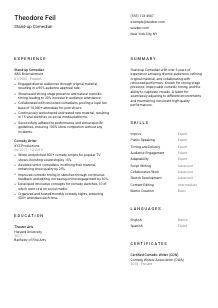
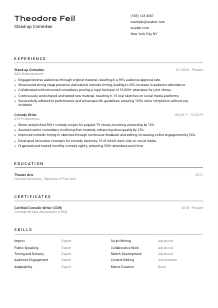
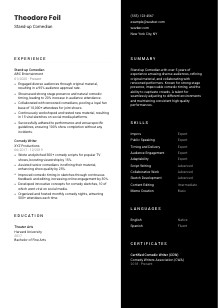
Cracking jokes, but your CV falls flat? Check out this Stand-up Comedian CV example, created with Wozber free CV builder. It shows how to weave comedic genius into a professional outline, setting the stage for a career that leaves them roaring with laughter!
Stand-up hiring moves fast, and the CV has to answer one question quickly: can you hold a room with original material and adjust when the crowd, venue, or energy shifts. For comedians, a credible CV does not read like a generic performance profile. It needs to show where you have performed, how you connect with audiences, and whether you keep developing material instead of leaning on the same ten minutes.
A tailored CV changes how your background is sorted in the first pass, especially when a club, producer, or event team is screening for stage experience, audience work, and practical details like language fluency or location. Wozber's free CV builder helps shape that experience into an ATS-compliant CV, so your credits, performance outcomes, and collaboration work are easy to scan and easy to connect to the booking brief.
For a stand-up comedian, the header does more than identify you. It tells a venue, producer, or talent coordinator whether you are immediately reachable, professionally presented, and available for the kind of work being booked.
Your name should be the most visible element at the top of the page, in a clean font that is easy to spot on a quick skim. If you perform under a stage name, use the name you are booked under consistently across your CV, website, clips, and social profiles so there is no confusion when someone cross-checks your credits.
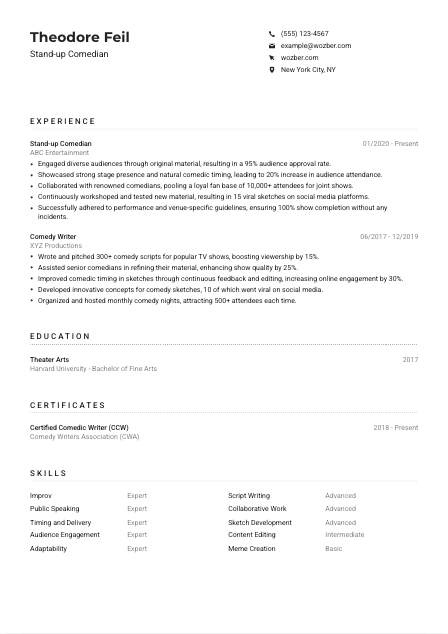
Place "Stand-up Comedian" directly under your name. That keeps your positioning clear, especially if your background also includes comedy writing, hosting, acting, or sketch work. In the example CV, the job title matches the target role exactly, which helps the reader connect the document to the booking need right away.
Use the number where you actually take professional calls or messages. Comedy bookings can move quickly, especially for fill-ins, showcases, and event lineups, so accuracy matters. One wrong digit can cost you an audition slot, a guest set, or a last-minute booking.
Use a straightforward email address based on your name, not a joke handle or old personal username. Agents, venue managers, and event producers may be forwarding your details internally, so a clean email makes you easier to contact and easier to take seriously.
If a posting asks for a specific city, show it clearly in your header. Here, New York City, NY matters because the job description states it outright. You do not need a full street address, but city and state help confirm local availability and reduce questions about travel or relocation.
Your personal details should settle the practical questions fast: who you are, what kind of comedy role you are pursuing, how to reach you, and whether you meet any location requirement. Wozber's ATS-friendly CV template keeps that information clean and easy to parse.




This section carries the most weight for stand-up roles because live performance history is where your professionalism becomes concrete. Clubs and producers want to see that you have written material, tested it in front of real audiences, adapted on stage, and contributed to successful shows.
Before rewriting your bullets, identify the experiences the employer is actually asking for. In this case, that includes 3+ years of professional stand-up, original material, audience engagement, improvisation, collaboration, and continued workshop of new jokes. Your experience section should mirror those priorities with real gigs, recurring performances, writing credits, and measurable audience response where you have it.
List your roles in reverse chronological order, but give the strongest stand-up work the most space. If you also have adjacent experience in writing rooms, hosting, improv, or sketch production, keep it, but frame it in terms that support your stand-up profile. The sample CV does this well by leading with a current stand-up role and then using earlier comedy writing experience to reinforce material development and collaboration.
Generic lines like "performed comedy sets" do not tell much. Show what happened. Audience approval scores, attendance growth, repeat bookings, sold-out rooms, social traction from bits, or positive producer feedback all make your stage work easier to understand. "Engaged diverse audiences through original material, resulting in a 95% audience approval rate" works because it ties performance style to a clear outcome.
Stand-up can look solo from the audience, but plenty of comedy work is collaborative behind the scenes. Mention writers' rooms, co-produced shows, festival lineups, recurring group showcases, or work with other comedians if it shaped the quality or reach of your performances. The example's reference to collaborating with established comedians helps show credibility and shared audience growth, not just name-dropping.
One of the clearest markers of a working comedian is active development. Include bullets about testing new sets, refining jokes through crowd feedback, building new themed shows, or turning stage material into digital clips that gained traction. In the sample, workshoped material leading to viral sketches shows ongoing creative output, which is exactly the kind of freshness many comedy employers value.
Your experience section should show more than time spent on stage. It should make clear that you write, refine, perform, adjust in the moment, and deliver shows that land with real audiences. Wozber's ATS CV scanner can help you line up those bullets with the language used in the posting so the strongest parts of your comedy work are not missed.
Formal education is rarely the deciding factor in stand-up, but it can strengthen your profile when it connects to performance, writing, theater, or communication. Used well, this section adds context for your craft rather than filling space.
If you have a college degree, include the school, degree, field of study, and graduation year or date. Even when a booking does not require formal education, training in theater arts, writing, performance, media, or communications can reinforce the technical side of your stage work. The example's BFA in Theater Arts supports live performance credibility without overstating its importance.
Degrees and coursework matter most when they connect to how comedians actually work. Theater can support stage presence. Creative writing can support joke structure and storytelling. Public speaking and improv training can support delivery and crowd interaction. If your academic background is relevant, let that link be obvious.
You do not need to turn the education section into a transcript. Include selected coursework if it adds something your experience section does not fully show, such as improvisation, scriptwriting, performance studies, or media production. This is especially useful earlier in your career, when formal training helps round out lighter stage credits.
College comedy troupes, improv groups, open mic series, student productions, or hosting roles can be worth naming if they involved regular public performance, writing original material, or producing events. These experiences show repetition and audience exposure, which matter more than club names alone when you are building early credibility.
Stand-up is built on repetition and revision, so recent workshops, improv classes, and writing labs can support your CV, especially if they sharpen a specific skill like crowd work or joke writing. If these are not formal enough for the education section, you can reference them in certificates, skills, or the summary instead.
Keep education in proportion. It should support your performance story with relevant training, not compete with your live credits. In an ATS-friendly CV format, a concise education section adds context without slowing down the reader's path to your stage experience.
Certificates are optional for most stand-up roles, but they can help when they reflect writing discipline, improv training, production knowledge, or other skills that improve your work on stage and in collaborative comedy settings.
Lead with credentials that support the actual work of a comedian, such as comedic writing, improv, performance coaching, voice work, or event safety training if it is relevant to your gigs. The example's "Certified Comedic Writer (CCW)" adds value because it connects directly to original material development.
A short, focused list is better than a long list of loosely related courses. Choose certificates that strengthen the case you are already making in experience and skills. If a credential helps explain your material development, your collaborative work, or your ability to perform in different settings, it belongs here.
Dates show whether the credential is current, recently earned, or maintained over time. That matters more when the certificate reflects an active discipline, such as writing, teaching, coaching, or regulated venue work. Clear dates also help the reader place the training alongside your performance timeline.
If you add new training in improv, writing, hosting, podcast production, or audience work, update the section so it reflects where your craft is heading now. Comedy careers often expand across live shows, digital content, and collaborative formats, and your certifications can help show that range when they are relevant.
Certificates should add useful depth, not decoration. Pick the ones that support your act, your writing process, or your ability to work professionally in live performance settings. With Wozber's ATS optimisation, those credentials stay easy to read and easy to match to the posting.
For stand-up comedians, the skills section works best when it reflects how the job is actually done: writing material, reading the room, controlling pace, handling interruptions, and adjusting delivery without losing the set. Keep it specific to performance and comedy work.
Use the posting as a guide to which abilities belong near the top. Here, improvisation, stage presence, comedic timing, audience engagement, adaptability, and original material development are all central. If those are real strengths, include them using clear wording that matches the employer's language naturally.
Focus on the abilities that help someone picture you on stage or in a comedy production workflow. Strong options include crowd work, set writing, joke editing, hosting, room reading, timing and delivery, collaboration, script writing, and live performance stamina. The sample skills list works because it stays close to what a stand-up comedian actually uses in performance and preparation.
Put the most important stand-up skills first, then follow with adjacent strengths such as sketch development, writing room collaboration, or content editing. If you use proficiency labels, keep them honest and consistent. A focused skill list helps both human readers and ATS systems identify whether your background matches the demands of the stage, the venue, and the format of the work.
Your skills should reinforce the same picture your experience section creates: a comedian who can write, perform, adapt, and collaborate. In Wozber, that section is easy to tune for ATS alignment without turning it into a pile of disconnected keywords.
Language matters in comedy because delivery, nuance, timing, and crowd interaction all depend on it. If a role specifies fluency, list that clearly. If you speak more than one language, include it when it meaningfully expands the audiences or venues you can work with.
If the posting names a language requirement, list it at the top of this section. For this role, English fluency is mandatory, so it should be impossible to miss. The example CV handles this well by placing English first and marking it at a native level.
Additional languages can strengthen your appeal for multicultural venues, bilingual events, touring, or audience interaction across different communities. They are especially useful when your comedy includes crowd work, hosting, or performance in diverse markets. Spanish in the sample is a good illustration of a secondary language that could expand audience reach without being a core requirement.
Be precise with terms like "Native," "Fluent," "Conversational," or "Basic." In comedy, overstating language ability can create real problems if you are expected to host, improvise, or respond to an audience in that language. Honest labels protect your credibility.
If another language has shaped your act, audience base, or hosting work, that can be worth signaling elsewhere in your CV too. The value is not just translation. It is the ability to read cultural cues, adjust references, and connect with different rooms more naturally.
Only include languages you would be comfortable using in a professional setting, whether on stage, backstage, or in promotion. A short, believable list does more for you than a long list of half-learned languages.
This section should quickly confirm whether you can perform, host, and communicate in the language the job requires, and whether you can connect with wider audiences beyond that baseline. That kind of specificity matters in comedy, where delivery and audience rapport are inseparable.
The summary is your quickest chance to frame your act in professional terms. For stand-up comedians, that usually means a short paragraph covering experience level, style of work, audience connection, and one or two strengths that match the booking need.
Start with a direct line that tells the reader who you are professionally. The sample summary does this well with "Stand-up Comedian with over 5 years of experience," then moves into audience and material strengths. That kind of opening works because it establishes level and context immediately.
Use the summary to surface the qualities a buyer of talent or hiring manager will look for first, such as original material, strong stage presence, natural timing, and improvisation. Keep the wording grounded in how you actually perform. If you are strongest in crowd work, polished storytelling, clean corporate sets, or high-energy club rooms, let that come through.
Three to five lines is usually enough. Avoid broad claims like "passionate performer" unless you back them with something more concrete. A summary should quickly connect your experience to the kind of comedy work you are pursuing, not repeat vague praise about being entertaining.
Close by reinforcing what audiences, venues, or collaborators can expect from you. In this example, adaptability across environments is a useful final point because it ties directly to live performance reality. A good closing line leaves the reader with a clear sense of how you work, not just what you call yourself.
Your summary should give a fast, accurate read on your level, your style of performance, and the strengths that matter for the booking. Use Wozber's free CV builder to shape that paragraph into clear, ATS-optimised language that still sounds like a working comedian, not a template.
A stand-up comedian CV works when it shows professional stage time, original material, audience connection, and the ability to adapt in live settings. Every section should support that picture, from the location details a venue may need to the bullets that show crowd response, collaboration, and ongoing material development.
Use Wozber to organise those details in an ATS-friendly CV template, strengthen your wording with targeted tailoring, and check alignment with the posting through ATS CV scanner tools. The finished CV should make one thing easy to judge: you are ready to step on stage and deliver.