



Use Wozber and land your dream job
Create CV
No registration required
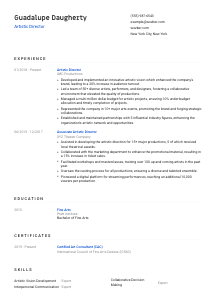
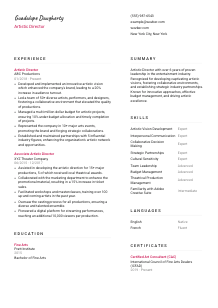
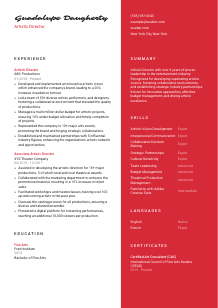
Orchestrating creativity, but your CV seems off-key? Embrace this Artistic Director CV example, created with Wozber free CV builder. It shows how easily you can harmonize your visionary leadership with job demands, ensuring your career takes centre stage in the most artistic way possible!
An Artistic Director is expected to do more than generate ideas. The work usually involves setting a clear creative direction, protecting artistic quality across productions or events, and leading artists, performers, and designers through the practical realities of deadlines, budgets, and public expectations. Your CV needs to show that your vision translates into finished work people attend, fund, and remember.
Hiring teams often have to distinguish between candidates with strong artistic backgrounds and candidates who can actually run a creative program. A tailored CV clarifies that difference fast by connecting your artistic leadership to outcomes such as audience growth, production quality, team direction, and resource control. Wozber's free CV builder helps shape that story into an ATS-compliant CV, so the first scan already shows where you have led the work, not just contributed to it.
This section is simple, but it still needs to support the hiring process. For an Artistic Director, the basics should make you easy to contact, easy to place, and easy to recognize as a candidate for senior creative leadership. Keep it clean, professional, and aligned with the role you want.
Your name should be the clearest element on the page. Use a professional font and slightly larger size so it anchors the CV without looking decorative. Artistic leadership is judged through your programming, productions, and results, not through stylized formatting.
Add "Artistic Director" below your name when that is the role you are pursuing. This creates immediate alignment with the posting and helps ATS systems connect your CV to the target position. If your recent title was Associate Artistic Director but you are stepping up, the rest of the CV needs to support that progression.
Include a reliable phone number and a professional email address. If you also maintain a website with production history, directing portfolio, press coverage, or season work, include it only if it is polished and relevant. For this kind of role, a strong digital presence can reinforce your public-facing and curatorial credibility.
If a role requires you to be in a specific market, include your city and state. In the example posting, New York City, New York matters because the employer wants someone already based there or ready to relocate. That kind of detail helps remove an avoidable question early.
A portfolio link is useful when it shows more than visuals. Include productions, event programs, media mentions, artistic statements, or collaborations that reflect the scope of your direction. For an Artistic Director, employers often want to see the taste level and leadership context behind the finished work.
This section should give the employer exactly what they need to contact you and place you in the right candidate pool. Clear details, the right title, and a relevant portfolio link are enough to support the rest of the CV.




This is the section that carries the most weight for an Artistic Director. Hiring teams want to see what kind of creative agenda you have led, what teams you have managed, and whether your artistic choices translated into stronger productions, audience response, partnerships, or financial discipline.
Before writing or editing bullets, identify the priorities in the posting. For this role, those include artistic vision, team leadership, collaboration with stakeholders, budget oversight, and public representation. Your experience section should mirror those themes using your own real work, not generic creative-language filler.
List your positions in reverse chronological order, starting with the job closest to the target scope. For senior arts leadership roles, recent work usually tells the employer the most about your current level of authority, whether that means season planning, production oversight, casting influence, or management of designers and performers.
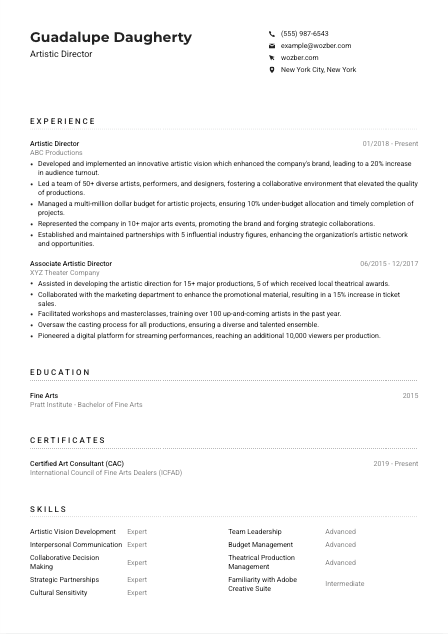
Each bullet should show what you directed, who or what you led, and what changed because of your work. Strong Artistic Director bullets often cover season or production vision, artist management, rehearsal or production collaboration, donor or media visibility, and operational outcomes. In the sample CV, "Developed and implemented an innovative artistic vision" works because it is followed by a business result, a 20% increase in audience turnout.
Quantification matters here because Artistic Directors are trusted with both creative quality and organizational resources. Useful metrics include audience growth, ticket sales, number of productions, team size, budget size, partnership count, media appearances, workshop reach, or delivery against schedule. The example's multi-million dollar budget, 50+ person team, and 10+ arts events make the level of responsibility easy to understand.
Choose achievements that show leadership rather than task assistance. If you include earlier roles, frame them around decisions you influenced, initiatives you launched, or productions you helped shape in visible ways. The sample's Associate Artistic Director role works because it shows awards, artist training, casting oversight, and a digital streaming initiative, all of which point toward larger creative leadership.
A strong experience section should make it easy to picture you running productions, guiding teams, and representing the organisation publicly. When your bullets connect artistic choices to audience, budget, and team outcomes, the CV starts reading at Artistic Director level.
Education is usually not the deciding factor for an Artistic Director, but it still matters when the posting asks for a degree in Fine Arts, Performing Arts, or a related field. Present it clearly and let it confirm the formal foundation behind your artistic practice and leadership.
If the posting calls for a bachelor's degree in Fine Arts, Performing Arts, or a related discipline, make sure that information is easy to find. A Bachelor of Fine Arts, like the one in the example, answers that requirement immediately and keeps the employer from searching for basic qualification details.
List your degree, field of study, school, and graduation year in a straightforward order. This section does not need design flourishes. Clarity matters more than style, especially when ATS parsing is involved and the employer is checking for a required academic background.
Include your concentration or field if it adds useful context. Fine Arts, Performing Arts, Theater, Stage Design, Directing, or Arts Administration can all help position your background more precisely, depending on the kind of organisation and productions you are targeting.
If you are earlier in your career, selected coursework, honors, or major productions can help fill in your profile. For senior candidates, keep this brief unless the training is unusually relevant, such as specialised directing study, curatorial research, or cross-disciplinary arts programming.
Professional development can belong here or in certifications if it shows current growth in areas such as artistic programming, inclusive leadership, cultural management, digital production, or fundraising for the arts. That is especially useful when your recent learning supports the demands of a modern artistic leadership role.
This section should confirm that you meet the academic requirement and support the kind of artistic work you lead. Once that is clear, let your experience carry the heavier argument.
Certifications are rarely the core deciding factor for Artistic Director hiring, but they can still strengthen your profile when they reflect current expertise, arts-sector credibility, or specialised leadership knowledge. Include them selectively and tie them to the kind of work you want to lead.
Choose certificates that relate to artistic practice, arts management, curatorial work, cultural leadership, production tools, or adjacent business skills such as fundraising or nonprofit governance. The sample's Certified Art Consultant credential is useful because it adds professional depth rather than generic training.
Do not turn this section into a full archive. An Artistic Director CV benefits more from two relevant credentials than from a long list of loosely connected courses. Keep the focus on certifications that strengthen your credibility with boards, producers, creative teams, or arts organizations.
If a credential is active, recently completed, or tied to current practices, show the date. That helps employers understand whether the training reflects your present capabilities, especially when it relates to digital production, software familiarity, or contemporary leadership standards in the arts.
The arts sector keeps changing through new production models, audience channels, accessibility expectations, and technology. Continuing education in those areas shows that you are not leading from an outdated playbook. It also gives you fresh material to connect with future job descriptions.
Certifications work best when they add specificity to your profile, not when they try to replace core experience. Choose the ones that reinforce your authority, current knowledge, and relevance to the organisation you want to lead.
The skills section should reflect the blend of creative judgment, people leadership, and operational control that defines this work. Hiring teams look for someone who can shape a vision, guide a team through production realities, and communicate effectively with artists, executives, and external partners.
Start with the skills named or implied in the job description. Here, that includes artistic vision, leadership, communication, team management, and familiarity with production software or tools. Then match those areas to the capabilities you have actually used in rehearsal rooms, production planning, public programming, or cross-functional arts collaboration.
Lead with the capabilities that matter most for Artistic Director hiring. Artistic Vision Development, Team Leadership, Interpersonal Communication, Strategic Partnerships, Budget Management, and Production Management all speak directly to the responsibilities in the example posting. Save less central software knowledge for later in the section unless the employer emphasizes it heavily.
A compact list of relevant skills works better than an inflated catalogue. Include a balance of creative, leadership, and operational skills, then make sure your experience section proves them. In the sample CV, skills like Collaborative Decision Making and Cultural Sensitivity work because the experience already shows team leadership, public representation, and artist development.
This section should reinforce the same message found in your experience: you can set a creative direction, lead people well, and keep the work moving. If a skill cannot be backed up elsewhere on the page, reconsider whether it belongs here.
Language ability can matter more for Artistic Directors than for many other leadership roles because the work often involves artists, audiences, funders, media, and community partners with different backgrounds. Still, this section should stay factual and only highlight language strengths that are relevant to the work.
If the posting requires English, list it clearly with an accurate proficiency level. That matters for artistic statements, media interviews, donor conversations, rehearsal communication, and written materials. In the example, "Native" English directly addresses the requirement without overexplaining it.
Extra languages can be valuable when your work includes international artists, multicultural programming, touring, festivals, or community engagement. A language like French may be useful in certain performance, curatorial, or partnership contexts, but it should be presented as an added asset rather than a universal requirement.
Use clear labels such as Native, Fluent, Advanced, or Intermediate. Avoid vague terms. For leadership roles, overstating language ability can create problems quickly when the work involves press, negotiation, artist feedback, or public appearances.
Not every Artistic Director role needs multiple languages. Include them when they strengthen your profile for the organisation or audience you want to serve. In institutions with international programming or broad community outreach, language ability can support relationship-building and public trust.
For Artistic Directors, language skills can also point to cultural fluency and inclusiveness. When that is a meaningful part of your work, this section can quietly support a broader profile built around collaboration, artist care, and programming that reaches diverse audiences.
List the languages that matter, label them accurately, and let them support the kind of artistic community you are equipped to lead. For many roles, clear English communication remains the essential baseline.
The summary should capture your level, your artistic perspective, and the kind of results your leadership has produced. For an Artistic Director, this is where you connect creative authority with organizational impact in a few focused lines.
Read the posting closely before writing this section. The strongest summaries reflect the kind of artistic leadership the employer needs, whether that means production strategy, event programming, team development, stakeholder collaboration, or public representation. Your first line should immediately place you at the right level.
A direct opening works best here. State that you are an Artistic Director or senior creative leader, note your years of experience, and name the kind of work you lead. The example summary does this well by combining tenure in the entertainment industry with artistic vision and leadership.
Choose strengths that connect clearly to the employer's priorities. For this role, that could include developing artistic strategy, managing multidisciplinary teams, overseeing budgets, building partnerships, or representing the organisation publicly. If you mention outcomes, keep them believable and tied to your experience elsewhere on the page.
Aim for three to four lines with concrete language. Avoid broad claims about passion or creativity unless you also show how that translated into stronger productions, audience engagement, or operational success. A concise summary gives the employer a fast read on your level before they move into the details.
Your summary should quickly establish that you are a creative leader who can shape programming, guide people, and deliver results. When it aligns closely with the role, the rest of the CV has a clear frame to build on.
An Artistic Director CV needs to show more than taste or creative participation. It should make your leadership visible through artistic strategy, production outcomes, team management, public representation, and control of resources.
Use Wozber's free CV builder to organise that experience into an ATS-friendly CV format, then refine it with the ATS CV scanner so the language lines up with the role you are targeting. The finished CV should make it easy to judge whether you can lead the organisation's artistic vision from concept to opening night.




