



Use Wozber and land your dream job
Create CV
No registration required
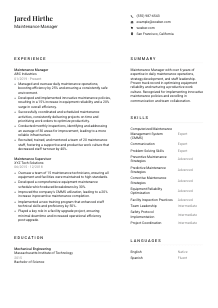
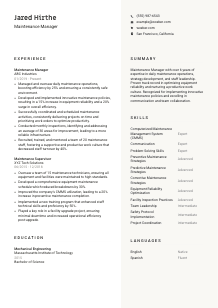
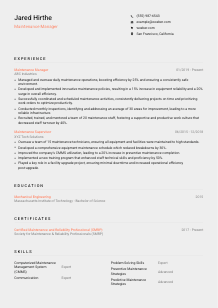
Keeping things running smoothly, but your CV seems a bit rusty? Check out this Maintenance Manager CV example, created with Wozber free CV builder. Learn how to showcase your maintenance mastery to match job demands, ensuring your career is as well-oiled as the machinery you oversee!
Maintenance management sits where equipment reliability, plant uptime, safety standards, and labour coordination meet. Hiring teams want to see how you keep operations moving when assets fail, schedules tighten, and preventive work competes with production demands. Your CV should make that operating judgment visible, showing how you lead maintenance programs, prioritise work orders, improve reliability, and manage technicians in a live environment.
Screening usually turns on whether your background reads like true maintenance leadership or a more limited technician or supervisor track. Wozber's free CV builder helps you shape an ATS-compliant CV that reflects the employer's language around CMMS, preventive maintenance, and team oversight, so your experience is recognized quickly for the management scope it represents.
Maintenance Manager CVs are often reviewed fast, especially when the employer needs someone who can step into an active operation with minimal delay. Your contact section should confirm role alignment, professional presence, and any location detail that affects scheduling or relocation decisions.
Place your full name at the top in a clean, readable format. This section does not need styling flourishes. It needs to look credible and easy to scan, the same way a well-run maintenance schedule is clear at a glance.
Add "Maintenance Manager" directly under your name if that is the role you are pursuing. This helps frame the rest of the document around maintenance leadership, not a narrower technician or facilities support profile.
Include a current phone number and a professional email address. If you use a website or LinkedIn profile, make sure it supports your maintenance background with details on plant operations, asset management, project work, or leadership history rather than a generic online presence.
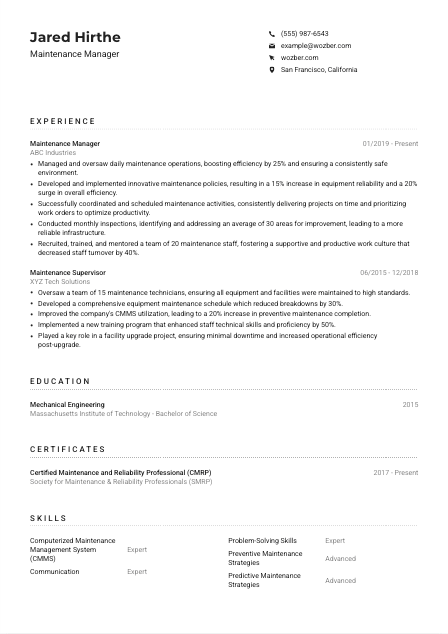
If a posting specifies location, include your city and state or make relocation clear. In the example, listing San Francisco, California directly supports a stated requirement and removes a common point of hesitation for employers filling site-based operations roles.
A portfolio is not mandatory for most Maintenance Manager roles, but a strong LinkedIn profile can reinforce your leadership path, certifications, facility scope, or CMMS and reliability work. Include it only when the information is current and relevant to maintenance operations.
This section should answer basic access questions immediately: who you are, what role you are targeting, and whether you are available where the operation needs you. Keep it lean and specific.




This is the section that carries the most weight for a Maintenance Manager. Employers are looking for proof that you can run maintenance operations, improve asset performance, lead technicians, and keep work moving without compromising safety, uptime, or production needs.
Start with the employer's actual needs, then choose experience bullets that speak to them directly. For this role, that means maintenance operations oversight, CMMS use, preventive and corrective planning, inspections, and team leadership. If you have broader plant or facilities experience, foreground the parts tied to reliability, scheduling, and staff management.
List your most recent maintenance role first so the reader sees your current scope right away. That matters in hiring because a recent Maintenance Manager or Maintenance Supervisor title usually tells more about your readiness than older technical work, especially when you are being considered for daily operational ownership.
Describe what changed because of your work. Good Maintenance Manager bullets show improvements in uptime, equipment reliability, preventive maintenance completion, response time, work order flow, safety performance, or labour effectiveness. The sample CV does this well with results like a 25% efficiency gain and a 15% reliability increase tied to specific management actions.
Numbers make maintenance leadership more concrete. Use metrics that belong naturally to the function, such as reduced breakdowns, higher PM completion rates, lower downtime, faster turnaround, inspection findings resolved, or technician retention. The example's reduction in staff turnover and increase in CMMS-driven preventive work are good models because they connect leadership to operating results.
Every bullet should help the reader picture you managing maintenance, not just performing tasks. Prioritise work that shows planning, coordination, root-cause response, vendor or project involvement, policy development, and team supervision. If an older role was more hands-on, rewrite it to emphasize scheduling, standards, escalation handling, or process improvement where truthfully applicable.
The best experience sections make it easy to see your maintenance scope, the systems you influenced, and the operational results you delivered. That is what moves you from experienced candidate to credible site leader.
For Maintenance Manager roles, education usually supports the technical judgment behind your decisions. It helps establish that you can work comfortably with mechanical systems, maintenance planning, equipment behaviour, and process improvement, especially in organizations that prefer engineering or industrial backgrounds.
If the job asks for a bachelor's degree in Mechanical Engineering, Industrial Technology, or a related field, present that information clearly and exactly. In the example, "Bachelor of Science in Mechanical Engineering" aligns neatly with the posting and removes uncertainty early.
List degree, field of study, school, and graduation year in a simple order. This is one of the easiest sections for ATS parsing, so clarity matters more than layout creativity.
Avoid abbreviations or partial descriptions if the full wording better reflects the requirement. A Maintenance Manager opening that asks for Mechanical Engineering should not make the reviewer guess whether your background is closely related or only loosely technical.
Most experienced Maintenance Managers do not need to list classes, but recent graduates or candidates moving into management from a technical base can include relevant subjects such as thermodynamics, industrial systems, reliability engineering, controls, or maintenance planning if they help explain readiness.
Honors, senior projects, or relevant capstone work can help if they connect to equipment performance, manufacturing systems, or facility operations. Leave them out if your professional maintenance results already tell the stronger story.
This section does not need to do heavy lifting if your experience is strong. It does need to confirm the technical foundation the role calls for without forcing the reader to interpret it.
Certifications are useful in maintenance leadership because they show continued investment in reliability, systems thinking, and industry standards. Even when a posting does not require one, the right credential can strengthen your authority in asset management and maintenance strategy.
Start with certifications that support the actual work of the job. For Maintenance Managers, that often means credentials tied to reliability, maintenance planning, safety, technical systems, or leadership within industrial operations.
Choose credentials that make sense for equipment reliability and maintenance oversight. The sample's CMRP is a strong example because it speaks directly to maintenance and reliability practice, which is central to many manager-level openings.
Include the issue date and renewal range when relevant. This helps the employer see that your knowledge is current, especially for certifications connected to compliance, safety, or recognized maintenance standards.
Maintenance environments change with new monitoring tools, reliability programs, energy demands, and digital systems. Ongoing certification work can support your CV when you want to show growth beyond day-to-day supervision and into broader asset strategy.
A well-chosen certification strengthens the technical and strategic side of your CV. It tells employers that your maintenance approach is shaped by recognized standards, not only by years on the floor.
A Maintenance Manager skills section should read like an operating toolkit, not a generic mix of buzzwords. The strongest lists combine maintenance systems knowledge, reliability methods, safety awareness, and the leadership skills needed to coordinate people, vendors, and priorities under pressure.
Read the posting closely and note both direct requirements and implied responsibilities. Here, CMMS proficiency, preventive and predictive maintenance, corrective action, leadership, communication, and problem-solving all point to the real demands of managing a maintenance function.
Use the same terminology the employer uses when it matches your background. If you have worked extensively in CMMS-driven planning, work order prioritization, inspections, and equipment reliability, name those skills plainly. The example skills list does this well by pairing strategy terms with operational areas like facility inspection and safety protocol implementation.
Do not overload this section with every tool or soft skill you have ever used. Put the most relevant maintenance capabilities first, especially those tied to planning systems, asset reliability, troubleshooting leadership, compliance, and team management. Clean ordering also helps in ATS-friendly CV format because the core terms are easier to identify.
Your skills section should quickly confirm that you understand the systems, maintenance methods, and leadership demands behind the title. Make it read like the skill set of someone who can run the operation, not just support it.
Maintenance Managers spend a large part of the job communicating. They brief technicians, document issues, coordinate with operations, explain delays, and report on risks or repair priorities. Language skills matter most when they affect safety, instruction quality, vendor communication, or reporting accuracy.
If the posting specifies English proficiency, list English clearly with an honest proficiency level. For this opening, strong written and verbal English matters because maintenance managers often translate technical issues into updates for leadership, operators, and frontline teams.
Order languages by relevance to the job. The required language should appear first, followed by any additional languages that may help you manage a multilingual technician workforce, coordinate contractors, or work across different sites.
Extra languages can add value in maintenance environments with diverse crews or supplier networks. The example includes Spanish, which can be a practical asset in many operations settings, though it is an advantage rather than a universal requirement.
Use clear levels such as Native, Fluent, Advanced, or Conversational only when they reflect what you can actually handle on the job. In maintenance management, overstating language ability can create real problems during safety conversations, training, or escalation handling.
If you work in facilities with cross-functional teams, field service coordination, or internationally sourced equipment, language range can support smoother communication. Mention it when it genuinely strengthens your ability to manage maintenance work and people.
Language entries should support the real communication demands of the job. At minimum, make the required English proficiency unmistakable and add other languages only when they contribute to operational effectiveness.
The summary needs to establish your level quickly. For Maintenance Manager hiring, that usually means years of supervision or management, the type of maintenance environment you have led, and the operational improvements you are known for delivering.
Your summary should reflect the employer's maintenance priorities, not a generic leadership statement. If the posting emphasizes CMMS, equipment reliability, inspections, and staff development, those themes should appear early when they match your history.
Start with your title or professional identity, then add years of experience and core strengths. For example, a Maintenance Manager with 6+ years in industrial operations, preventive maintenance planning, and technician leadership gives a clearer picture than a broad operations summary.
Include measurable wins that support the role you want next. The example summary points to maintenance strategy and team leadership, and it would be even stronger because the experience section backs that up with reliability, efficiency, and turnover improvements. Use the metrics you can defend most confidently.
Aim for a short paragraph that a hiring manager can absorb in seconds. Three to five lines is usually enough to establish maintenance scope, technical focus, and leadership impact without repeating the full experience section.
A sharp summary tells the reader right away that you understand maintenance as a business-critical function. It should leave no doubt about your experience level, leadership range, and ability to improve reliability in an active operation.
A strong Maintenance Manager CV shows more than technical know-how. It shows how you lead people, organise maintenance work, improve equipment performance, and support safe, stable operations. When each section reflects those priorities clearly, hiring teams can place you at the right level much faster.
Wozber can help you tighten that alignment with its free CV builder, ATS-friendly CV templates, and ATS CV scanner, so your experience reads clearly in both human review and ATS optimisation. The finished CV should make one thing easy to judge: you can take ownership of maintenance performance from day one.




