



Use Wozber and land your dream job
Create CV
No registration required
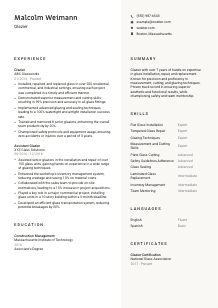
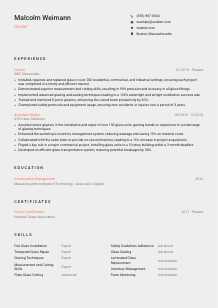
Shaping windows but your CV looks foggy? Clear things up with this Glazier CV example, made with the Wozber free CV builder. Learn how to reflect your glassy expertise to match job specifications, making your career trajectory as crystal clear as your finest panes!
Glazier hiring moves quickly when a CV makes one thing obvious: you can measure accurately, cut cleanly, install safely, and leave glass watertight and airtight across real job sites. Generic trade language falls flat here. Hiring teams want to see the kind of glass you handle, the environments you work in, and whether your work holds up in residential, commercial, or industrial settings.
A tailored CV changes how your trade experience is read. When your wording reflects the posting's terminology, from tempered and laminated glass to sealing methods and safety practice, your background is easier to match in an ATS and easier to trust in a first review. Wozber's free CV builder helps organise that language into an ATS-compliant CV, so the hiring team can quickly see whether your experience fits the installation standards and site demands of the role.
This section is straightforward, but it still carries hiring weight. For a glazier, clear contact details, the right job title, and location information can answer practical questions before anyone reaches your experience, especially when a posting includes work authorization or local availability requirements.
Your name should sit at the top in a clean, readable format. Keep it slightly larger than the rest of the text so a hiring manager can identify you immediately when scanning multiple trade CVs in a row.
Place "Glazier" directly under your name if that is the role you want. This creates an immediate match with the posting and helps position your background around installation, repair, replacement, measurement, and sealing work rather than a broader construction label.
List a working phone number and a professional email address. On field-based roles, missed calls matter. If a supervisor wants to schedule a quick interview or confirm site availability, incorrect contact information can cost you the opportunity.
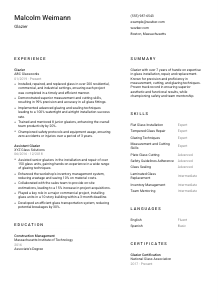
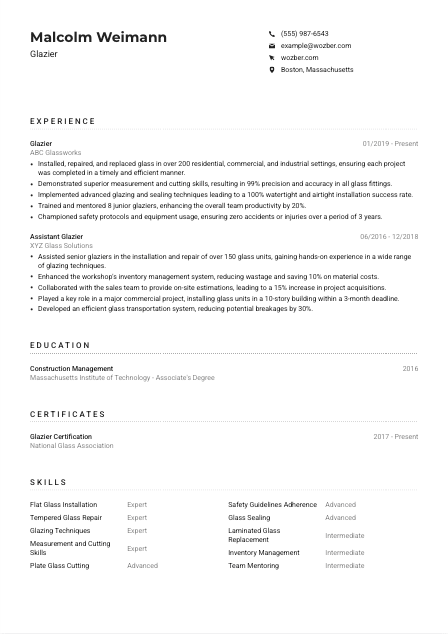
If the employer wants someone already based in a specific area, add your city and state. In the example, Boston, Massachusetts supports the local eligibility requirement without adding unnecessary detail. Use location this way when it answers a stated posting condition.
A LinkedIn profile can be useful if it mirrors your CV and shows consistent job dates, certifications, or project scope. A portfolio link also makes sense if you have professional photos of storefront installations, custom glass work, or large commercial projects. Skip anything incomplete or outdated.
This section should confirm that you are reachable, local when required, and clearly positioned as a glazier. When those basics are clean, the reader can move straight to your installation record and trade experience.




This is the section that carries the most weight for most glazier roles. Employers want to see where you worked, what kind of glass and settings you handled, how precise your installations were, and whether you delivered safe, durable results under real job conditions.
Start with the roles that show hands-on glass installation, repair, and replacement work. If a posting asks for 3+ years of experience, make that timeline easy to spot through your most recent glazier positions and related responsibilities.
For every job, include your title, employer, and dates in a consistent format. Trade hiring often involves quick review by someone balancing crews, schedules, and active projects, so they need to understand your work history at a glance.
Your bullets should show what you installed, how you worked, and what results followed. Good glazier bullets often mention glass types, project environments, measurement accuracy, sealing quality, safety performance, or crew contribution. The sample CV does this well with points about 99% fitting precision and a 100% watertight and airtight installation record.
Quantify scope and performance wherever you can. That might mean number of installations completed, accuracy rates, reduction in breakage, material savings, safety record, deadline performance, or team productivity. "Installed glass in over 200 settings" tells a hiring manager far more than "responsible for installations."
Keep the section centered on glazing work and adjacent construction experience that supports it. If an older role does not strengthen your case for handling glass, measurements, sealants, safety protocols, or customer-facing site work, trim it back or leave it out.
A well-built experience section should make your range clear, from repair calls to large installs, and show that your work is accurate, durable, and safe. That is the standard most hiring managers are looking for when they read past the job title.
Education is rarely the deciding factor for a glazier, but it can still strengthen the CV when it supports construction knowledge, blueprint reading, safety awareness, or broader understanding of how installation work fits into a building project.
If you have a degree, diploma, or trade-school background connected to construction, building systems, or a related craft, include it. In the example, an Associate's Degree in Construction Management adds useful context even though the role itself is primarily experience-driven.
List the school, degree, field of study, and graduation year or date. Simple formatting helps both ATS parsing and human review, especially when the employer is mainly checking whether you have any formal training that complements your field experience.
Relevant coursework can help if you are earlier in your career or if your studies covered construction methods, safety, blueprint interpretation, or materials handling. Only include classes that reinforce your ability to work accurately on installations and repairs.
Honors, projects, or distinctions are worth adding when they connect to the work. For example, a capstone tied to building systems or site coordination may be useful. If you already have several years of strong glazier experience, keep this part brief.
If your trade qualification matters more than your schooling, give certifications their own section instead of burying them here. That is especially important when a posting asks for an up-to-date glazier certification or state licensure.
Education should reinforce your trade foundation without competing with the experience section. Keep it relevant, concise, and connected to the kind of installation work you want to do next.
For many glazier openings, current certification or licensure can move your CV higher in the stack quickly. It tells the employer that your qualifications are current and that you meet a standard tied to safety, installation practice, or local compliance.
Check whether the employer asks for a glazier certification, state license, safety credential, or another trade qualification. Here, the requirement calls for a valid and up-to-date glazier certification or relevant state licensure, so that information should be easy to find on your CV.
Prioritise certifications tied to glazing, installation, safety, or code-related work. A relevant trade credential adds much more value than unrelated certificates, especially when the employer is hiring for hands-on field performance.
Always show who issued the certification and when it was earned or renewed. The sample CV handles this well by naming the National Glass Association and showing an active date range, which helps confirm that the credential is current.
Remove expired credentials that no longer help your case, and update renewals as soon as they happen. In construction and installation work, recency matters because employers often read certifications as a sign of ongoing compliance and professional upkeep.
When certification is part of the hiring criteria, do not make the reader search for it. A clear, current credentials section helps show that you meet the baseline for safe and qualified glazing work.
A glazier skills section should read like a practical toolbox, not a generic list of strengths. Focus on the technical abilities, material handling knowledge, and work-site habits that show you can install, repair, measure, cut, and seal glass to spec.
Use the posting to identify the exact technical skills the employer cares about. For this role, that includes working with flat, plate, tempered, and laminated glass, plus measurement, cutting, glazing, sealing, and safety practices. Match those terms when they truthfully reflect your background.
Lead with the skills that define daily glazier work. Glass installation, repair, measurement accuracy, edge sealing, silicone application, and handling different glass types should appear before broad soft skills. The example skills list gets this right by emphasizing glazing techniques and measurement work first.
Order the section so the most important and strongest capabilities appear first. If you are highly experienced in flat glass installation and glazing techniques but only occasionally work with laminated replacement, that order should be visible. This helps the employer quickly map your strengths to the work they need done.
Your skills list should support the experience section with clear trade language. When it reflects real installation methods, materials, and safety practice, it gives the hiring manager a faster read on where you can contribute from day one.
Glaziers spend plenty of time working with crews, reading instructions, confirming measurements, and sometimes speaking with customers or site contacts. Language skills matter most when they affect safe communication, clear coordination, and reliable day-to-day work.
If the posting asks for English proficiency, list English clearly and state your level honestly. For this opening, that requirement is explicit, so your CV should remove any doubt that you can follow instructions, discuss installation details, and work safely on site.
Lead with English when it is the required language for the role. This small detail helps the employer confirm a basic requirement quickly before moving deeper into your trade background.
Additional languages can help on multilingual crews, customer-facing residential jobs, or large commercial sites with varied teams. They are not a substitute for trade skill, but they can make coordination smoother and widen the environments where you can work effectively.
Use levels such as Fluent, Conversational, or Basic in a truthful way. Overstating language ability can create problems quickly in a trade where safety instructions, measurements, and installation details need to be understood without confusion.
If the job involves direct customer interaction, service calls, or diverse work crews, language ability can add practical value. Include it when it helps explain how you communicate on the job, not just to fill space.
For a glazier, language skills are most useful when they support safety, coordination, and clear customer interaction. Present them simply and accurately so the employer knows you can communicate where it counts.
Your summary sits at the top of the CV, so it needs to establish your trade level quickly. For a glazier, that usually means years of experience, types of work performed, standout technical strengths, and one or two outcomes that show reliability on the job.
Open with a direct statement that names you as a glazier and shows your years of experience. A line such as "Glazier with over 7 years of experience in glass installation, repair, and replacement" works because it immediately covers scope and seniority.
Follow with two or three skills that align closely with the target role, such as measurement accuracy, cutting, glazing, sealing, or experience with tempered and laminated glass. This gives the employer a quick sense of your working range before they reach the bullet points below.
Use the summary to hint at results, not just duties. The example CV does this by stressing precision and strong installation results. You might mention high fitting accuracy, reliable watertight sealing, strong safety performance, or experience across residential and commercial sites, depending on what best matches your background.
Aim for a compact paragraph, usually three to five lines. The summary should sharpen the employer's first impression, not repeat your entire work history. Save the detail for your experience section.
A useful summary tells the reader, within seconds, what kind of glazier you are and what standards you work to. When it is specific, concise, and aligned with the posting, the rest of the CV lands with more force.
A glazier CV works best when it mirrors the trade itself: precise, practical, and built to hold up under scrutiny. If your experience, skills, certification, and project results are clearly aligned with the posting, the employer can quickly see whether you are ready for their mix of installation, repair, sealing, and site safety demands.
Wozber's free CV builder can help you shape that content into an ATS-friendly CV format, and its ATS CV scanner can surface missing terminology or requirements before you apply. Use that support to tighten your wording, match the posting accurately, and make your hands-on glazing experience easy to judge.
That is what gets a glazier CV shortlisted.