



Use Wozber and land your dream job
Create CV
No registration required
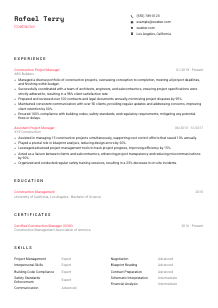
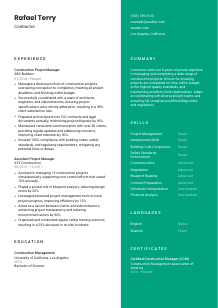
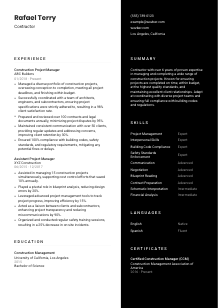
Building foundations, but your CV feels shaky? Check out this Contractor CV example, built with Wozber free CV builder. Learn how to blueprint your contracting expertise to match job specifics, constructing a career that's as sturdy as your structures!
Contractor CVs are reviewed through the lens of execution. Hiring teams want to see whether you have actually run construction work from pre-construction through closeout, kept schedules and budgets under control, handled subcontractor coordination, and protected the project from compliance or safety issues. If those realities are buried under vague management language, the CV misses the core of the job.
A tailored CV changes what stands out first. When your project scope, blueprint fluency, contract work, and code compliance are stated in the same language used in the posting, Wozber's free CV builder helps shape that into an ATS-compliant CV that reads clearly in both screening systems and human review. That makes it easier to see whether you can manage a job site, client expectations, and project risk without costly surprises.
For a Contractor, the header should do one practical job. It should confirm who you are, how to reach you, and whether you meet basic screening requirements such as title alignment and location. Keep it clean, professional, and immediately relevant to the type of construction role you want.
Use your full name as the most visible text on the page. In construction hiring, your CV often moves between recruiters, operations leaders, and project executives, so your name should be easy to spot and remember.
Place the job title directly under your name when it accurately reflects your background. If you are applying for a Contractor role, using "Contractor" or a closely aligned title such as "Construction Project Manager" helps frame your experience before the reader reaches your project history.
Your contact information needs to be reliable and businesslike. Missed calls, bounced emails, or unprofessional handles create doubt before anyone reads about schedules, budgets, or site leadership.
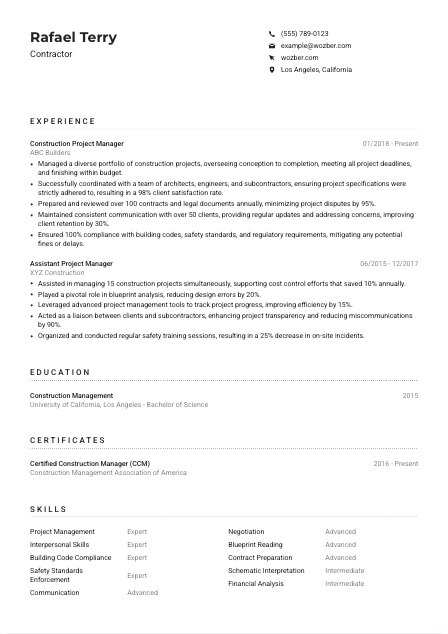
If the posting specifies a city or relocation requirement, show that detail clearly in your header. Here, listing Los Angeles, California immediately answers a stated requirement and removes a common point of hesitation early in the review.
Include LinkedIn or a professional website if it strengthens your application. For contractors, that can be useful when it shows project history, construction credentials, recommendations, or a portfolio of completed work. Make sure the details match your CV exactly.
This section does not need personality flourishes. It needs to confirm that you are reachable, professionally presented, and positioned for the job before the hiring team starts reviewing project experience.




This is where contractor CVs are won or lost. Employers want to see the kind of projects you managed, how you coordinated trades and design partners, what happened to schedule and budget under your watch, and whether you kept work compliant. Write this section like a record of delivered projects, not a list of routine responsibilities.
Start by marking the work themes in the job description. For this role, that includes full project oversight, coordination with architects and engineers, contract and change order handling, client communication, and code compliance. Those points tell you which parts of your background deserve the most space.
List your most recent position first, then work backward. For each entry, include company name, job title, and dates. That structure lets the reviewer track how your responsibility progressed from support roles into direct control of project delivery, subcontractor management, or client-facing decision making.
Replace generic statements like "managed construction projects" with outcomes and scope. Show what you delivered, who you coordinated with, and what standards you maintained. The example CV does this well by tying project oversight to deadlines, budget performance, client satisfaction, and dispute reduction rather than stopping at broad duty language.
Quantify where the numbers reflect real construction performance. Useful measures include number of projects, annual contract volume, budget savings, reduced incidents, fewer design errors, on-time completion, or client retention. Metrics like "reviewed over 100 contracts annually" or "reduced on-site incidents by 25%" feel credible because they map to how contractor performance is judged in practice.
Every bullet should help prove that you can run construction work, coordinate teams, control documentation, or protect the project from delays and compliance issues. If a line does not connect to project management, general contracting, technical drawing review, negotiation, client communication, or regulatory execution, trim it or rewrite it.
A hiring manager should be able to scan your experience and picture you on an active build, keeping people aligned, paperwork accurate, and the schedule moving. That is the standard this section needs to meet.
Education matters in construction hiring, especially when the posting asks for a bachelor's degree in a related field or equivalent experience. This section should confirm that baseline quickly and show whether your academic background supports the type of project work you manage.
If the job asks for a bachelor's degree in a related field, make sure that information is easy to find. Degrees in construction management, civil engineering, architecture, or similar fields usually belong near the top of this section because they connect directly to site coordination, drawing interpretation, and project planning.
List degree, field of study, school, and graduation year in a straightforward order. Hiring teams scanning multiple contractor CVs do not need extra formatting here. They need to confirm the credential fast and move on to your project track record.
When your degree aligns with the role, say so clearly. "Bachelor of Science in Construction Management" speaks more directly to the job than a shortened or vague version of the same credential. The sample CV handles this well by naming both the degree and the field without clutter.
If you are early in your career, a senior capstone, estimating project, or coursework in scheduling, construction law, or blueprint reading can add useful context. If you already have 5+ years of project delivery experience, education should stay brief unless an academic detail directly supports the target role.
Honors, scholarships, or leadership in construction-related organizations can be worth noting when they reinforce commitment to the field. Keep them if they add professional context, not simply because they are available to list.
Your education section should confirm that you meet the role's stated requirement and that your training connects naturally to construction work. After that, let your project experience do the heavier lifting.
Certifications and licenses carry real weight in contracting because they speak to code knowledge, professional standards, and legal authority to operate. When a posting names credentials such as CCM or a general contractor license, this section becomes more than supporting information.
Put the most relevant certification first, especially if the employer calls it out. In this case, a Certified Construction Manager credential fits the requirement directly and reinforces experience in overseeing projects, documentation, and construction teams.
List licenses and certifications that strengthen your case for running construction work, not every short course you have completed. Construction management certifications, contractor licenses, safety credentials, or code-related training usually matter more than generic learning certificates.
Show when the certification was earned and whether it is current. This matters in construction because employers want to know that your credential is active and that your knowledge of standards and regulations is current, not outdated.
As project scope grows, so should your credential set. If you are targeting larger commercial work or more senior contractor roles, updated certifications in construction management, safety, or licensing can strengthen your positioning and support salary negotiations.
A well-chosen certificate list tells the employer that your experience is backed by recognized standards. For contractor roles, that can be the detail that separates broad construction experience from documented professional authority.
Contractor skills need to reflect how projects actually get delivered. Hiring teams look for a mix of technical construction knowledge, control of documentation and compliance, and the interpersonal range to manage clients, subcontractors, and design partners under pressure.
Read the job description for explicit requirements, then look for the work behind them. "Reading blueprints" points to technical interpretation. "Manage projects from conception to completion" points to scheduling, budgeting, coordination, and risk control. Build your skills list from those real capabilities rather than generic buzzwords.
Only include skills you can support with experience. If blueprint reading, contract review, or building code compliance appears in the posting and you have done that work, surface it clearly. The sample CV uses a strong mix of project management, blueprint reading, contract preparation, safety standards enforcement, and communication, which maps closely to the role without turning into a long keyword dump.
Group the most relevant abilities first and trim anything too broad or weakly related. For contractor CVs, high-value skills often include project management, blueprint and schematic interpretation, subcontractor coordination, contract administration, client communication, negotiation, budgeting, code compliance, and safety oversight.
When this section is tailored well, it reads like the operating toolkit of someone who can run a construction project, not just someone familiar with the industry vocabulary.
Language ability matters in contracting because clear communication affects approvals, client updates, site coordination, and safety. This section is usually short, but it can help confirm a required language and show added value on diverse crews or client-facing projects.
If the posting makes one language mandatory, list it first with an accurate proficiency level. Here, English belongs at the top because it is explicitly required and central to contracts, meetings, documentation, and compliance communication.
Lead with the language you use to run meetings, review documents, and communicate with clients or inspectors. If you are a native or fluent English speaker, say so clearly so the employer does not have to infer it.
Additional languages can strengthen a contractor CV when they support communication with crews, subcontractors, vendors, or clients. Spanish, for example, can be especially useful on many construction sites, but it should appear as added value rather than replacing the core requirement.
Use realistic levels such as Native, Fluent, Advanced, or Intermediate. Overstating language ability can create problems quickly in a role where misunderstanding a drawing note, client request, or safety instruction has real consequences.
Not every contractor job needs multiple languages, but some markets and project teams do benefit from it. Include other languages when they strengthen your ability to manage communication across the people involved in the work.
This section should quickly confirm that you can handle the communication demands of the role. Any additional language should support clearer coordination on the project, not distract from your core construction qualifications.
Your summary should read like the top-line case for hiring you to run construction work responsibly. In a few lines, it needs to establish your experience level, the kind of projects or responsibilities you have handled, and the operational strengths that match the role.
Start with the core of the job you are targeting. For a contractor role, that usually means project oversight, schedule and budget control, coordination with architects, engineers, and subcontractors, contract handling, and code compliance. Use those themes to decide what belongs in the opening lines.
State your title or area of expertise and your years of experience early. "Contractor with 6+ years of experience managing construction projects" tells the reader far more than a soft opening built around general ambition or work ethic.
Choose strengths that mirror the posting and are backed up in your experience section. In this case, that might be on-time and within-budget delivery, strong blueprint and technical drawing interpretation, contract and change order review, and consistent compliance with codes and safety requirements. The sample summary works because it stays close to those operational points.
Aim for a short paragraph, not a biography. If the summary starts repeating bullets from the experience section, cut it back. Its job is to establish your contractor profile quickly enough that the reader wants to examine the project record underneath.
A good summary tells the hiring team what kind of construction leader you are and what kind of work you can handle. Once that is clear, the rest of the CV has a much easier job.
A contractor CV needs to show more than general construction familiarity. It should make your project control, technical reading ability, documentation discipline, client communication, and compliance record easy to find. When those points are aligned to the posting, the document starts reading like a hiring case instead of a work history.
Wozber's ATS-compliant CV tools can help you tighten that alignment, from structure and phrasing to role-specific terminology and ATS optimisation. Use the guide above to shape each section around how contractor performance is actually judged, then refine it with an ATS CV scanner so the final version is clear to both software and the people responsible for the next build.




