



Use Wozber and land your dream job
Create CV
No registration required
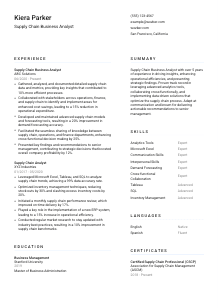
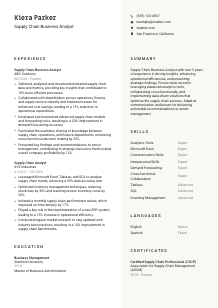
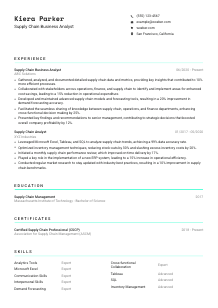
Solving supply chain puzzles, but your CV doesn't fit the picture? Check out this Supply Chain Business Analyst CV example, created with Wozber free CV builder. Learn how to weave your analytical insights into job requirements, so your career journey flows as smoothly as streamlined logistics!
Supply Chain Business Analysts work where operational friction becomes measurable. Hiring teams want to see whether you can turn demand patterns, inventory movement, supplier or fulfillment data, and process bottlenecks into decisions that improve cost, accuracy, and service levels. Your CV should make that analytical range visible quickly, especially through forecasting work, KPI reporting, and cross-functional problem solving.
A tailored CV changes how your background is interpreted in early screening. When the language reflects the employer's supply chain workflows and analytics stack, an ATS-compliant CV is more likely to surface the right match between your experience and the role. Wozber's free CV builder helps structure that alignment cleanly, so your dashboards, forecasting results, and collaboration with operations or finance are easy to recognize from the first pass.
For a Supply Chain Business Analyst, the header should do one practical job well. It should confirm who you are, how to reach you, and whether you meet any immediate logistical requirements before the reader gets into forecasting results, inventory analysis, or dashboard work.
Use your full name as the most visible text in the header. Keep it clean and easy to scan so the focus stays on your professional identity, not on decorative formatting.
Place "Supply Chain Business Analyst" beneath your name if that is the role you are targeting or already performing. Matching the title used in the posting helps frame your experience around supply chain analysis, process improvement, and reporting from the start.
Add a phone number and a professional email address that you check regularly. If you include a website or portfolio, make sure it supports your CV with relevant material such as dashboards, project summaries, or analytics work rather than unrelated content.
Some openings include a firm location requirement. Here, being based in San Francisco, CA is part of the screening criteria, so listing your city and state in the header removes uncertainty early. Use location this way when it is clearly relevant, not as a default line for every application.
A LinkedIn profile or personal site can help if it reflects the same career story as your CV. For this profession, consistency matters. If your profile mentions supply planning projects, ERP work, Tableau dashboards, or SQL-based analysis, it should match the accomplishments and tools shown on the page.
Your header should remove simple objections before they appear. If your name, title, contact details, and any required location are easy to find, the reader can move straight to your supply chain results and analytical depth.




This section carries the most weight for Supply Chain Business Analyst hiring. Titles matter, but the real differentiator is whether your bullets show how you used data, forecasting logic, inventory insight, and stakeholder coordination to improve an operation.
Read the posting for the work behind the wording. In this case, the recurring themes are data analysis, process improvement, cost reduction, forecasting, dashboard ownership, and communication with supply chain, operations, and finance. Those themes should guide which projects and metrics you prioritise.
List your most recent role first, then work backward with job title, employer, and dates. That simple structure helps hiring teams quickly place your progression from analyst support work into broader ownership of models, KPI tracking, or strategic reporting.
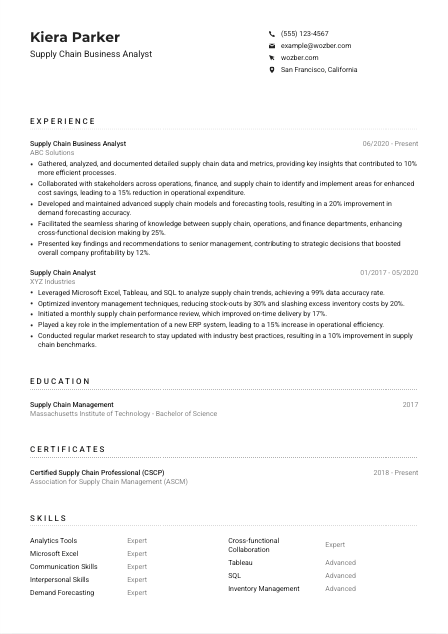
Each bullet should show what you analysed, what action followed, and what changed. For a Supply Chain Business Analyst, that often means demand forecast accuracy, inventory levels, stock-out reduction, cost savings, service performance, or decision support for leadership. The sample CV does this well by tying supply chain models to a 20% improvement in forecasting accuracy instead of stopping at "developed models."
Metrics carry real weight in supply chain work because performance is measured constantly. Use percentages, dollar savings, cycle-time improvements, forecast accuracy gains, fill rate changes, on-time delivery improvements, or inventory reductions when they are true and attributable. Numbers like a 15% reduction in operating expense or a 30% drop in stock-outs give your analysis business context.
Keep bullets focused on supply chain analysis, planning support, reporting, systems, and cross-functional execution. If a past role included unrelated administrative work, leave it out unless it directly contributed to data quality, process mapping, or stakeholder coordination. Every line should help the reader see you handling supply chain decisions, not just working near the function.
Your experience section should show a pattern of turning supply chain data into action. When your bullets connect tools, analysis, and measurable operational outcomes, you make it much easier to picture your contribution in planning meetings, KPI reviews, and strategic recommendations.
Education matters here because it helps establish your grounding in supply chain logic, business analysis, and quantitative thinking. It is especially useful when your degree lines up with planning, operations, logistics, or business decision support.
Start by checking the degree language in the posting. For this role, a bachelor's degree in Supply Chain Management, Business, Operations Research, or a related field is the stated baseline. If your education matches directly, name it clearly so there is no guesswork for the recruiter or ATS.
Use a standard format with degree, field of study, school, and graduation year. That is enough for most experienced candidates and keeps the section readable beside more detailed experience in forecasting, inventory management, or analytics.
If you hold a degree that directly supports the role, do not bury it. A Bachelor of Science in Supply Chain Management speaks immediately to subject-matter familiarity. In the example, that degree aligns tightly with the posting, while the MBA adds broader business context.
Coursework can help if you are early in your career, changing specializations, or applying to a role with a technical planning focus. Relevant examples might include demand planning, inventory optimisation, operations research, data analytics, or statistics. Skip course lists once your work experience already proves those capabilities.
Honors, leadership roles, or major capstone projects can add value when they relate to supply chain or analysis. A project on network optimisation or forecasting methods is worth more here than a generic campus activity. Keep the emphasis on preparation that supports the work you now do.
Your education should confirm that you have the academic base for supply chain analysis and business decision support. Lead with the qualifications that match the role most directly, then let your experience carry the deeper proof.
Certifications are not always mandatory for Supply Chain Business Analyst roles, but they often strengthen your profile by showing formal knowledge in planning, inventory, logistics, or process improvement. In a field where methods and systems evolve, current credentials can help reinforce your depth.
Some employers require specific certifications, while others simply value them. This job description does not list one as mandatory, which means certifications should support your candidacy rather than dominate it.
List certifications that reinforce the kind of analysis and operational understanding the role demands. CSCP and CPIM are strong examples because they relate directly to supply chain performance, planning, and inventory management. They add context to CV bullets about forecasting accuracy or stock control improvements.
If a certification is active, renewed, or earned recently, include the date or active range. That helps show your knowledge is current, especially in fields affected by changing planning practices, systems, and performance expectations.
If you are pursuing additional learning, focus on credentials that support your target work. Courses or certifications in supply planning, data analytics, ERP platforms, SQL, or business intelligence can all add value when they connect naturally to the jobs you are applying for.
The best certifications strengthen the story your experience already tells. When they point toward planning, inventory control, forecasting, or analytics, they add useful depth without distracting from your day-to-day results.
For Supply Chain Business Analysts, the skills section should read like a practical operating toolkit. Employers are looking for a mix of analytics capability, supply chain knowledge, and collaboration skills that support reporting, planning, and process improvement.
Use the job description to identify explicit tools and capabilities, then add adjacent skills that naturally support the role. Here, Excel, Tableau, SQL, demand forecasting, inventory management, and communication are direct matches. You can also include areas like KPI reporting, process analysis, or cross-functional collaboration if your experience backs them up.
Do not turn this section into a long inventory of software and soft skills. Prioritise the tools and methods most likely to matter in the role, especially analytics platforms, forecasting, reporting, inventory analysis, and stakeholder communication. The sample CV keeps the list relevant by emphasizing Excel, Tableau, SQL, forecasting, and collaboration.
Present skills in a way that helps the reader process them quickly. You might group technical tools separately from analytical or business-facing strengths, or simply order them by importance to the target role. Either way, make the link to supply chain analysis easy to see at a glance.
Your skills list should confirm the capabilities already demonstrated in your experience. When the tools, methods, and collaboration strengths line up across sections, your profile reads as consistent and credible.
Language ability matters in supply chain roles when your work depends on clear reporting, stakeholder updates, and alignment across teams. Even when the role is not global in scope, strong communication in the working language is often essential for presenting analysis and influencing decisions.
If the job description names a required language, include it clearly. This role specifically asks for strong English communication skills, so English should appear first in this section if it is one of your working languages.
Use a straightforward rating such as Native or Fluent. For a Supply Chain Business Analyst, this matters because the role often involves writing reports, explaining dashboard trends, and presenting recommendations to operations or senior management.
Extra languages can be useful in companies with international suppliers, regional operations, or multicultural internal teams. They are not a substitute for core analytical ability, but they can support smoother coordination across the supply chain.
Use realistic labels such as Fluent, Intermediate, or Basic. Inflated ratings can create problems quickly if the role requires live meetings, written reporting, or cross-border communication.
Only emphasize languages when they support how the work gets done. In some openings, English alone is enough. In others, an additional language may strengthen your value if supplier communication, regional planning, or international operations are part of the job.
If language matters to the role, make your proficiency easy to read. Clear communication is part of the job for Supply Chain Business Analysts, especially when analysis needs to move from spreadsheets and dashboards into decisions.
Your summary sets the lens for the rest of the CV. For this profession, it should quickly establish your years of experience, analytical strengths, and the kind of operational improvements you help deliver through data, forecasting, and cross-functional work.
Start with a direct line that names your role and experience level, such as "Supply Chain Business Analyst with 5+ years of experience." That immediately positions you in the right lane for roles centered on planning, reporting, and operational analysis.
Follow with two or three strengths that reflect how you work. Good options for this role include supply chain data analysis, demand forecasting, inventory optimisation, dashboard development, or process improvement. Keep them tied to actual work, not vague traits.
Use the summary to reinforce the qualifications that are central to the posting. In this case, that includes analytics tools, supply chain process knowledge, and communication across operations, finance, and leadership. The sample summary handles this well by connecting advanced analytics with cross-functional collaboration and strategic recommendations.
Aim for a short paragraph that can be read in seconds. Replace broad claims with specifics, such as years of experience, supply chain focus, and the kinds of outcomes you influence. The summary should invite the reader into the rest of the CV, not repeat every bullet that follows.
A good summary makes your direction clear before the reader reaches your job history. For a Supply Chain Business Analyst, that means showing analytical depth, supply chain understanding, and a record of improving decisions with data.
A strong Supply Chain Business Analyst CV shows how you move from raw data to practical action. If your sections align around forecasting, inventory insight, reporting tools, process improvement, and cross-functional influence, hiring teams can quickly understand where you add value.
Use Wozber's free CV builder to organise that story in an ATS-friendly CV format, then refine the wording with its ATS CV scanner and AI-powered tailoring tools so your experience matches the language of the role naturally. The final result should make one thing easy to judge: you can analyse the supply chain, communicate the findings, and help turn them into better business decisions.




