



Use Wozber and land your dream job
Create CV
No registration required
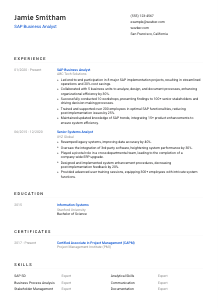
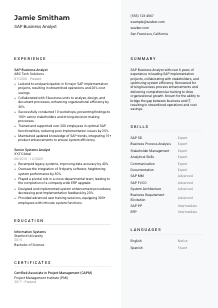
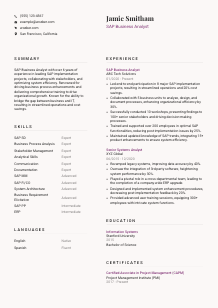
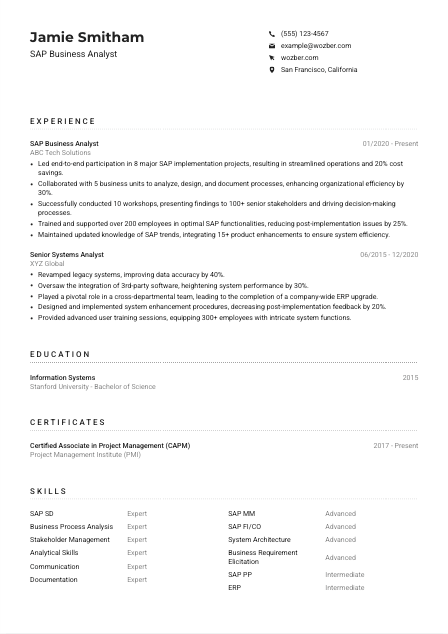
Navigating systems, but your CV feels disconnected? Check out this SAP Business Analyst CV example, created with Wozber free CV builder. It shows how to match your functional insights with job criteria, forging a career profile that runs as smoothly as an automated process!
SAP Business Analyst hiring usually turns on one practical question fast: can you connect business process needs to workable SAP solutions across implementation, testing, training, and support. CVs often get vague here. They say
For an SAP Business Analyst, the header needs to do more than identify you. It should confirm that you are reachable, professionally presented, and aligned with any immediate screening requirements before the reader gets into SAP modules, process work, or implementation history.
Use your full name as the clearest visual anchor on the page. Keep it slightly larger than the body text and easy to read. In a field where hiring teams may review candidates with similar SAP module exposure, a clean, professional header helps your CV feel organised from the start.
Place
Add a phone number and professional email address you check regularly. Accuracy matters here because SAP hiring processes often move through recruiter screens, stakeholder interviews, and follow-up scheduling. One typo can slow that down unnecessarily.
If a posting names a location requirement, show it clearly in your header. For the example role, listing San Francisco, California immediately answers a stated filter without using CV space elsewhere. Only include full street address details if an employer specifically asks for them.
A current LinkedIn profile or professional website can support your CV, especially if it reflects SAP implementation work, ERP projects, business analysis scope, or stakeholder-facing responsibilities. Make sure dates, titles, and major accomplishments match what appears on the CV.
Your personal details should remove friction. The reader should immediately know who you are, what role you are targeting, how to reach you, and whether you meet any stated location requirement.




This section carries most of the weight for an SAP Business Analyst. Hiring teams are looking for implementation scope, business process work, SAP module exposure, stakeholder interaction, and the outcomes your analysis produced once the system was live.
Start by marking the responsibilities and requirements that define the role. For this posting, that includes end-to-end SAP implementation, business process analysis and documentation, workshops with senior stakeholders, user training, post-implementation support, and familiarity with modules such as SAP SD, MM, FI/CO, and PP. These themes should shape which achievements you choose and how you phrase them.
Show your most recent and most relevant work first. For each position, include title, employer, and dates. This format helps reviewers quickly trace your progression from broader systems or ERP analysis into deeper SAP implementation ownership, as the example CV does by leading with a dedicated SAP Business Analyst role.
Write bullets that show what you drove, not just what you were assigned. In this profession, that means describing requirement gathering, process mapping, workshop facilitation, configuration support, user training, testing coordination, and post-go-live issue resolution in terms of business outcomes. A bullet such as leading participation across multiple SAP implementations is stronger when paired with what changed operationally.
Quantify results where the numbers reflect real project impact. Useful measures include cost savings, process efficiency gains, reduction in support issues, number of business units supported, workshop volume, stakeholder audience size, adoption rates, or training reach. The example CV uses metrics well by tying SAP project work to 20% cost savings, 30% efficiency improvement, and a 25% reduction in post-implementation issues.
Earlier experience can stay on the CV if it supports your story, but give priority to work that shows enterprise systems analysis, ERP upgrades, process redesign, cross-functional collaboration, and SAP-related delivery. If a past role was broader, pull out the parts that connect directly to implementation work, documentation quality, system improvement, or user support.
By the end of the experience section, the reader should be able to picture you working across workshops, requirements, SAP process changes, training, and post-go-live support. That is the level of relevance this role needs.
Education is usually a quick validation point for an SAP Business Analyst, but it still matters. It tells the employer whether you have the academic grounding to work across business processes, enterprise systems, and structured analysis in a corporate environment.
Check what the employer specifically asks for before you format this section. Here, the requirement is a bachelor's degree in Business Administration, Information Systems, or a related field. If your degree matches directly, make that connection easy to spot.
List your degree, field of study, school, and graduation year. Keep the layout straightforward so both recruiters and ATS tools can read it cleanly. The example CV handles this well with
When your degree lines up with the role, do not bury that detail. A degree in Information Systems, Business Administration, or a similar discipline supports the analytical and enterprise-process side of SAP work. Put the field of study in plain view rather than relying on the school name alone.
For experienced SAP Business Analysts, this is optional. Include coursework, capstones, or projects only when they reinforce skills the employer cares about, such as process modeling, ERP systems, systems analysis, data management, or business architecture. Skip filler that does not help explain your fit for SAP implementation work.
Honors, scholarships, or relevant student leadership can stay if they add something specific, especially for earlier-career candidates. For someone with 5+ years of SAP-focused experience, keep this section lean unless an achievement directly supports enterprise analysis, technology leadership, or structured project work.
This section does not need to do heavy lifting, but it should confirm that your formal background supports the blend of business analysis and systems work the role requires.
Certifications are useful here when they reinforce how you work on SAP programs, enterprise change, or cross-functional delivery. They are especially helpful if they add project structure, process expertise, or platform credibility beyond your job titles alone.
Start with the job description. If a certification is required or preferred, mirror that wording exactly. In this case, no specific credential is listed, so your certificates should support the role rather than trying to satisfy a non-existent checkbox.
List credentials that strengthen your relevance for implementation work, stakeholder coordination, process improvement, or enterprise systems. The sample CAPM certificate is a good supporting example because SAP implementations rely on planning discipline, milestone tracking, and coordination across teams, even when project management is not the primary title.
Show the year earned and, if relevant, the active period or renewal status. That helps employers understand whether your knowledge is current, especially in environments where SAP releases, product enhancements, and implementation methods keep evolving.
If you have room to strengthen this section, pursue certifications that map naturally to the work you want, whether in SAP modules, business analysis, agile delivery, testing, or project execution. Recent learning is particularly useful when you want to show growth from general systems analysis into deeper SAP specialization.
Certifications should reinforce your delivery profile, not distract from it. Include the ones that make your SAP implementation, process analysis, or project coordination background more credible.
The skills section should read like the toolkit of someone who can move between business users and SAP teams without losing accuracy. That means combining module knowledge, analysis capabilities, documentation skills, and stakeholder-facing strengths in a way that matches the role you are targeting.
Start with the skills the employer already named. For this role, that includes SAP SD, MM, FI/CO, PP, business process understanding, system architecture, analytical ability, communication, and stakeholder management. If you genuinely have them, use the same wording so the match is clear to both ATS screening and human review.
Balance technical and business-facing skills. A hiring manager wants to see module familiarity and process knowledge, but also requirement elicitation, documentation, workshop facilitation, training, and cross-functional communication. The example CV does this well by combining SAP module skills with business process analysis and stakeholder management rather than listing only software terms.
Group or order your skills so the most relevant ones appear first. Do not overload the section with every platform or soft skill you have used. A tighter list makes it easier to spot whether you can support implementation work, business process design, and post-go-live adoption in an enterprise SAP setting.
A well-built skills section should quickly answer whether you understand SAP, can work through business requirements, and can communicate effectively with users, technical teams, and senior stakeholders.
Language ability matters when the work involves workshops, documentation, user training, and stakeholder communication. For an SAP Business Analyst, that usually means making sure the required business language is unmistakable and then adding any others that could help in multi-region or cross-border environments.
If the job description specifies spoken and written English, list English first and show your proficiency clearly. This role does exactly that, so placing
Additional languages can help when SAP programs involve regional teams, shared service environments, or international business users. Include them when they are relevant, but do not let secondary languages overshadow a required one.
Use clear terms such as Native, Fluent, Advanced, Intermediate, or Basic. Avoid inflating ability. In roles that involve workshops, requirements gathering, and training sessions, overstating language proficiency can quickly become obvious.
If you have worked with distributed teams, offshore support groups, or multilingual business units, extra language capability can be useful context. It is not a substitute for SAP and business analysis expertise, but it can support your profile when collaboration spans regions.
Only include languages you can use in real business settings. For this profession, that may mean reading functional documentation, supporting users, or participating in workshops with confidence. The value is practical communication, not just an extra line on the page.
Language details should strengthen your case for clear communication in workshops, documentation, support, and stakeholder conversations. Lead with the required language and keep the rest relevant.
Your summary needs to tell the reader, in a few lines, what kind of SAP Business Analyst you are. It should connect years of experience, implementation scope, module or process familiarity, and the business outcomes you have influenced.
Start with the mix the role requires: SAP implementation experience, business process analysis, stakeholder collaboration, documentation, training, and post-implementation support. That combination is more useful than a generic statement about being results-driven or detail-oriented.
Lead with a direct line such as
Use one or two measurable results or practical achievements to show why your experience matters. Cost savings, efficiency gains, reduced support issues, successful workshop delivery, or broad user training all fit naturally here. The sample summary is strongest when it links SAP implementation work to streamlined operations and business process improvement.
Aim for three to five lines. That is enough space to show your SAP background, your business analysis strengths, and the kind of change you help deliver. Cut anything that could apply to almost any analyst and keep what points clearly to enterprise SAP work.
A good summary gives the hiring team a fast read on your SAP implementation background and the business outcomes tied to it. If this section is precise, the rest of the CV lands with more context and credibility.
An SAP Business Analyst CV should make your implementation experience, process analysis work, stakeholder communication, and training impact easy to trace from top to bottom. When those threads are clear, hiring teams can quickly see how you would contribute across workshops, documentation, testing, and post-go-live support.
Wozber's free CV builder helps you shape that story in an ATS-friendly CV format, and its ATS CV scanner can help you align module names, business analysis terms, and job-specific language with the posting. The final result should make one thing easy to judge: you can translate business needs into SAP solutions that work in a real enterprise environment.




