



Use Wozber and land your dream job
Create CV
No registration required
Crafting winning pitches, but your CV doesn't make the cut? Check out this Proposal Manager CV example, built with Wozber free CV builder. Learn how to align your strategic storytelling skills with company needs, propelling your career to the top of the shortlist!
Proposal management sits at the intersection of deadlines, persuasion, and operational control. Hiring teams want to see that you can move a response from kickoff to submission without losing compliance, message quality, or input from busy subject matter experts. Your CV should make that coordination visible, not just list that you "managed proposals."
When a Proposal Manager CV is tailored well, reviewers can quickly separate general writing experience from true bid leadership, content ownership, and win-process discipline. Wozber's free CV builder helps shape an ATS-compliant CV around the language of the posting so your experience with proposal workflows, collaboration, and results is easier to recognize early.
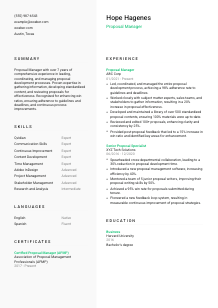
Proposal teams work on deadlines, details, and trust. The top of your CV should reflect that same control by giving a clean identity block that immediately matches the role you want and, where relevant, the employer's stated location requirement.
Use your full name in a larger, readable font so the document opens with clarity. For a Proposal Manager, polished presentation matters because the role itself is judged through well-structured, client-facing documents.
Place "Proposal Manager" directly under your name when that is the target role. This helps both recruiters and ATS tools connect your background to proposal leadership, response coordination, and content management work right away.
Your contact information should be simple, current, and businesslike. Small errors here suggest the same kind of preventable oversight that can hurt a proposal submission.
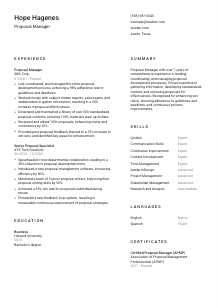
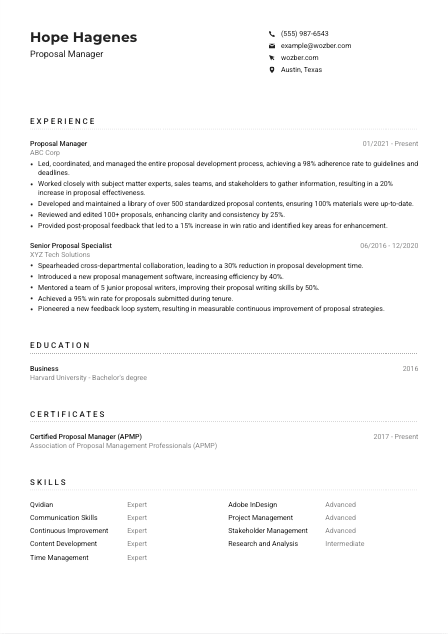
If the employer specifies a location, include it clearly. In the example, listing Austin, Texas directly supports a stated requirement and removes an early question about availability or relocation.
Add a LinkedIn profile or professional website if it reinforces your CV with consistent titles, project history, or credentials such as APMP. Keep the information aligned across both so your career story reads cleanly.
This section should confirm the basics fast: who you are, what role you are targeting, and whether you meet practical requirements like location and contact availability. For a Proposal Manager, that kind of precision sets the tone for the rest of the CV.




This section carries the most weight because proposal management is measured through execution. Employers want to see how you handled deadlines, coordinated contributors, improved content quality, and influenced outcomes such as win rate, turnaround time, or compliance performance.
Read the posting and mark the operational themes behind it: leading the full proposal process, partnering with sales and subject matter experts, maintaining reusable content, editing for consistency, and tracking post-submission results. Those themes should shape which bullets you keep and which you rewrite. Mirroring that language also strengthens ATS optimisation without sounding forced.
Start with your most recent job and include title, company, and dates for each position. Keep the structure easy to scan so the reviewer can quickly follow your growth from proposal support work into ownership of larger response cycles or team leadership.
Each bullet should show what you owned and what changed because of your work. Strong Proposal Manager bullets often cover compliance, cross-functional coordination, content development, editing, submission management, and post-proposal analysis. In the example, bullets about managing the full process, editing more than 100 proposals, and building a 500-item content library work because they show real scope, not vague support.
Quantify the outcomes that matter in this field. That can include adherence to deadlines, proposal volume, win ratio, turnaround time, content library size, efficiency gains, or stakeholder response speed. Metrics like a 15% win-rate increase or a 30% reduction in development time tell a hiring manager much more than "improved proposals."
Keep the section centered on proposal-relevant work. General writing, administrative support, or unrelated side achievements should stay only if they clearly connect to response management, persuasive content, stakeholder coordination, or process improvement. Every line should reinforce that you can run complex submissions under pressure.
The experience section should leave no doubt that you can organise contributors, protect deadlines, improve proposal quality, and learn from results. When your bullets show both workflow control and measurable outcomes, hiring teams can picture you running their next submission cycle.
For Proposal Manager positions, education is usually a qualification checkpoint rather than the main selling point. Still, it matters when the posting calls for a bachelor's degree in business, communications, or a related field, so present it clearly and without clutter.
If the posting specifies a bachelor's degree, make sure that credential is easy to find. A degree in Business, Communications, Marketing, English, or another related discipline supports the mix of writing, coordination, and commercial understanding the role requires.
List your degree, field of study, school, and graduation year or expected year. Clean formatting is enough here. The goal is to confirm qualification quickly, not to over-explain your academic background.
If your degree directly matches the posting, do not bury it. In the example, a bachelor's degree in Business aligns neatly with the employer's stated requirement, which helps the recruiter confirm a key credential in seconds.
Early-career candidates can use relevant coursework, capstones, or academic writing projects to show experience with business communication, research, or persuasive writing. If you already have several years of proposal work, keep education brief and let experience carry the CV.
Honors, associations, or campus leadership can stay if they reinforce communication, project coordination, or business writing ability. Otherwise, save the space for proposal wins, process improvements, and software expertise.
This section should confirm that you meet the academic bar and, where applicable, show a field of study that supports proposal work. Once that is established, let your experience and results do the heavier lifting.
Certifications can add weight in proposal management because they show formal training in bid processes, project structure, or professional standards. They are especially useful when a posting names APMP or project management credentials as preferred rather than required.
Start with certifications that map directly to the role. APMP is one of the clearest examples for proposal management, and project management credentials can also support your ability to run timelines, coordinate contributors, and manage deliverables.
Do not crowd this section with every course completion. Include credentials that strengthen your case for proposal leadership, content strategy, compliance management, or cross-functional execution.
List the certification name, issuing body, and active or earned date. This is especially helpful for renewable credentials because employers can quickly see that your training is current.
Proposal management changes with tooling, procurement standards, and response expectations. Ongoing certification work shows that you stay current on best practices in bid strategy, proposal development, and structured project execution.
Relevant certifications add another layer of trust, especially when they connect directly to proposal processes or formal project discipline. If you have APMP or a comparable credential, make sure it is easy to find.
A Proposal Manager skills section should read like the toolkit behind successful submissions. Focus on the capabilities that drive proposal quality and delivery, including software, document production, coordination, editing, and process improvement.
Proposal work depends on both systems and people. Include hard skills such as proposal management platforms, content development, editing, document design, and reporting, along with soft skills like stakeholder management, written communication, and deadline control.
Match your list to the posting's language where it reflects real experience. If an employer asks for Qvidian, Adobe InDesign, communication skills, or project management, those should appear prominently instead of being buried under generic strengths.
Keep the section selective. A tighter list built around proposal production, collaboration, and process management is more convincing than a long inventory of unrelated abilities. In the example, Qvidian, Adobe InDesign, stakeholder management, content development, and continuous improvement all support the actual work described in the role.
Hiring teams should be able to glance at this section and see how you support proposal production from content assembly through final submission. Prioritised, role-specific skills help them do that quickly.
For Proposal Managers, language ability matters most when it affects writing quality, editing accuracy, and communication with internal contributors or clients. If the posting calls out English proficiency, treat that as a requirement to confirm rather than a detail to leave implied.
When effective English is specifically listed, show your English level clearly. Proposal roles depend on precise writing, tone control, and careful editing, so language proficiency is directly tied to job performance.
Include each language and use straightforward labels such as Native, Fluent, Intermediate, or Basic. That gives the reviewer a realistic sense of where you can write, present, or collaborate comfortably.
Extra languages can be useful when proposals support international clients, multilingual teams, or regional business development. They are a plus, but they should not overshadow your core proposal-management qualifications.
Do not overstate fluency. Proposal work often involves nuance, review cycles, and client-facing language, so an inflated claim can quickly become obvious in interviews or writing exercises.
Some Proposal Manager roles are heavily domestic and English-only. Others support global sales efforts where an additional language helps with localization, stakeholder communication, or regional context. Include what strengthens your case for the specific opening.
This section should quickly answer a practical question: can you write and collaborate at the level the role requires. For proposal work, that matters because every submission depends on precise language and controlled messaging.
The summary sits at the top of the CV, so it should quickly establish your level, your proposal scope, and the kind of results you deliver. For this role, that usually means years of experience, ownership of the proposal lifecycle, collaboration with sales and subject matter experts, and outcomes tied to quality, speed, or win rate.
Before writing the summary, identify the few themes that matter most in the role. Here, those include end-to-end proposal management, collaboration across teams, maintaining reusable content, editing for persuasiveness, and using post-proposal feedback to improve performance.
Start with your title and years of experience so the reviewer can place you quickly. A line such as "Proposal Manager with 7+ years of experience leading complex proposal development" is stronger than a broad statement about being results-driven.
Use the next sentence or two to highlight proposal-specific strengths and outcomes. Mention content libraries, deadline control, proposal editing, collaboration with SMEs and sales teams, or measurable wins such as stronger compliance rates or improved win ratios. The example summary works because it ties years of experience to clear proposal functions and business results.
Aim for a short paragraph with only the details that sharpen your case. If a sentence does not help explain your proposal expertise, submission ownership, or measurable impact, cut it. This section should read like an executive brief, not a biography.
A well-written summary should position you as someone who can guide proposal development, coordinate contributors, and improve submission outcomes from day one. Once that top section is clear, the rest of the CV has a much stronger foundation.
A Proposal Manager CV should make one thing obvious fast: you can coordinate people, shape persuasive content, protect deadlines, and improve results over time. When each section supports that story with clear language, relevant tools, and metrics tied to proposal performance, the document reads with the same control employers expect in a real submission.
Use Wozber's free CV builder to organise your content in an ATS-friendly CV format, tailor wording with role-specific terminology, and check alignment with an ATS CV scanner. The final result should make it easy for a hiring team to see that you can step in and run a disciplined, high-quality proposal process.