



Use Wozber and land your dream job
Create CV
No registration required
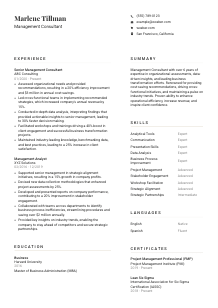
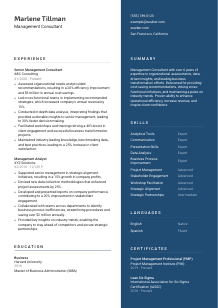
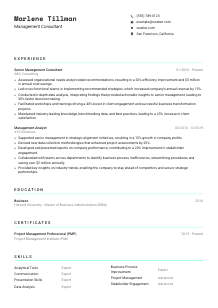
Deciphering business strategies, but your CV feels like a tricky equation? Unravel this Management Consultant CV example, created with Wozber free CV builder. Learn how to highlight your advisory acumen to match job demands, ensuring your career formula always leads to success!
Management consulting CVs are judged quickly on one practical question: can this person diagnose business problems, turn analysis into recommendations, and help clients execute change. Titles alone do not answer that. Your CV needs to show the kind of work consultants are trusted with, whether that means identifying process waste, shaping transformation plans, leading workshops, or helping senior leaders make decisions with clearer data.
Screening gets much easier when those consulting outcomes are tied closely to the target role's language. Wozber's free CV builder helps you align your wording with the job description and build an ATS-compliant CV that surfaces the right terms, from cross-functional delivery to cost reduction, so hiring teams can quickly see where your consulting experience maps to organizational improvement work.
Management consulting is client-facing work, so the top of the CV should read like a polished business document. Keep this section clean, direct, and aligned with the role you want, with no distractions that dilute your professional positioning.
Put your full name at the top in a prominent format, then follow it with the exact role title you are pursuing when it fits your background. Using "Management Consultant" immediately frames your profile around advisory work, transformation, and strategic problem-solving instead of leaving the reader to infer your direction from past job titles alone.
List a reliable phone number and a professional email address you check often. Consulting interview processes move quickly, and employers may reach out for case interviews, presentation rounds, or client-facing discussions on short notice. A simple email format such as firstname.lastname@email.com supports the polished, detail-aware impression expected in consulting.
If a consulting role includes a location requirement, state your city and state clearly. In the example here, San Francisco, California matters because the posting specifically asks candidates to be based there or willing to relocate. Mentioning that upfront removes a logistical question before the employer gets into your project experience.
Include LinkedIn or a professional website if it strengthens your candidacy with consulting-relevant detail, such as project scope, speaking, publications, or industry expertise. Make sure the information matches your CV closely. For consultants, inconsistencies between platforms can raise doubts about timeline accuracy, client exposure, or level of responsibility.
Do not use space on age, marital status, photo, or other non-job-related details. Consulting CVs work best when every line contributes to a business case for your candidacy, whether that is analytical depth, leadership range, industry exposure, or communication ability.
This section should confirm who you are, how to reach you, and whether you meet any practical requirement such as location. That is enough to let the reader move straight into your consulting credentials.




This is the core of a management consultant CV. Hiring teams want to see how you assessed operations, influenced decisions, improved performance, and worked across functions or stakeholders. The strongest bullets show both the problem you addressed and the measurable business result.
Read the posting for recurring themes, then reflect those themes in your bullet points using language that matches your actual work. Here, the employer wants organizational assessment, data analysis, recommendations, implementation leadership, and workshop facilitation. If you have done similar work, say so directly in your experience instead of relying on broad phrases like "supported strategy" or "worked on projects."
Start with your most recent role and make each entry easy to scan with title, company, and dates. In consulting, progression matters. Moving from analyst-level support into senior consultant or project leadership work helps employers understand your range, client maturity, and ability to own recommendations rather than only contribute analysis.
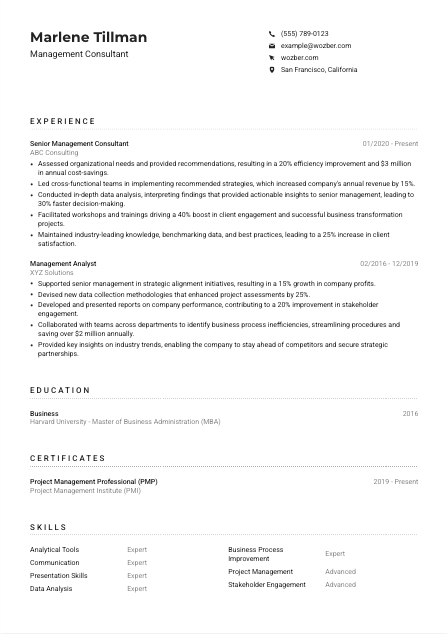
Consulting experience should read like delivered value. Focus each bullet on what changed because of your work: efficiency gains, cost savings, revenue growth, faster decision cycles, smoother implementation, or stronger client adoption. The sample CV does this well by tying recommendations to a 20% efficiency improvement and $3 million in annual savings, which is much more persuasive than simply saying "assessed organizational needs."
Numbers carry weight in consulting because they show that your analysis led to decisions with measurable consequences. Use percentages, dollar savings, timeline improvements, adoption rates, margin changes, or engagement outcomes where they are real and defensible. Metrics like 30% faster decision-making or $2 million saved annually immediately tell the employer what level of impact your work has had.
If you have a mix of consulting, operations, and management experience, give more space to the work that best mirrors the target role. Emphasize assessments, strategic recommendations, process redesign, stakeholder presentations, transformation programs, and workshop delivery. Older or less relevant experience can stay brief if it does not strengthen your case for advisory and implementation work.
Your experience section should show a pattern of diagnosing issues, shaping recommendations, and helping organizations perform better. If those outcomes are visible at a glance, the rest of the CV becomes much easier to trust.
Education matters in management consulting because it often signals business grounding, analytical training, and exposure to strategy or organizational work. Present it clearly, with the degrees that best support your consulting profile easiest to find.
List degrees that connect directly to consulting work, especially business, management, economics, finance, operations, or similar fields. For this role, a bachelor's degree is required and an MBA or advanced degree is preferred, so business-focused degrees deserve clear placement and consistent formatting.
Keep each entry simple: degree, field of study, school, and graduation year. That structure is easy for recruiters and partners to scan during high-volume review. A clean education section also helps when the employer is checking for minimum requirements such as a bachelor's degree or preferred advanced study.
If you have an MBA or another relevant graduate degree, make sure it is easy to spot. In consulting, advanced study can reinforce strategic training, quantitative capability, and executive-level business exposure. In the example, the MBA directly supports the posting's preference without needing extra explanation.
Coursework, academic projects, honors, or case competitions can help when you are earlier in your career or when they connect directly to strategy, operations, analytics, or change management. If you already have substantial consulting experience, keep academic detail selective so the section stays focused and does not compete with stronger professional proof.
Leadership roles, research, or business-related organizations can be worth mentioning if they sharpen your profile, especially for candidates with lighter experience. Choose items that point to analysis, structured problem-solving, teamwork, or presentation ability, all of which translate well into consulting environments.
This section should confirm that you meet the academic baseline and, where applicable, strengthen your credibility with advanced business training. Clear structure is usually enough.
Certifications are especially useful in consulting when they support how you work, not just what you know. Project delivery, process improvement, operational excellence, and change execution are all areas where the right credential can add weight to your profile.
When a posting mentions certifications such as PMP or Six Sigma, list them prominently if you hold them. Those credentials support the kind of structured delivery and process improvement work many consulting employers value, particularly in transformation, operations, or implementation-heavy engagements.
Do not list every course or badge you have earned. Prioritise certifications that align with your actual consulting work, such as project management, Lean, Six Sigma, change management, analytics, or industry-specific credentials. In the example, PMP and Lean Six Sigma strengthen the case for leading initiatives and improving operational performance.
Show the year earned and, if applicable, whether the certification is current. This matters most for credentials with renewal expectations or when recency supports your profile. A current certification suggests you are maintaining standards that are still relevant to client delivery and modern consulting practices.
Consulting rewards people who keep sharpening their methods. If you continue to build expertise in facilitation, project leadership, analytics, or operational improvement, relevant certifications can show that your toolkit is expanding along with your experience. Keep the list focused on credentials that add practical value to your target role.
The best certifications on a consulting CV reinforce execution, improvement, and structured problem-solving. If a credential does not strengthen one of those points, it can usually stay off the page.
A management consultant's skills section should sound like someone who can analyse a business issue, work across stakeholders, and guide action. Focus on capabilities that are easy to connect to client engagements, transformation work, and decision support.
Pull required and repeated terms from the job description, then use the ones you genuinely bring. For this posting, that includes analytical tools, project management tools, communication, presentation, and data analysis. Matching this language helps both ATS screening and human review, especially when the employer is sorting candidates with overlapping business titles.
Feature skills tied to how management consultants actually work: business process improvement, data analysis, project management, stakeholder engagement, workshop facilitation, strategic alignment, and executive presentation. The sample CV also includes analytical tools and communication, which fit naturally because they support diagnosis, recommendation, and client delivery.
Avoid turning the section into a long inventory of vague strengths. Group or order skills so the most relevant ones appear first, and keep the emphasis on methods, business capabilities, and client-facing execution. A shorter list of well-chosen skills is far more credible than a crowded list that mixes core consulting abilities with unrelated software or soft-skill filler.
Every skill listed should support the picture built in your experience section. If the employer can connect those skills to consulting deliverables and outcomes, the section is doing its job.
Language ability matters in consulting when it affects client communication, workshop delivery, executive presentations, or international project work. Even when only one language is required, presenting proficiency clearly helps employers understand how you will operate in meetings, reports, and stakeholder discussions.
If the posting specifies a language requirement, include it clearly and use an honest proficiency level. Here, strong English communication is required, so English should appear prominently. For management consultants, that does not only mean casual fluency. It means being able to present findings, facilitate sessions, and write clear recommendations.
Additional languages can strengthen your profile when consulting work involves multinational teams, regional markets, or diverse stakeholders. A second language is especially useful if it supports workshop facilitation, relationship building, or project delivery across different business contexts.
Stick to simple levels such as Native, Fluent, Intermediate, or Basic. Hiring teams need a practical sense of whether you can lead a workshop, contribute in meetings, or read business material in that language. Overstated language claims can become a problem quickly in client-facing roles.
If the employer works across regions or serves international accounts, language breadth may add meaningful value. That does not make extra languages a universal requirement for consulting, but when they are relevant, they can support your case for cross-cultural communication and broader client coverage.
If your consulting path involves global projects or multicultural teams, improving a relevant language can widen the range of clients and engagements you can support. Only list what you can use with confidence today, then build from there over time.
Language skills should clarify how you communicate in real consulting settings, from presentations to stakeholder meetings. Keep the section honest and relevant to the work you want to do.
The summary sits at the top of the CV, so it needs to establish your consulting value in a few lines. This is where you connect years of experience, functional strengths, and business results into a concise opening statement that makes the reader want the details.
Start with your title or closest professional positioning, then mention your years of relevant experience. For example, "Management Consultant with 6+ years of experience" is stronger than a general business label because it immediately frames your background around advisory work, problem-solving, and organizational improvement.
Use the summary to highlight the outcomes that matter most in consulting: cost savings, efficiency gains, business transformation, better decision-making, or growth support. The example summary works because it points to organizational assessments, data-driven insights, and transformation efforts rather than relying on broad claims about leadership or passion.
Three to five lines is usually enough. That gives you room to mention experience level, core consulting strengths, and a couple of high-value outcomes without repeating the experience section. Dense, specific language works better here than broad adjectives or generic statements about being results-driven.
Adjust the summary based on the consulting focus of the role. Some employers care more about operational improvement, some about transformation delivery, and others about strategic analysis or workshop leadership. Tailoring this section helps the employer understand your most relevant consulting lane before they read the rest of the CV.
When this section is done well, the reader immediately understands your consulting level, your core strengths, and the kind of business outcomes you are known for. That context makes every later bullet land harder.
Your CV should now show a clear pattern of business diagnosis, structured analysis, stakeholder communication, and measurable improvement. That is the combination employers look for when they need someone who can recommend change and help make it stick.
Use Wozber's free CV builder to tighten the language, organise content in an ATS-friendly CV format, and check alignment with the role through its ATS CV scanner. The end result should make it easy to judge your consulting scope, delivery style, and business impact.