



Use Wozber and land your dream job
Create CV
No registration required
Bridging gaps and making connections, but your CV feels disconnected? Sync with this Liaison Officer CV example, created with Wozber free CV builder. Learn how to present your diplomatic dexterity in line with job requirements, forging a career path that paves the way for fruitful collaborations!
Liaison work sits at the point where communication gaps turn into project delays, mixed messages, or unnecessary conflict. A Liaison Officer CV needs to show that you can keep information moving across departments, agencies, or external partners, while handling sensitive conversations with sound judgment, strong written communication, and reliable follow-through.
Screeners usually look first for direct signs of coordination work, stakeholder-facing communication, and experience handling reports, meetings, or issue resolution in complex settings. Wozber's free CV builder helps you shape that experience into an ATS-compliant CV that uses the right terms naturally, so hiring teams can quickly recognize your ability to represent an organisation, keep parties aligned, and move initiatives forward.
For Liaison Officer positions, the header section does more than identify you. It should immediately support the logistics of the role, especially when the employer has clear expectations around contactability, location, or formal eligibility requirements. Keep it clean, professional, and easy to review.
Place your full name at the top in a clear, slightly larger font. In roles built around representation and communication, you want the reader to remember your name quickly after scanning your CV or meeting you in an interview process.
Add "Liaison Officer" beneath your name if that is the role you are applying for. This creates immediate alignment with the posting and helps frame your background around coordination, stakeholder communication, and issue resolution rather than a more generic administrative or diplomatic profile.
Use a direct phone number and a professional email address so outreach is straightforward. This role depends on clear, dependable communication, and even small details such as an outdated number or casual email handle can undercut the professional standard expected in agency-facing or diplomatic work.
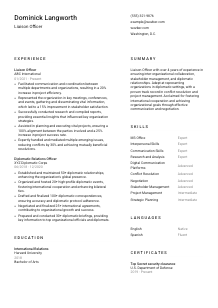
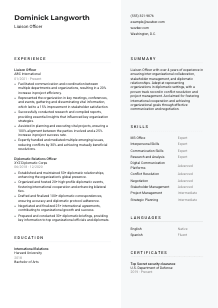
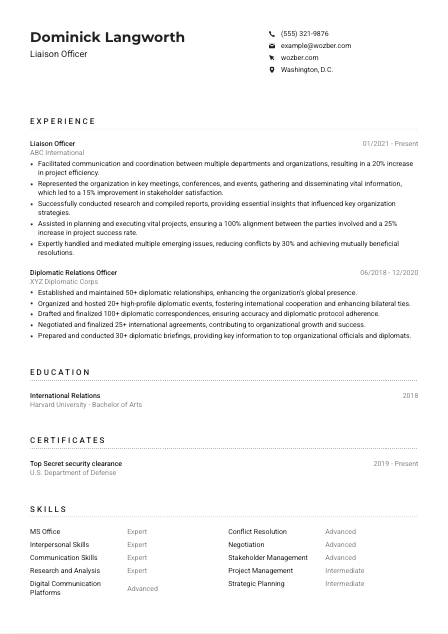
If the employer specifies Washington, D.C. or another required location, show that in your personal details. In the example, listing Washington, D.C. directly supports a stated requirement and removes an avoidable question about availability or relocation.
Include LinkedIn or another professional profile if it is current and consistent with your CV. For a Liaison Officer, this can reinforce your background in public affairs, diplomatic coordination, stakeholder engagement, or interagency work, but only if the content matches your CV language and dates.
Do not include age, gender, marital status, photo, or other unrelated details unless a specific application system requires them. Hiring teams need to see your communication credentials, coordination experience, and professional readiness, not personal information that does nothing to support your candidacy.
Your personal details should confirm that you are reachable, professionally presented, and positioned to meet the role's practical requirements. When this section is clear, the reader can move straight to your coordination work, stakeholder exposure, and ability to operate in sensitive environments.




The experience section carries most of the weight for a Liaison Officer application. Hiring teams want to see where you coordinated across groups, how you represented your organisation, what kind of reporting or research you handled, and whether your work led to smoother execution, stronger relationships, or fewer conflicts.
Study the posting for its core operating needs, then shape your bullets around those priorities. For Liaison Officer roles, that often means communication between departments or agencies, meeting representation, report preparation, project coordination, and dispute handling. If your previous title was different, as with the example's "Diplomatic Relations Officer," make the overlap unmistakable through the accomplishments you choose.
List your positions starting with the most recent and include job title, organisation, and dates. This helps the reader track your progression from support or diplomatic functions into higher-trust liaison work, especially when the role requires at least 3 years of relevant experience.
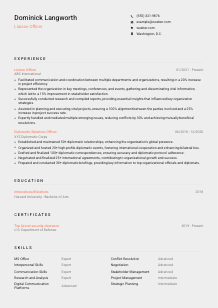
Do not stop at "attended meetings" or "coordinated stakeholders." Show what changed because of your work. Strong Liaison Officer bullets mention the parties involved, the communication action you took, and the result. The example does this well by linking coordination across departments and organizations to a 20% increase in project efficiency, and issue mediation to a 30% reduction in conflicts.
Quantify impact where the numbers are credible and relevant. In this field, useful measures include stakeholder satisfaction, project success rate, number of relationships managed, agreements negotiated, events supported, reports produced, or disputes resolved. The sample CV uses percentages and counts effectively, including 50+ diplomatic relationships and 100+ correspondences, which gives scale to otherwise broad claims.
Prioritise experience that supports liaison responsibilities first. If you have work in administration, policy support, program operations, or external affairs, select bullets that emphasize coordination, briefing, negotiation, and cross-functional communication rather than general office tasks. Every line should help the reader picture you handling the information flow and stakeholder dynamics of the target role.
A hiring team should be able to trace how you communicate across groups, represent an organisation in formal settings, and keep initiatives moving when priorities conflict. When your experience section does that with specific outcomes, your candidacy becomes much easier to trust.
Education matters more in Liaison Officer hiring when the role touches public affairs, diplomacy, interagency coordination, or politically sensitive environments. Your degree section should make the academic fit easy to spot, especially if the employer names fields such as International Relations or Political Science.
Check whether the employer asks for a specific academic background. Here, a bachelor's degree in International Relations, Political Science, or a related field is part of the stated requirement, so that information should be presented clearly and without extra digging.
List your degree, field of study, school, and graduation date or expected completion date. A simple structure helps hiring teams confirm that you meet the formal baseline while keeping the focus on the relevance of your coursework and institutional background.
If your degree maps closely to the posting, spell that out clearly. The example's Bachelor of Arts in International Relations does this immediately and supports the diplomatic and inter-organizational focus of the role without any extra explanation.
Most mid-career Liaison Officers do not need a long course list, but relevant coursework can help if you are earlier in your career or changing sectors. Classes in international negotiation, public policy, conflict resolution, security studies, or political communication can reinforce your preparation when professional experience is still developing.
Honors, fellowships, debate teams, Model UN, policy societies, or research projects can add value if they reflect diplomacy, analysis, writing, or stakeholder engagement. Keep these details selective and only include them when they support the kind of communication and judgment the role requires.
Your education section should quickly answer whether you meet the formal background expected for the role. Once that is clear, the rest of the CV can concentrate on how you applied that foundation in real coordination, reporting, and relationship-management work.
Certifications and formal credentials matter in Liaison Officer roles when they affect access, mobility, or eligibility. This section is especially useful when a posting mentions security clearance, driving requirements, or other credentials tied to the organisation's operating environment.
Read the posting closely and separate preferred credentials from true requirements. In this case, a Top Secret security clearance or the ability to obtain one, along with a valid state driver's license, are part of the role's practical eligibility. That should shape what you include and how prominently you present it.
List certifications and clearances in order of hiring importance. For a liaison role involving sensitive information or interagency access, security clearance belongs near the top. In the example, the Top Secret clearance is more decision-relevant than a general professional certificate, so it deserves priority.
Include issuance dates, validity periods, or current status when those details help clarify that the credential is active. For clearances and licenses, current status matters because it affects onboarding speed, assignment eligibility, and immediate operational readiness.
Update credentials as soon as they change. If you renew a license, obtain a clearance, or complete relevant training in areas such as security awareness, protocol, or conflict mediation, reflect that promptly. In liaison work, outdated status details can create avoidable questions about access and preparedness.
This section should tell the employer whether you can step into the role's access, mobility, and compliance requirements with minimal delay. When relevant credentials are current and clearly dated, they support your case in a very practical way.
A Liaison Officer skills section should read like the operating toolkit behind your day-to-day work. Focus on the abilities that support cross-group communication, research, reporting, negotiation, and issue management, then back those skills up elsewhere in the CV with examples and outcomes.
Start with the language used in the job description. For Liaison Officer roles, that usually includes interpersonal communication, relationship building, negotiation, research, reporting, project coordination, conflict resolution, MS Office, and digital communication tools. Using these terms naturally helps both recruiters and ATS systems match your background to the role.
Choose skills that reflect the way liaison work gets done. A balanced list often combines hard skills such as report drafting, MS Office, briefing preparation, and digital communication platforms with professional skills such as stakeholder management, mediation, and diplomacy. The example's mix of research and analysis, conflict resolution, negotiation, and stakeholder management is a good model for this balance.
Group or order your skills so the most relevant ones appear first. Avoid padding the section with broad traits that are not demonstrated elsewhere. For this role, a concise skills list built around communication, coordination, reporting tools, and relationship management is much more persuasive than a long list of generic strengths.
Your skills section should reinforce how you operate in meetings, correspondence, project coordination, and high-stakes communication. If the listed skills line up with both the job posting and your experience bullets, the CV reads as consistent and credible.
Language ability can be a practical hiring advantage for Liaison Officers, especially in diplomatic, international, or community-facing settings. Even when only English is required, the way you present language proficiency can strengthen your profile for communication-heavy roles.
Check the posting for mandatory language skills and put those first. Here, proficient English communication is explicitly required, so English should appear clearly and with an accurate proficiency level.
Place the required or primary working language at the top of the section. That gives the reader an immediate answer on whether you can handle meetings, correspondence, reports, and stakeholder communication in the language the role uses every day.
If you speak additional languages, include them when they are relevant to the environment or strengthen your ability to work across cultures. The example adds Spanish, which can be useful in many liaison contexts even when it is not a formal requirement.
Choose straightforward descriptors and apply them honestly. Hiring teams may use this section to gauge whether you can manage written communication, live discussions, or external representation without support.
Language skills matter most when they help you build trust, reduce misunderstanding, or support work across agencies, communities, or international partners. Present them as a practical communication asset, not as filler at the end of the CV.
For a Liaison Officer, language proficiency is relevant when it supports representation, relationship building, and smoother coordination. List only the languages you can use credibly in professional settings, and make the level clear.
The summary should give a hiring team a fast, accurate picture of your experience level and operating strengths. For Liaison Officer roles, that means naming your years of relevant work, the environments you have worked across, and the coordination or diplomatic functions you handle well.
Before writing the summary, identify the few themes the employer repeats. In this role, those include liaison experience, communication, relationship management, research and reporting, project support, and conflict resolution. Build your opening lines around those priorities rather than using a generic career statement.
Start with a direct introduction that names your role identity and relevant tenure. The example does this effectively with "Liaison Officer with over 4 years of experience," which quickly establishes seniority and makes the profile easier to place against the 3-year requirement.
Mention the work you are trusted to handle, such as inter-organizational coordination, stakeholder management, diplomatic representation, negotiation, or project alignment. Choose strengths that are supported by the experience section, so the summary feels like a precise lead-in rather than a list of claims.
Aim for 3 to 5 lines that read clearly in one pass. A Liaison Officer summary should sound composed, informed, and practical, with enough detail to show your specialization without repeating the entire CV. Save the fuller evidence for your experience bullets.
A well-written summary should make the rest of your CV easier to interpret. When it clearly frames your background in coordination, representation, and issue resolution, hiring teams can immediately read your experience through the lens of the role you want.
You now have a clear structure for presenting yourself as a Liaison Officer who can coordinate across parties, manage sensitive communication, and support projects with reliable reporting and follow-through. Wozber's free CV builder can help you turn that experience into an ATS-compliant CV that stays aligned with the language hiring teams expect to see.
If you want another pass before applying, use an ATS CV scanner to check whether the requirements in the posting are reflected in your experience, skills, and summary. Whether you start from an ATS-friendly CV template or revise an existing draft, your final CV should make one thing easy to judge: that you can represent an organisation well, keep stakeholders informed, and help complex work move without avoidable friction.




