




Use Wozber and land your dream job
Create CV
No registration required
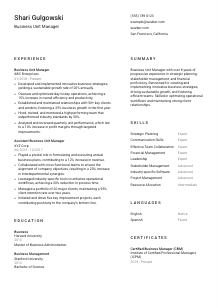
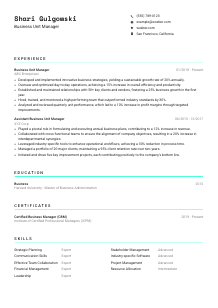
Steering P&Ls, but your CV seems in the red? Check out this Business Unit Manager CV example, created with Wozber free CV builder. Learn how to bring your strategic leadership in line with the job's compass, keeping your career chart flourishing in the black!
Business Unit Managers are hired to run a piece of the business with clear commercial accountability. Your CV needs to show that you can translate strategy into operating results, keep teams moving, and improve profitability without losing control of day-to-day execution. Hiring teams look for proof in outcomes such as revenue growth, margin improvement, process efficiency, client retention, and team performance.
A tailored CV helps separate broad management experience from true business unit ownership. When the language in your CV reflects the posting's priorities, such as financial management, strategic planning, resource allocation, and operational oversight, Wozber's free CV builder helps you shape an ATS-compliant CV that surfaces those qualifications quickly. That makes it easier for a hiring team to see whether you've already led a unit, function, or portfolio at the level this role requires.
This section should read like an executive header, not a full biography. For a Business Unit Manager, the basics matter because they establish professional identity, location fit when required, and clean contact access for follow-up conversations with recruiters, senior leaders, or HR.
Place your name at the top in a clear, readable format, then add the title "Business Unit Manager" directly below it. That immediate alignment matters for both ATS parsing and human review, especially when your background includes adjacent titles such as Operations Manager, General Manager, or Division Manager.
Include a phone number you answer reliably and a professional email address based on your name. Senior management roles are expected to look polished at every level, and small details like an outdated email handle can undercut the executive presence your CV should project.
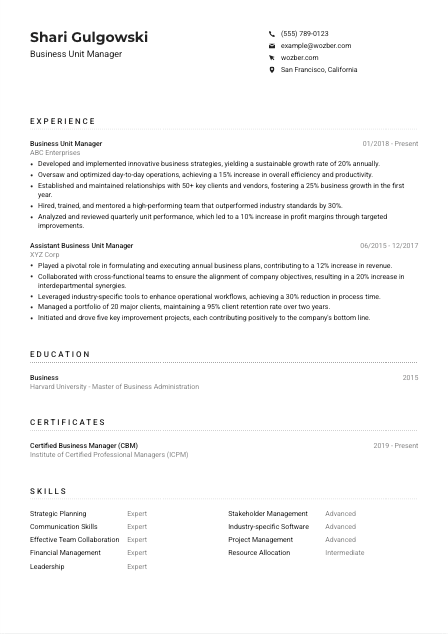
If the posting calls for a specific location, reflect that clearly in your header. In this example, listing San Francisco, California directly supports a stated requirement and removes a practical question early in the process. For other Business Unit Manager roles, only include location when it is relevant to the employer's setup or travel expectations.
Add a personal website or LinkedIn profile only if it strengthens your candidacy with useful business content, such as leadership scope, industry background, or measurable achievements. A generic or outdated link adds little for a role centered on operational leadership and commercial judgment.
Age, marital status, photo, and other non-job-related details do not help your case here. Business Unit Manager hiring decisions are driven by leadership scale, financial results, operational control, and stakeholder management, so keep the focus on information that supports those areas.
Your header should give the employer exactly what they need to contact you and confirm basic alignment. Keep it brief, accurate, and tailored to the role's practical requirements so the rest of the CV can stay focused on business performance.




This is the section most likely to decide whether you move forward. For a Business Unit Manager, employers want to see scope, business outcomes, leadership responsibility, and evidence that you improved the unit rather than simply kept it running.
Start by identifying the recurring themes in the role, then use them to shape your bullets. Here, the main priorities are business strategy, profitability, operations oversight, client and vendor relationships, people leadership, and performance review. Those should appear through concrete examples, not as a copied keyword list.
List roles in reverse chronological order and make the title, company, and dates easy to scan. For this profession, progression matters. Moving from an assistant or supporting management role into full unit ownership tells a stronger story than a flat list of responsibilities because it shows increased accountability for revenue, staffing, and execution.
Each bullet should answer a practical question: What did you own, what did you change, and what improved because of it? In the sample CV, achievements such as 20% annual growth, a 15% efficiency gain, and a 10% profit-margin increase work well because they connect strategy and operations to measurable commercial results.
Metrics should cover more than revenue. Include team size, client portfolio, vendor network, retention rates, cycle-time reduction, budget scope, or number of improvement initiatives when those figures are meaningful. The example's "50+ key clients and vendors" and "95% client retention rate" help show external relationship management, which is often a major part of business unit leadership.
Prioritise accomplishments that show ownership of planning, financial performance, resource allocation, hiring, mentoring, and cross-functional execution. If an older bullet describes work that is too tactical or too far from commercial leadership, trim it or rewrite it to highlight decision-making, business impact, or operational improvements that relate to the role you want now.
A Business Unit Manager CV should read like a track record of decisions, execution, and results. When your bullets show growth, margin, efficiency, client outcomes, and team leadership in concrete terms, employers can quickly see the level at which you operate.
Education matters here because the role often sits at the intersection of management, finance, operations, and strategy. Keep the section straightforward and aligned with the level of leadership expected, especially when the posting names a degree requirement or lists an MBA as preferred.
When a posting asks for a Bachelor's degree in Business, Management, or a related field, make sure that qualification is easy to find. List your degree, field of study, school, and graduation year in a clean format that ATS systems can parse without confusion.
If you hold an MBA or another advanced business degree, place it first. In this example, the MBA directly strengthens the candidacy because the role values strategic planning, financial management, and broader business judgment. For other openings, an advanced degree is helpful when it genuinely supports the level of leadership being pursued.
Use one structure across all entries so the section stays readable. Degree, field, institution, and year are enough for most experienced candidates. Clean formatting also supports ATS-friendly CV structure and avoids burying the credentials that already meet the requirement.
Most senior candidates do not need to list classes. Include relevant coursework only if it directly helps explain your preparation for work in areas such as finance, operations management, analytics, or organizational leadership, or if you are earlier in your career and need extra context.
Academic honors, leadership programs, or notable extracurriculars can stay if they reinforce business leadership or analytical strength. For a seasoned Business Unit Manager, though, education should support the story rather than compete with the experience section, which carries more weight in hiring decisions.
This section should confirm that you meet the role's academic baseline and, where applicable, show added business training such as an MBA. Present it clearly, then let your operating results do the heavier work elsewhere on the page.
Certifications are rarely the first deciding factor for a Business Unit Manager, but they can sharpen your profile when they reinforce leadership, operations, finance, or industry knowledge. Include them when they add credibility to the kind of unit you manage or the complexity of the environment.
Some Business Unit Manager roles do not require certifications at all, while others value industry-specific designations or management credentials. Start with the job description and include certificates that strengthen the exact mix of leadership, financial oversight, or operational specialization the employer wants.
Choose certifications that support the responsibilities you want to own, such as business management, financial planning, project delivery, operational improvement, or sector-specific compliance. In the sample CV, a Certified Business Manager credential adds a useful signal because it aligns with executive oversight and structured management practice.
If the certification is active, renewed, or recently earned, list the date range or issue year. That helps employers see whether your training is current, particularly in industries where tools, reporting standards, or regulatory expectations change quickly.
For leadership roles, certifications work best when they support an already credible management record. They can show that you continue building capability in areas such as performance management, strategic planning, or operational excellence rather than relying only on past titles.
A certificate should deepen the picture your experience already creates. If it strengthens your authority in business operations, financial decision-making, or team leadership, it earns its place.
Business Unit Manager roles combine commercial thinking with operational control, so your skills section should reflect both. Avoid turning it into a generic management checklist. Focus on the capabilities that support revenue, profitability, team performance, and execution across functions.
Read the job description closely and pull out the capabilities that directly affect unit performance. For this position, that includes strategic planning, financial management, resource allocation, stakeholder management, team leadership, and familiarity with industry-specific software or technologies.
List the strongest and most relevant capabilities first. A Business Unit Manager is usually evaluated on how well they plan, allocate resources, lead teams, review performance, and maintain key relationships, so those should appear before broad skills that could belong to almost any manager.
Use a concise list rather than a crowded inventory of every tool or trait you've ever used. The sample CV handles this well by combining strategic and interpersonal strengths with role-relevant functional areas such as financial management, stakeholder management, project management, and industry software. Aim for that balance of clarity and relevance.
Your skills section should reinforce the leadership and operational themes already proven in your experience. When the selection is tight and role-specific, it helps the employer connect your background to the business challenges they need solved.
Language skills matter when they affect leadership communication, client relationships, or cross-border work. For many Business Unit Manager roles, the main requirement is clear business communication in the company's working language, with additional languages becoming valuable when the market, client base, or partner network makes them useful.
If the posting makes a language mandatory, list it clearly with your proficiency level. Here, English is required, so it should appear first and be stated unambiguously. That removes an easy screening issue and confirms you can handle reporting, negotiations, and team communication in the expected language.
After the required language, list any others that support the role. Place the languages most useful to your client base, region, or stakeholder environment higher. This matters more than listing many languages without clear business value.
Additional languages can strengthen your profile when the unit works with diverse customers, vendors, or internal teams. In the example, Spanish adds useful breadth because it can support client communication and relationship-building, though it is an advantage rather than a universal requirement for every Business Unit Manager role.
Use plain levels such as native, fluent, professional working proficiency, or basic. Overstating language ability can create immediate problems in interviews or on the job, especially for leadership positions where presentations, negotiations, and performance discussions require accuracy and confidence.
Only give this section more space if languages genuinely matter to the business environment. If the role is heavily domestic, a short language section is enough. If the unit serves international accounts or multilingual teams, your language skills become more relevant because they support smoother communication and stronger external relationships.
For a Business Unit Manager, languages are most useful when they support communication with teams, clients, or partners. State them clearly, keep the levels honest, and let the role determine how much emphasis they deserve.
The summary sits at the top of the CV and should quickly establish the level at which you lead. For a Business Unit Manager, that means combining leadership scope with business outcomes, not writing a vague profile about being results-driven or strategic.
Start by identifying the few priorities that define the role. In this case, those include strategic planning, profitability, financial management, operational oversight, stakeholder relationships, and team leadership. Your summary should echo the most important of these in natural language.
The first line should immediately position you. A phrase such as "Business Unit Manager with 8+ years of leadership experience" works because it sets scope quickly. If your background includes managing a business line, regional function, or operational unit, mention that level of responsibility early.
Use the next sentence or two to connect your strengths to measurable outcomes. The sample summary does this well by linking strategic planning and stakeholder management to sustainable growth, operational workflow improvement, and strong client relationships. That approach is far more persuasive than general claims about leadership ability.
Aim for three to five lines that make a hiring manager want to read the experience section. For this profession, the strongest summaries mention business impact, leadership scope, and functional strengths such as financial oversight or operational improvement without becoming a paragraph-length biography.
Your summary should make one thing clear within seconds: you have already led teams, operations, and business performance at a level relevant to the role. If that message is sharp and credible, the rest of the CV has a much easier job.
A Business Unit Manager CV works when every section points to the same conclusion: you can lead a unit, improve performance, and make sound commercial decisions. That means aligning your title, experience, education, and skills around outcomes the business actually tracks, such as growth, profit, efficiency, retention, and team results.
Use Wozber's free CV builder to organise that story in an ATS-friendly CV template, then refine it with the ATS CV scanner so the language reflects the target role's requirements. The final version should make your leadership scope and business impact easy to judge before the first interview.




