



Use Wozber and land your dream job
Create CV
No registration required
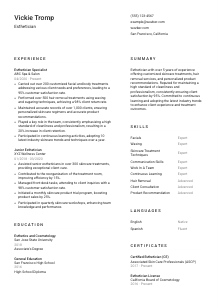
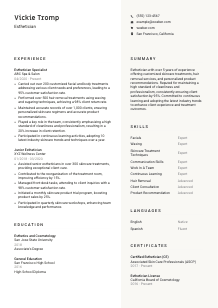
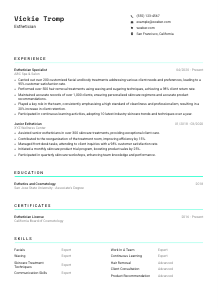
Perfecting complexions, but your CV seems blemished? Browse this Esthetician CV example, made with Wozber free CV builder. Learn how to blend your skincare savvy with job requirements, so your career shines as brightly as your clients' radiance!
Estheticians are hired on the quality of client experience they create from consultation through aftercare. A CV for this field needs to show more than a list of services. It should make clear that you can perform treatments safely, keep treatment areas clean, document client history accurately, and build trust that brings people back for repeat bookings and product purchases.
When your CV is tailored to the posting, hiring teams can quickly connect your treatment mix, client care style, and retail experience to the services they offer. Wozber's free CV builder helps you shape that information into an ATS-compliant CV with the right esthetics keywords and structure, so the employer can see faster whether you match their service menu, standards, and client-facing expectations.
Front-desk staff, spa managers, and salon owners need straightforward contact information before they can move you to the next step. In esthetics, this section also helps confirm practical requirements such as title alignment and, when requested, local availability. Keep it clean, professional, and easy to scan.
Use your full name in a larger font than the rest of the CV so it is easy to spot. Avoid extra descriptors or decorative wording. In a service business where first impressions matter, your CV should feel as polished as your treatment room setup.
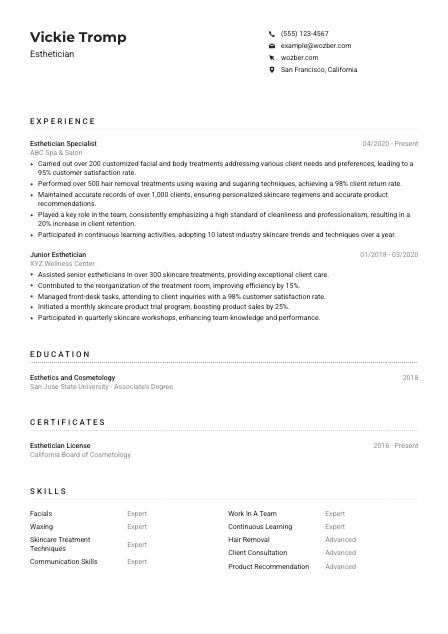
Place "Esthetician" directly under your name if that is the target role. If your current title is more specific, such as "Esthetician Specialist," you can still align it to the opening as long as it reflects your actual work. This helps a hiring manager immediately connect your background to facials, waxing, consultations, and skincare service delivery.
Include a reliable phone number and a professional email address. Double-check for typos. In client-service roles, responsiveness matters, and employers often reach out quickly when they are filling schedules, expanding service coverage, or replacing a departing team member.
If a job requires local presence, include your city and state clearly. For the example role, listing "San Francisco, California" addresses that requirement right away. Do this when location is relevant to the posting, especially for on-site spa and salon roles where employers want to avoid relocation uncertainty.
A LinkedIn page, booking profile, or portfolio can help if it reflects your treatment background, certifications, retail experience, or client-facing professionalism. Only include it if the information is current and consistent with your CV.
This section should remove friction, not create it. When your title, contact details, and location line up with the role, the reader can move straight to your treatment experience and client results.




Spa and salon hiring decisions often turn on what you have handled in a real treatment setting. Employers want to see the services you performed, the pace you worked at, the client outcomes you supported, and how well you contributed to cleanliness, documentation, and retail recommendations. Your experience section should read like practice, not theory.
Pull the main duties from the job description and reflect them in your bullets using your real experience. For an esthetician role, that usually means customised facials, body treatments, waxing or sugaring, skincare consultations, recordkeeping, product recommendations, and professional sanitation. When those terms match your background, use them naturally in your descriptions.
Start with your most recent esthetics role and include job title, employer, and dates. This helps the reader understand your current level quickly, whether you are already running a full treatment book, supporting a busy spa floor, or moving up from junior service work into a more independent client-care role.
Bullet points should show what you delivered. Good esthetician metrics include number of treatments performed, customer satisfaction, return rate, retention, retail sales, efficiency improvements, or size of client records managed. The sample CV does this well by pairing services with outcomes such as 200 plus customised treatments, a 95% satisfaction rate, and a 98% client return rate.
If you have unrelated jobs, trim them down or leave them off when you already have enough relevant salon or spa experience. Customer service from another setting can help, but your priority is to show treatment competence, consultation ability, hygiene standards, and comfort working with clients in a professional care environment.
Esthetics changes with new techniques, product lines, and treatment protocols. Mention workshops, vendor training, advanced service education, or new modalities you adopted. In the example, ongoing learning is tied to applying updated skincare trends and techniques, which is stronger than simply saying "passionate about learning."
The best experience sections show a pattern of safe service delivery, repeat business, clean operations, and useful skincare guidance. That is what helps a hiring team picture you working the floor from day one.
Education matters in esthetics because it shows where your technical foundation started. Even when employers care more about hands-on work than classroom detail, your training still helps establish that you learned skin theory, treatment basics, sanitation standards, and client-care principles in a formal setting.
List the degree, diploma, or esthetics program most relevant to your practice. For many candidates, that will be esthetics, cosmetology, or a related beauty program. If your education is directly tied to skincare and treatment work, make that easy to find.
Include the school name, credential, field of study, and graduation year or date. Clean formatting works best here. Hiring teams are usually checking this section for background confirmation, not a long academic story.
If the posting requires a valid Esthetician or Cosmetology License, place that credential in the certifications section rather than burying it under education. The example role specifically asks for licensure, so the CV should make that requirement visible within seconds.
If you are earlier in your career, you can include honors, advanced coursework, student clinic work, or specialty training in areas like chemical peels, hair removal, or skincare analysis. For experienced estheticians, keep these additions selective and relevant.
Post-qualification classes can be especially valuable when they relate to services on the employer's menu. Training in advanced facials, body treatments, acne protocols, waxing methods, or retail product knowledge shows that your education did not stop after school.
Your education section should confirm that you have the training behind your hands-on work. Keep it concise, relevant, and positioned to support the more decisive parts of the CV, especially experience and licensure.
In this field, credentials are operational requirements, not decorative extras. A valid license tells the employer you can legally perform services. Additional certifications can strengthen your profile when they relate to the treatment menu, product lines, or service level the spa or salon wants to offer.
Start with the credential that allows you to practice. For many employers, this is the first item they look for after confirming your experience. Make sure the license name, issuing body, and validity are clear.
List the credentials most relevant to the target role first. If the employer emphasizes facials, hair removal, specialised therapies, or skincare consultation, certifications in those areas deserve space before unrelated training. Relevance matters more than quantity.
An active credential carries more weight than one with unclear status. Use dates, renewal ranges, or wording such as "Present" where accurate. The sample CV handles this clearly with an active California license and a current esthetician certification.
Continuing certification can help you move into higher-value treatments, premium spas, or more specialised client care. Add new credentials when they reflect real capability, such as advanced exfoliation, acne treatment, lymphatic techniques, or product-specific education that supports retail recommendations.
If a license is required, do not make the employer hunt for it. Put your essential credential first, then use additional certifications to show where your treatment expertise goes beyond the basics.
A useful esthetician skills section balances technical treatment ability with client-facing service. Hiring managers usually scan this area for the core services they need covered, plus the consultation, hygiene, teamwork, and retail strengths that shape day-to-day performance in a spa or salon.
Read the description closely and note the treatment types, consultation tasks, and workplace expectations it names. In the example, that includes facials, body treatments, waxing, sugaring, client care, communication, cleanliness, and teamwork. Those are the skills to surface if they match your actual background.
Only list strengths that are backed up by experience, training, or certifications. If you claim expertise in waxing, facials, or personalized skincare regimens, your work history should show treatment volume, client outcomes, or related responsibilities that support those claims.
Group technical and interpersonal skills in a logical order. For example, place service skills like facials, hair removal, skincare treatment techniques, and product recommendation near client consultation, communication, and teamwork. That mix reflects how the work actually happens in a treatment room and on a spa floor.
This section should make your treatment strengths easy to spot at a glance. Keep the list relevant to the employer's services and grounded in what you have already done with real clients.
Language ability matters in esthetics because treatment quality depends on clear consultation, informed consent, aftercare guidance, and product discussion. If you can communicate smoothly with more clients, you can often improve both service quality and the overall guest experience.
If the job specifies a language requirement, place it at the top of this section. For the posted role, effective English communication is required, so "English" should appear clearly with an honest proficiency level.
Additional languages can be valuable in salons and spas that serve diverse communities. They can support consultations, comfort during treatments, clearer aftercare instructions, and stronger product recommendations at checkout.
Choose levels that accurately reflect how well you can work with clients. "Native," "Fluent," "Intermediate," and "Basic" are usually enough. Overstating your level can create awkward situations during consultations or front-desk interactions.
In a large city or tourist-heavy market, multilingual ability can support broader client coverage. That does not make extra languages mandatory for every esthetician role, but when they are relevant, they can strengthen your value in a client-facing environment.
Only include languages you could comfortably use in real work situations, whether that means greeting clients, discussing skin concerns, explaining a waxing process, or walking someone through a home-care routine.
For estheticians, language skills matter most when they improve consultation quality and client comfort. Present them honestly so the employer can judge how you would communicate on the floor.
The summary sits at the top of the CV, so it needs to tell the employer quickly what kind of esthetician you are. This is where you connect your years of experience, core treatments, client-care strengths, and a few concrete outcomes in a tight paragraph that matches the role you want.
Shape the summary around the work named in the posting. If the employer needs someone with spa or salon experience, facial and body treatment capability, waxing skills, consultation strength, and clean documentation habits, bring those points forward early.
Lead with your title and experience, then name the service areas you are strongest in. A line such as "Esthetician with over 5 years of experience in customised skincare treatments and hair removal services" works because it immediately tells the reader your level and your treatment focus.
Choose specifics that reflect the job, such as client satisfaction, cleanliness standards, personalized regimens, product recommendations, or repeat business. The sample summary uses a 95% client satisfaction result and highlights professionalism and continuous learning, which aligns well with the role's expectations.
Aim for a short paragraph, not a biography. Every phrase should earn its place by clarifying service scope, client-care quality, or business value. If a sentence does not help the employer picture you handling appointments, recommending products, or contributing to the team, cut it.
A focused summary helps the employer understand your treatment strengths before they read the rest of the page. When it reflects the services, care standards, and client outcomes they need, the rest of your CV lands with more force.
An esthetician CV works best when it shows licensed practice, hands-on treatment experience, consultation quality, sanitation standards, and the kind of client outcomes that matter in a spa or salon. Once those pieces are tailored to the job description, your CV gives a hiring manager a much clearer view of how you would perform with their clients and team.
Use Wozber's free CV builder to organise your experience in an ATS-friendly CV format, strengthen wording with role-specific terminology, and check alignment with an ATS CV scanner. The final result should make it easy to judge your service range, client-care standards, and readiness to step into the room and deliver.




