



Use Wozber and land your dream job
Create CV
No registration required
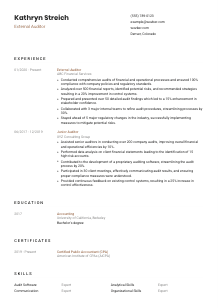
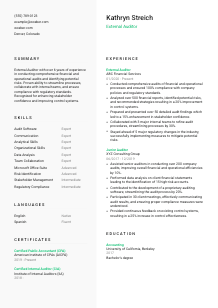
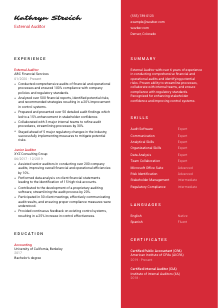
Auditing firms, but your CV isn't getting a thumbs-up? Investigate this External Auditor CV example, created with Wozber free CV builder. Learn how to clearly outline your assurance expertise to align with job requirements, ensuring your auditing career stays "accountable" to success!
External audit work lives in the details. Hiring teams want to see whether you can review financial statements, test controls, trace compliance issues, and turn findings into clear recommendations that management can act on. A CV for this field works best when it shows that kind of judgment directly, through audit scope, regulatory exposure, risk analysis, and the business results of your recommendations.
Screening gets much easier when those audit strengths are tied closely to the target opening's language. Wozber's free CV builder helps you shape an ATS-compliant CV around the posting's terminology, whether that means financial and operational audits, control reviews, audit software, or stakeholder presentations. That gives reviewers a faster read on whether you can step into the audit cycle and contribute with minimal ramp-up.
In audit hiring, even the header section should feel orderly and professional. It needs to show that you understand business standards, communicate clearly, and can meet any practical requirement the employer flagged, such as location or contact availability.
Use your full name as the main heading in a readable format. For an External Auditor, that simple choice matters more than it seems. A clean header signals the same precision employers expect in audit documentation, workpapers, and final reports.
Place "External Auditor" beneath your name when that matches the role you are pursuing. It immediately connects your profile to the opening and helps frame the rest of the CV around audit work rather than broader accounting or finance duties.
Your phone number and email should look business-ready and be easy to reach. Audit roles involve steady communication with clients, internal teams, and stakeholders, so your contact details should reflect that same professionalism.
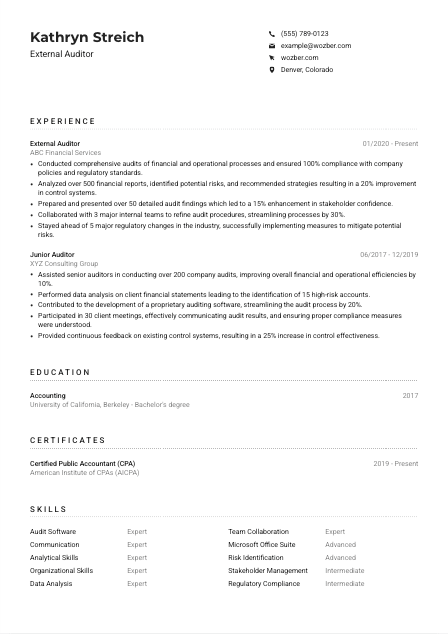
If the employer asks for candidates based in a specific city or open to relocation, address that clearly in your header. In the example, listing Denver, Colorado directly supports a stated requirement and removes an avoidable question early in the review.
Include LinkedIn or a personal professional site only if it supports your candidacy. For auditors, that usually means a profile with consistent job dates, certifications such as CPA or CIA, and experience that matches the audit work described on the CV.
This section should read like the start of a well-prepared audit file: accurate, polished, and easy to act on. If your header already matches the role and key logistics, the rest of the CV can stay focused on your audit capability.




This is where an External Auditor CV either becomes convincing or stays generic. Employers need more than a list of employers and duties. They want to see what you audited, how you assessed risk, what controls or processes you improved, and how clearly you communicated findings.
Start by marking the responsibilities that define the opening. For this role, that includes auditing financial and operational processes, analysing reports and controls, presenting findings, collaborating on corrective actions, and keeping up with regulatory change. Those points should shape the bullets you choose and the language you use.
List positions in reverse chronological order with title, employer, and dates. That structure helps reviewers quickly track your audit progression, from early support work to more independent testing, reporting, and stakeholder-facing responsibilities.
Replace generic task lists with accomplishment bullets that show scope, method, and result. The sample does this well with points like analysing more than 500 financial reports, presenting over 50 audit findings, and improving control systems by 20%. Those details show real audit execution, not just participation.
Numbers are especially useful in this field because they show volume, complexity, and business effect. Quantify audits completed, reports reviewed, control gaps identified, compliance rates, process improvements, corrective action adoption, or time saved through better procedures or software. Metrics like 100% compliance, 30% process streamlining, or identified high-risk accounts make your contribution easier to judge.
Prioritise work that supports external auditing, internal controls, regulatory compliance, risk assessment, client or stakeholder communication, and data analysis. If you have adjacent accounting or finance experience, keep only the parts that strengthen your case for audit work. Every line should move the reader toward the same conclusion: you can run or support audits effectively in a regulated environment.
Your experience section should leave no doubt about the kind of audit work you can handle. When your bullets show testing, analysis, findings, recommendations, and measurable improvements, hiring teams can picture you contributing in the next engagement cycle.
External auditors are trusted with financial accuracy, control evaluation, and compliance reporting, so the education section needs to show a solid accounting or finance foundation. Keep it straightforward, but make sure it reflects the academic background the role actually asks for.
If the posting calls for a bachelor's degree in Accounting, Finance, or a related field, make that easy to find. For audit positions, this is often a baseline requirement rather than a nice extra, so do not bury it below less relevant education.
Include your degree, field of study, school, and graduation year or date range. Auditing depends on organised, accurate presentation, and the education section should reflect that same discipline.
When your degree directly supports the role, say so plainly. The example's Bachelor's degree in Accounting aligns cleanly with the employer's requirement and reinforces technical preparation in financial reporting, controls, and analysis.
Relevant coursework can help if you are early in your career or if your program included subjects that map directly to the role, such as auditing, financial accounting, internal controls, risk management, or regulatory compliance. Skip long course lists once your professional audit experience carries more weight.
Honors, major projects, accounting society leadership, or audit-focused casework can be useful when they add context to your technical development. Keep them only if they reinforce your readiness for audit responsibilities rather than filling space.
For audit roles, your education section should quickly answer one question: do you have the technical base for financial review and control analysis? If that answer is clear at a glance, the reader can move straight to your professional track record.
Certifications carry real weight in auditing because they point to recognized technical standards and professional discipline. When a posting mentions CPA or CIA, employers are looking for more than initials. They are looking for proof that you understand audit frameworks, ethics, controls, and reporting expectations at a professional level.
Lead with certifications that the employer named or would naturally value for the position. Here, CPA and CIA belong at the top because they connect directly to audit credibility and match the stated preference in the job description.
List certifications that reinforce your ability to perform audit work, interpret standards, and communicate findings with confidence. A short, relevant certifications section is more effective than a crowded list of unrelated training.
Show when each certification was earned and whether it is current. In audit and compliance work, recency matters because standards, regulations, and continuing education expectations keep evolving.
If you are pursuing additional audit, risk, or compliance training, include it when relevant. Ongoing education supports the part of the role that involves staying current with regulatory changes and understanding how those changes affect audit scope and recommendations.
A focused certifications section strengthens your credibility quickly. When your credentials line up with the role's audit requirements, they support the rest of your CV with recognized professional standing.
The skills section for an External Auditor should read like a practical audit toolkit, not a generic keyword bank. It needs to show that you can work through audit procedures, analyse financial data, communicate findings, and manage documentation in the systems employers actually use.
Pull out the tools and capabilities named in the posting, then compare them with your actual experience. For this opening, audit software, Microsoft Office, communication, analytical ability, and organisation all deserve attention because they connect directly to day-to-day audit work.
An External Auditor needs both. Include technical capabilities such as audit software, data analysis, regulatory compliance, risk identification, and Excel or broader Office proficiency, then support them with communication and collaboration skills used in client meetings, management presentations, and corrective action follow-up.
Keep the section focused on the skills most relevant to planning, testing, documentation, reporting, and stakeholder interaction. The example's mix of audit software, data analysis, communication, and control-related skills works because each item supports a recognizable part of the audit process.
A well-chosen skills section should make it easy to picture you handling fieldwork, analysis, reporting, and follow-up. Keep it concise, role-specific, and grounded in tools and abilities you can back up elsewhere on the CV.
Language skills matter in audit when they affect reporting, client communication, or work across multi-region teams. Even when the role is locally based, the posting may still require a specific working language for documentation, presentations, and regulatory communication.
If English proficiency is listed as mandatory, place English first and state your level clearly. For an External Auditor, this matters because audit reports, management discussions, and compliance documentation depend on precise language.
Additional languages can strengthen your profile when the organisation serves diverse clients, works across regions, or coordinates with international teams. They are a plus, but they should follow the required working language rather than distract from it.
Use clear levels that reflect how well you can work in professional contexts, especially where audit interviews, written findings, or regulatory terminology are involved.
If you have strong language ability beyond the requirement, it can support work with cross-functional teams, international subsidiaries, or varied client groups. That is especially relevant in audit environments where clear communication affects evidence gathering and recommendation follow-through.
Only include languages you would be comfortable using in a professional setting. In the sample, English and Spanish work well because they extend communication range without overstating capability.
Language entries should support the kind of audit communication the role requires, from report writing to stakeholder conversations. Accuracy matters here as much as it does in any other section.
The summary should quickly establish what kind of auditor you are, how much experience you bring, and what audit value you tend to deliver. In a field built on clarity and judgment, this section works best when it is specific about audit scope, regulatory awareness, and the outcomes your work has produced.
Before writing, identify the few points that define the opening. Here, those include financial and operational audits, risk identification, control improvement, communication with management, and regulatory compliance. Your summary should reflect that mix rather than sounding like a generic accounting profile.
Start with your title and years of relevant experience, then name the kind of audits you handle. A line such as "External Auditor with 6+ years of experience in financial and operational audits" gives immediate context and sets the right level.
Choose points that connect directly to the role, such as analysing financial reports, improving control systems, presenting findings to stakeholders, or using audit software effectively. The example summary works because it stays close to audit responsibilities and mentions outcomes like stronger controls and stakeholder confidence.
Aim for a short paragraph of 3 to 5 lines. Skip broad adjectives and use space for specifics that support interview-worthy claims, such as years of experience, audit scope, compliance focus, or measurable process improvement.
A strong summary gives the reader your audit specialty, level, and value in a few lines. When it is tailored to the role, it frames the rest of the CV around the kind of findings, controls, and business improvements you know how to deliver.
A tailored External Auditor CV should now show the essentials clearly: the right accounting foundation, relevant audit experience, certifications that strengthen trust, and results tied to compliance, controls, and risk analysis.
Use Wozber's free CV builder to refine wording, keep your ATS-friendly CV format clean, and strengthen ATS optimisation around the exact audit language in the posting. The finished CV should make it easy to see how you review controls, communicate findings, and support better financial and operational decisions.




