



Use Wozber and land your dream job
Create Resume
No registration required
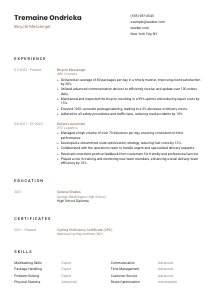
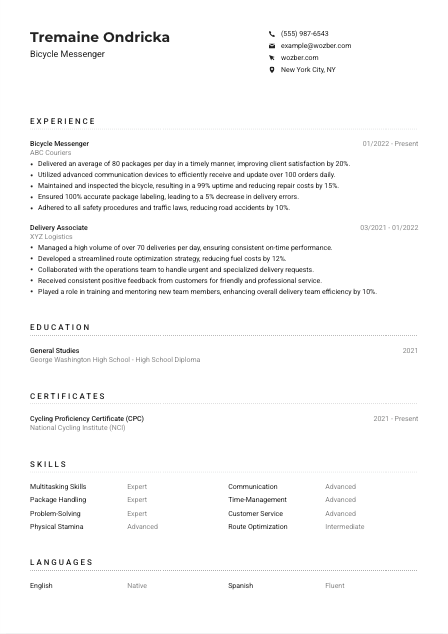
Dodging traffic, but your resume seems stuck in the bike lane? Check out this Bicycle Messenger resume example, created with Wozber free resume builder. Learn how to bring across your urban grit and speedy ventures to match job specifics, ensuring your career path races as quickly as your two-wheeled missions!
Bicycle messenger work is judged in motion. Hiring teams want to see whether you can move packages quickly through crowded streets, follow traffic laws under pressure, handle weather and route changes, and still deliver accurate handoffs with labels and signatures intact. Your resume should make that day-to-day reliability visible, not bury it under generic delivery language.
A tailored resume changes how quickly your delivery volume, route knowledge, and safety habits come through in both ATS screening and human review. Wozber's free resume builder helps you match the posting's language in an ATS-friendly resume format, so dispatch-facing skills like order updates, on-time delivery, and bike upkeep are easier to spot right away. That clarity matters when employers are choosing between general couriers and candidates who already know how to perform on a bike.
For a Bicycle Messenger, the header does more than identify you. It immediately answers practical questions about contactability, location, and role focus. Keep this section direct so a dispatcher or hiring manager can tell within seconds that you are reachable, local when required, and applying for the right kind of delivery work.
Use your full name in a slightly larger font than the rest of the header. Skip nicknames unless that is how you are known professionally. For a role built around speed and clear handoffs, your contact section should feel just as clean and readable as the delivery records you would be trusted to manage.
Place the job title directly below your name and match it to the role you want. If the posting says "Bicycle Messenger," use that wording rather than a broader label like "Courier" or "Delivery Worker." It immediately connects your application to bike-based delivery, route navigation, and street-level logistics instead of general transport work.
Your phone number and email should support quick scheduling and follow-up, especially for roles that often hire fast.
If a posting calls for a candidate to be based in a specific city, include that city and state in your header. In the example, listing "New York City, NY" directly addresses the employer's local requirement and signals familiarity with the area's streets, traffic flow, and delivery pace.
If you have a LinkedIn profile or similar page, include it only when it supports the application with consistent job history, delivery experience, or certifications. Make sure the dates, titles, and responsibilities match your resume. For hands-on logistics work, accuracy across profiles matters more than having extra links.
This section should answer the basics without friction: who you are, what job you want, how to reach you, and whether you meet any location requirement. Once that is clear, the rest of the resume can focus on delivery speed, safety, and reliability.




Experience matters quickly in bicycle messenger hiring because the job comes with little room for hesitation. Employers want to know whether you can keep pace, manage multiple deliveries, communicate status updates, and stay safe in traffic. Your bullet points should read like proof from the road, with clear volume, accuracy, and reliability built into each one.
Start by marking the parts of the job description that reflect daily performance: timely deliveries, communication device use, bicycle inspection, accurate labeling, signatures, traffic-law compliance, and stamina. These details tell you what your experience section needs to emphasize. For this kind of role, generic bullets about being "hardworking" or "responsible" are weaker than specifics about delivery counts, on-time performance, or safety records.
List your most recent role first, then work backward. Include employer name, job title, and dates for each position. Bicycle messenger and courier hiring often moves fast, so your chronology should make it easy to see whether you already have the required 1+ year of related delivery experience without forcing the reader to piece it together.
Each bullet should show what you handled and how well you handled it. Useful details include packages delivered per shift, client update volume, urgent delivery handling, route efficiency, and package accuracy. The example does this well with lines such as delivering an average of 80 packages per day and improving client satisfaction by 20%, which tells the employer both the pace and the result.
Quantify the work in terms that matter for bicycle delivery. Package volume, on-time rates, client satisfaction, repair reduction, bike uptime, order updates processed, and safety improvements all make your claims concrete. In the sample resume, "99% uptime" and a reduction in delivery errors are especially strong because they connect maintenance and handling accuracy to real operating results.
Stay focused on work that supports bike-based delivery. Customer service is relevant when it relates to handoffs, signatures, and client communication. Teamwork matters when it shows coordination with dispatch or operations. Older or less relevant experience should only stay if it helps prove stamina, time management, route planning, or dependable high-volume delivery under pressure.
A Bicycle Messenger resume works best when the experience section quickly shows pace, precision, and safe execution. If a hiring manager can see your delivery volume, reliability, and street-level judgment in a few bullets, you are already making the right case.
Education usually plays a supporting role here, but it still needs to be handled cleanly. Most bicycle messenger postings do not ask for advanced academic credentials. They want confirmation that you meet the stated baseline while your experience, route knowledge, and delivery record carry the application.
Check the posting for the minimum requirement and meet it directly. Here, the employer asks for a high school diploma or equivalent, so that credential should appear clearly on the resume. There is no need to overcomplicate the section when the requirement is straightforward.
List the school name, diploma or degree, field if useful, and graduation year. This keeps the section easy to scan and avoids distracting from the more important parts of the resume, such as delivery experience and job-specific skills.
If your education directly meets the requirement, make sure that is obvious. In the example, "High School Diploma" lines up exactly with what the employer requested. That kind of direct match is enough for many messenger roles, especially when paired with solid recent delivery experience.
Extra coursework is optional, but it can help if it relates to logistics, cycling safety, urban navigation, or customer service. Include it only when it adds useful context. A long list of unrelated classes will not carry much weight compared with practical delivery performance.
Academic honors or leadership can stay if they show consistency, responsibility, or physical discipline, but keep them brief. For this profession, the resume earns more traction from field execution than from classroom detail, so do not let this section crowd out stronger proof from your work history.
Meet the requirement, present it cleanly, and move on. For most Bicycle Messenger applications, education confirms eligibility while your experience shows how you perform on the street.
Certifications are not always required for bicycle messenger jobs, but the right one can strengthen your resume when it reinforces safe riding, maintenance awareness, or delivery readiness. This section works best when it adds practical value instead of padding the page.
Lead with certifications that support bike-based delivery, road safety, first aid, or related logistics training. Even when a posting does not require formal credentials, a relevant certificate can show that you take safe riding and professional standards seriously. The sample's "Cycling Proficiency Certificate" is a good example because it supports the role without pretending to be mandatory everywhere.
A short, relevant certificate section is stronger than a long list of unrelated completions. If a credential does not support delivery work, equipment handling, or customer-facing service, leave it out. This keeps the resume aligned with what the employer actually needs on the road.
Add the issue date or active date range, especially for certifications tied to current safety practices or recent training. Dates help employers see whether the credential is current and whether you have continued developing skills that matter in an active delivery environment.
If you plan to strengthen your profile, look for training that improves performance in real messenger work, such as defensive cycling, bike maintenance, first aid, or urban route safety. Those additions can be useful when competing for roles with stricter service or safety expectations.
The best certificates support what your experience already shows: that you can ride safely, work reliably, and handle delivery demands with professionalism. When they do that, this section earns its place.
The skills section should reflect how bicycle messenger work actually gets done. Employers are looking for a mix of physical capability, route judgment, package handling, communication, and consistency under time pressure. Keep the list focused on the skills that support daily delivery performance rather than broad traits that could belong to any job.
Read the posting closely and note both the stated and implied skills. In this case, that includes time management, multitasking, local traffic knowledge, physical stamina, communication device use, safe riding, and accurate package handling. Those are the terms that should shape your skills section and your experience bullets.
Select skills you genuinely use in messenger or delivery work and phrase them in language the employer will recognize. "Physical Stamina," "Time-Management," "Communication," and "Route Optimization" all make sense when they reflect actual experience. The sample resume handles this well by balancing operational skills with customer-facing ones instead of listing generic personality traits.
Do not overload the section. A focused list is easier to scan and stronger for ATS optimization when the terms accurately match the posting. Prioritize skills tied to route execution, safety, package accuracy, dispatch communication, and delivery pace. If a skill does not help you move, track, or complete deliveries more effectively, it probably belongs elsewhere or not at all.
Your skills section should sound like the toolkit of someone who can complete deliveries efficiently and safely. When the list reflects real street-level work, it supports everything else on the resume.
Language matters in messenger work because instructions, client updates, signatures, and handoffs all depend on clear communication. Even in a fast-moving role, employers need confidence that you can understand dispatch directions, confirm delivery details, and interact professionally with customers and office staff.
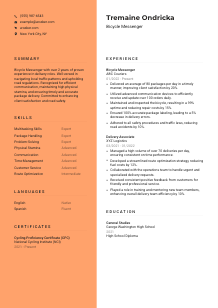
If the posting names a required language, list it first with your proficiency level. Here, English is mandatory, so it should appear clearly and prominently. That tells the employer you can handle route instructions, delivery confirmations, and customer communication without delay.
Additional languages can strengthen your application, especially in dense urban markets where you may interact with a wide mix of clients, front desks, and building staff. In the sample resume, Spanish adds extra value, but it works best as a secondary strength after the required English proficiency is already clear.
Use honest ratings such as Native, Fluent, Intermediate, or Basic. Overstating language ability can create problems quickly in a job where instructions may change mid-route and client communication needs to be precise.
For most Bicycle Messenger resumes, this section should stay short. English fluency may be essential, while additional languages are a plus depending on the customer base and service area. Do not let this section become larger than your evidence of delivery experience and reliability.
When you speak more than one language, present it as a communication advantage in the field. It can help with smoother pickups, clearer handoffs, and better customer interactions, particularly in busy neighborhoods and mixed commercial districts. Keep the emphasis practical rather than decorative.
This section should quickly confirm that you can understand instructions and communicate clearly during pickups and deliveries. That is the part employers need to see first.
The summary sits at the top of the resume, so it needs to establish your value quickly. For a Bicycle Messenger, that usually means showing experience level, delivery reliability, knowledge of streets and safety rules, and the kind of pace or accuracy you bring to the job. Keep it short, but make every line count.
Before writing the summary, identify the few points that define your candidacy best. For this profession, that might be years of delivery experience, familiarity with city traffic patterns, safe riding habits, communication with dispatch or clients, and consistent on-time performance. Build from what the job needs every day.
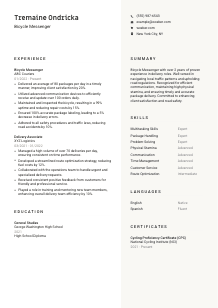
Your first line should place you clearly in the field. A direct opening such as "Bicycle Messenger with over 2 years of experience in high-volume delivery roles" tells the reader right away that you are not starting from zero. That kind of framing is much stronger than a vague statement about being motivated or dependable.
Use the next lines to connect your background to the posting. Mention route knowledge, traffic-law compliance, package accuracy, customer updates, or stamina in varied weather if those are true to your experience. The example summary works because it ties local traffic knowledge, communication, and timely delivery into one concise snapshot.
Aim for 3 to 5 lines. That is enough space to mention your role, experience, and a few strengths without repeating bullets from the experience section. A summary should sharpen the employer's first impression, then hand off to the detailed proof below.
When your summary quickly establishes delivery experience, safety awareness, and dependable execution, the rest of the resume becomes easier to trust. That is the tone you want at the top of the page.
A Bicycle Messenger resume should leave no doubt about your pace, accuracy, route confidence, and ability to work safely in real street conditions. Before applying, review each section and make sure the language matches the job description closely enough for ATS optimization while still sounding natural and true to your experience.
Use Wozber's free resume builder to tighten structure, strengthen role-specific wording, and produce an ATS-compliant resume that highlights the details employers actually care about. If your final draft makes your delivery record, communication habits, and road judgment easy to understand, you are ready to send it.




