



Use Wozber and land your dream job
Create Resume
No registration required
Cruising through job ads, but your resume seems in park? Rev up your prospects with this Driver resume example, created with Wozber free resume builder. Learn how to steer your driving experience to match job requirements, putting your career in the fast lane to success!
Driving jobs are built on consistency. Employers want someone who can move goods or passengers safely, stay on schedule, keep accurate trip and fuel logs, and catch vehicle issues before they turn into delays or compliance problems. Your resume should make that operating standard easy to see from the first few lines.
A tailored driver resume also helps clarify whether your background matches the actual route, vehicle, and record-keeping demands of the opening. Using Wozber's free resume builder to shape an ATS-compliant resume makes it easier to align your wording with the job description, surface requirements like CDL status and inspection routines, and show that you can be trusted on the road from day one.
For drivers, the Personal Details section does more than identify you. It confirms basic hiring requirements quickly, especially when dispatch availability, licensing, and local presence matter. Keep it clean, professional, and easy to scan.
Your name should be the most visible text in the header. Use a slightly larger font so it anchors the page immediately. In driving roles, hiring teams often review resumes quickly, so clear identification matters.
Use the exact job title you are pursuing when it fits your background, such as "Driver" or a more specific variation like "CDL Driver." This helps frame the rest of the resume correctly and supports ATS matching when the posting uses that title.
List a phone number you answer reliably and a professional email address. If a dispatcher, recruiter, or operations manager needs to reach you about route coverage, interview timing, or license verification, there should be no friction.
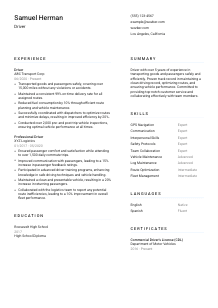
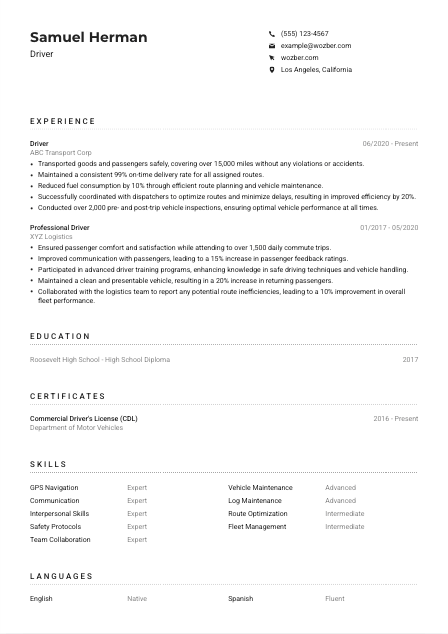
Some driving jobs are location-sensitive because routes, shift timing, and local coverage matter. In the example posting, being based in Los Angeles, California is part of the requirement, so showing "Los Angeles, California" in the header immediately removes a practical question.
A LinkedIn profile or professional website is optional, but include one if it is current and supports your application. For drivers, that might mean a profile with consistent job dates, license details, or transportation experience that matches the resume.
This section should tell an employer who you are, how to reach you, and whether basic logistics line up before they even reach your experience. Keep it simple and accurate.




The Experience section carries the most weight on a driver resume. Employers want to see the kind of routes you handled, how safely you operated, whether you met delivery or transport expectations, and how well you worked with dispatch, passengers, or logistics teams.
Start by identifying the work patterns the employer cares about most. For a driver, that usually includes safe transport, punctuality, inspections, log accuracy, route coordination, and compliance with traffic laws. In the example posting, transporting goods or passengers safely, coordinating with dispatchers, and performing pre- and post-trip inspections are all direct resume priorities.
List your most recent driving work first. For each role, include job title, employer, and employment dates. This layout helps hiring teams quickly trace your recent driving history, route continuity, and whether you meet requirements such as 2+ years in a similar role.
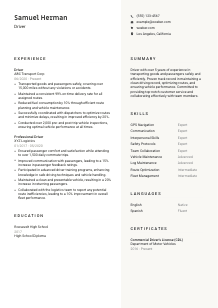
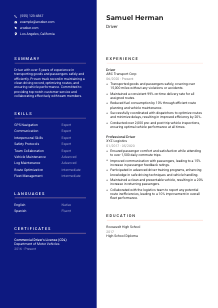
Do not stop at listing responsibilities like "drove vehicle" or "completed deliveries." Show how well you did the work. Useful bullets for drivers mention on-time performance, accident-free miles, passenger satisfaction, inspection volume, route efficiency, or fuel savings. The sample resume does this well with details like 15,000 miles driven without violations and a 99% on-time delivery rate.
Metrics make driving experience more credible because they reflect how the work is actually measured. Include mileage, number of trips, delivery timeliness, fuel reduction, inspection counts, customer ratings, or fleet efficiency improvements when you can support them. Results like reducing fuel consumption by 10% or improving route efficiency by 20% show more than effort. They show performance.
Focus on experience that supports the target role. Safe driving records, vehicle checks, route planning, navigation tools, passenger service, and dispatcher coordination all belong. Older or unrelated work can stay brief unless it adds something useful, such as customer-facing communication or schedule discipline that transfers directly to transportation work.
After reading this section, an employer should understand what you drove, how reliably you handled the work, and what results you delivered on the road. Make your track record easy to trust.
Education usually plays a supporting role on a driver resume, but it still helps round out the application. In many driving roles, employers care far more about your record, license, and work history than academic detail, so present this section clearly and without extra filler.
If the job does not ask for a specific degree, list your highest completed credential. For many driver positions, a high school diploma is enough to cover the requirement and show basic literacy, communication ability, and follow-through.
Include the school name, credential, and graduation year or completion date. That is usually all this section needs. The sample resume handles this cleanly with a straightforward high school diploma entry.
If you completed coursework tied to transportation, vehicle systems, safety compliance, or defensive driving, include it when it strengthens your application. This is especially useful early in your career, when you may have fewer years of driving experience to showcase.
Only include workshops, technical programs, or extracurricular activities if they support the role in a real way. Automotive repair training, logistics coursework, or transportation-focused programs can help. General school activities usually do not need space on an experienced driver resume.
Driving resumes are usually stronger when space goes to experience, certifications, and skills. Unless education is a stated requirement or a major strength in your background, keep this section brief and move the focus back to your driving record and operational results.
Education should confirm your background without competing with the parts of the resume that matter more for driving work. Clear, brief, and relevant is enough.
For many driver openings, certifications are not optional. They determine what vehicles you can operate, whether you meet legal requirements, and how quickly an employer can move you forward. This section should make your current qualifications obvious.
Always compare your credentials to the posting before you write this section. If the role calls for a valid Commercial Driver's License with endorsements, that needs to appear first and exactly as held. In the example, the CDL is the key qualification and should be impossible to miss.
List certifications that affect your ability to perform the job safely and legally. That may include CDL class details, passenger or hazardous materials endorsements, defensive driving training, or other transportation-specific credentials. Skip unrelated certificates that do not support the target position.
Employers need to know whether your license or certification is active. Include the issuing organization and date range or expiration information when relevant. Active credentials reduce back-and-forth and help establish compliance quickly.
Additional endorsements can expand the jobs you qualify for and make you more useful to employers managing different routes or vehicle types. If you are pursuing new endorsements or recently completed updated safety training, include them when they are official and relevant.
This section should answer a basic hiring question immediately: are you properly licensed and current for the work? Put the most important driving credential first and keep the details precise.
Driver skills are practical. Employers look for the mix of safe vehicle operation, route execution, communication, and basic record-keeping that keeps trips running smoothly. A focused skills section helps reinforce what your experience already shows.
Start with the skills named in the posting and use those terms when they are accurate. Common examples include GPS navigation, communication, interpersonal skills, vehicle inspections, log maintenance, route planning, and safety protocols. This improves ATS alignment and makes the resume feel closely matched to the job.
Lead with skills tied directly to the role's daily work. For the sample job, that would include GPS and navigation apps, communication with dispatchers, safe driving practices, vehicle condition checks, and trip or fuel logging. Prioritizing these skills keeps the section grounded in the actual demands of transportation work.
A shorter list of job-relevant skills is stronger than a long list of vague abilities. Keep broad terms like "team player" or "hardworking" out unless they are supported elsewhere through specific accomplishments. Save the space for skills that affect safety, efficiency, compliance, and service quality on the road.
Your skills should reinforce your ability to drive safely, communicate clearly, and manage the practical details that come with each route. Choose the skills an operations team would actually care about.
Language ability can matter in driving roles because instructions, dispatch communication, passenger interaction, and incident reporting all depend on being understood clearly. Include this section when it adds relevant context to the way you work.
If the posting calls for English competency, list English clearly with your proficiency level. Do not leave a required language implied. In the example, English is a stated requirement, so it should appear prominently rather than as an afterthought.
If you speak more than one language, include those that could help with passengers, customers, dispatch teams, or local communities. In some markets and service environments, bilingual ability can be useful even when it is not formally required.
Describe your level accurately with terms such as Native, Fluent, Intermediate, or Basic. These labels help employers understand whether you can handle route instructions, customer conversations, or written reports in that language.
Extra language ability can be especially helpful in passenger transport, delivery environments with direct customer contact, or large metro areas where drivers interact with diverse communities. It is not a substitute for driving qualifications, but it can strengthen the overall profile.
If you are actively improving a language you use on the job, update your resume when your level changes meaningfully. Better language skills can support smoother customer communication, clearer dispatcher coordination, and fewer misunderstandings during service.
List languages when they improve your ability to communicate clearly in the environments where you drive. Keep the information truthful and relevant to the job.
The summary is your short introduction to the kind of driver you are. It should quickly establish your experience level, the type of driving work you have handled, and the results or standards that define your performance.
Read the posting first, then decide which parts of your background belong in the summary. For driver roles, that often means years of experience, safety record, route or passenger transport experience, inspection habits, and coordination with dispatch or logistics teams.
Start with your title and years of experience, such as "Driver with 5+ years of experience" or "CDL Driver with 3 years of regional delivery experience." This gives immediate context and helps the reader place the rest of your background.
Choose strengths that are central to the work, not generic traits. Clean driving record, on-time delivery performance, route optimization, customer service, vehicle inspections, and accurate logs are all stronger than broad claims about being motivated or dependable. The sample summary works because it combines safe transport, route optimization, and vehicle performance in a concise way.
Aim for 3 to 5 lines. A driver summary should read quickly and still communicate trust, experience, and job relevance. Cut anything that repeats later sections or sounds too broad to be backed up by your experience bullets.
A good summary gives the employer a fast read on your driving background and the standards you work to. By the end of it, they should already understand why your experience belongs in the interview pile.
A driver resume works best when it shows dependable execution in plain terms: safe miles, on-time trips, accurate logs, current licensing, and clear communication with dispatchers or passengers. When those details are easy to find, hiring teams can quickly judge whether you are ready for the route, vehicle, and service standard they need.
Use Wozber's free resume builder to organize your background into an ATS-friendly resume format, align your wording with the posting, and strengthen ATS optimization without losing the practical detail that matters in transportation hiring. The finished resume should make one thing clear at a glance: you can be trusted to deliver safely and reliably.




