



Use Wozber and land your dream job
Create Resume
No registration required
Steering through school zones, but your resume is missing the green light? Hop on board this School Bus Driver resume example, created with Wozber free resume builder. Learn how to match your road-worthy skills to the job's checkpoints, ensuring your career journey always runs on time!
School transportation work carries a specific kind of responsibility. You are trusted with students, strict pickup windows, daily safety checks, and calm bus management before the school day even starts. A School Bus Driver resume needs to make that trust easy to see through driving history, route reliability, student supervision, and attention to vehicle condition.
Screening often starts with a quick search for hard requirements such as a CDL with school bus endorsement, clean driving history, and school-facing communication skills. Wozber's free resume builder helps you shape those details into an ATS-compliant resume that surfaces the right certifications, route experience, and safety record early, so a transportation team can quickly tell you are ready to handle student transport without added guesswork.
This section does a practical job first. Transportation coordinators need to know they can reach you quickly and that you meet simple screening requirements without hunting through the page. Keep it clean, complete, and directly relevant to a student transportation role.
Use your full name at the top in a clear, readable format. Avoid nicknames or decorative styling. For driving roles tied to licensing, background checks, and route assignments, consistency matters. Your resume name should match the name used on your CDL and other official records.
Use "School Bus Driver" as your headline if that is the job you are pursuing. It immediately connects your resume to student transportation rather than general driving work. If your recent background includes transit or shuttle driving, this title helps frame your experience around school routes, student safety, and daily schedule adherence.
List a current phone number and professional email address, then verify both. One typo can cost you an interview request or follow-up from a transportation office. Keep the email simple, ideally based on your name, and avoid casual handles that weaken a safety-focused professional profile.
If an employer wants someone living in or near a specific area, show your city and state. Here, listing Springfield, Illinois directly addresses that preference. Keep this practical. You do not need a full street address, just enough location detail to show you are local or nearby for route scheduling and early start times.
Do not use space on age, marital status, photo, or other personal facts unrelated to licensing, communication, or availability. School transportation hiring focuses on qualifications, record, endorsements, and professionalism. Keep attention on the information that supports safe, dependable service.
Your personal details should show that you are reachable, professionally presented, and aligned with basic screening needs from the first glance.




For School Bus Driver hiring, experience is not just a list of driving jobs. It needs to show safe transport, schedule discipline, vehicle awareness, and the ability to manage students and communicate with adults when issues come up. Use your bullets to show how you operated, not simply where you worked.
Pull out the duties and requirements that shape day-to-day work, then reflect them in your experience bullets. For this role, that means safe student transport, route and schedule adherence, maintenance reporting, student discipline, communication with parents and school staff, and current training. If a posting asks for 3+ years of clean driving experience, make that visible through dates, job titles, and safety-focused accomplishments.
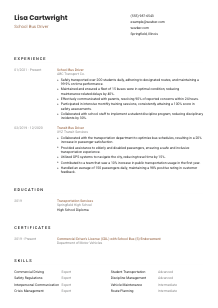
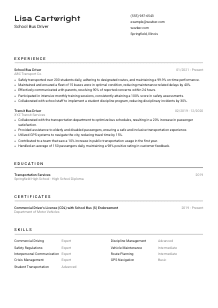
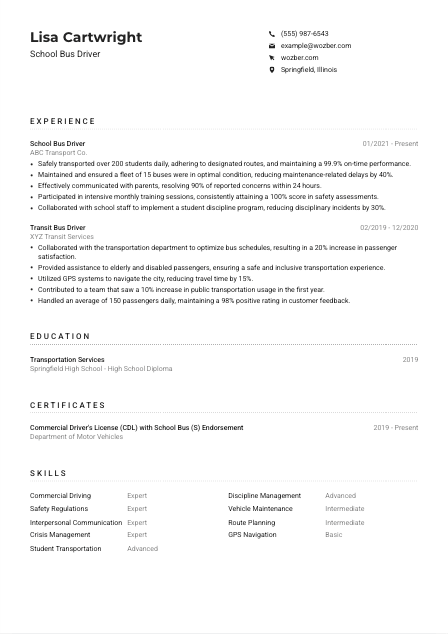
List jobs in reverse chronological order and include employer, title, and dates. Then use accomplishment bullets that show responsibility and scope. A school district wants to see whether you handled daily routes, student volume, timing, and bus condition. The sample resume does this well by pairing the School Bus Driver title with measurable route performance and fleet-related maintenance support.
Lead with outcomes tied to the real work of school transportation. Strong bullets mention transporting students safely, following assigned routes, maintaining order on the bus, reporting defects promptly, and coordinating with school personnel. "Safely transported over 200 students daily" works because it connects volume with safe execution, which is a core expectation in this field.
Quantify what hiring teams naturally care about: number of students transported, on-time performance, reduction in delays, safety assessment scores, response time to parent concerns, or lower incident rates. In the example, a 99.9% on-time rate, 40% fewer maintenance-related delays, and a 30% reduction in disciplinary incidents make the work easier to evaluate than generic claims about reliability.
If part of your background comes from transit, shuttle, delivery, or passenger transport, focus those bullets on transferable strengths. Highlight safe driving, navigation, schedule compliance, passenger communication, accessibility support, or incident handling. The transit bus role in the sample helps because it shows passenger management, route efficiency, and public-facing communication, all of which support a move into school transportation.
Your experience section should leave no doubt that you can handle a bus safely, keep a route on schedule, manage student behavior, and communicate clearly when something on the run needs attention.
Education usually plays a supporting role in School Bus Driver hiring, but it still helps round out your profile. Keep it brief and factual, and use it to reinforce reliability, training readiness, or any coursework connected to transportation, safety, or public service.
Most School Bus Driver postings focus more on licensing and driving record than on advanced education, so start by listing your highest completed education clearly. A high school diploma is often enough to satisfy expectations unless a district states otherwise.
Include school name, credential, field if relevant, and graduation year or date. Do not overload this section with extra explanation unless the education adds direct value. Clean formatting helps the employer move quickly to the sections that matter most, such as experience, certifications, and skills.
If your education included transportation services, automotive basics, public safety, or similar subjects, include the field. In the example, "Transportation Services" adds a useful layer because it supports the candidate's professional direction, even though it is not a universal requirement for the job.
Short courses in first aid, defensive driving, child safety, or crisis response can help if they are not already listed in certifications. Include them when they reinforce everyday responsibilities such as student supervision, emergency response, or safe bus operation.
Academic honors or extracurriculars are optional here. Include them only if they connect to responsibility, leadership, service, or safety awareness. For most experienced drivers, work history and licensing will carry more weight than school achievements, so keep this section proportional.
Keep education straightforward and useful. It should support your qualifications without distracting from the driving record, endorsements, and route experience that usually decide interviews.
For School Bus Driver applications, this section is essential. A district or contractor will often check licenses and required training before they spend much time on the rest of the resume. Put the credentials that authorize you to transport students front and center.
Place your CDL with school bus endorsement at the top of this section exactly as it appears officially. That requirement is central to the role, so do not bury it under optional training. In this case, "Commercial Driver's License (CDL) with School Bus (S) Endorsement" should be easy to spot immediately.
Order this section by hiring importance. State-required school bus training, student transportation credentials, defensive driving, first aid, or related safety certifications should appear before less relevant items. This ordering helps transportation staff confirm legal and operational readiness quickly.
Include issue dates and, if relevant, expiration or active date ranges. For roles tied to compliance, date visibility matters. The sample resume handles this well by showing both the CDL endorsement and state-required training as current, which reassures the employer that the candidate can move into service without credential gaps.
School bus driving requires refreshers, policy updates, and state or local training over time. Listing recent or continuing coursework shows that you stay current with regulations, student safety procedures, and operating standards. That is especially useful when a posting mentions periodic training as part of the job.
Your certifications section should quickly confirm that you meet licensing rules, maintain current training, and understand the compliance side of student transportation.
A School Bus Driver skills section works best when it reflects the actual run of the day. That includes safe vehicle operation, student management, communication with parents and staff, and awareness of maintenance or route issues. Prioritize the skills that affect safety, punctuality, and calm bus operations.
Read past the headline requirements and identify the capabilities behind them. A posting that asks for strong communication, knowledge of traffic laws, and safe bus operation points to skills such as commercial driving, student transportation, safety regulation knowledge, discipline management, incident response, and parent communication.
Lead with the abilities most tied to day-to-day performance. For this profession, that usually means commercial driving, safety compliance, student supervision, interpersonal communication, and vehicle inspection or maintenance reporting. In the sample resume, skills like Safety Regulations, Interpersonal Communication, and Discipline Management are strong because they mirror the job's main responsibilities.
Do not crowd the section with every skill you have ever used. Choose the ones you can support in your experience bullets or certifications. A shorter list with direct relevance is more useful than a long list of vague strengths. If you include tools like GPS navigation, keep them secondary to the core school transport skills that define the role.
A hiring manager should be able to scan your skills and immediately picture you handling a route safely, managing students appropriately, and communicating well with the school community.
Language ability matters here because school transportation involves constant interaction, not just driving. Drivers may need to speak with students, parents, dispatch, school staff, or emergency personnel, often in brief situations where clarity matters.
If the posting states that English speaking skills are mandatory, list English first and show your level clearly. That directly addresses a stated requirement and reassures the employer that you can handle route instructions, parent communication, and school coordination without confusion.
Additional languages can strengthen your resume when they support communication with families or students in the area you serve. Spanish, for example, may be useful in many districts. It is not required unless the employer says so, but it can add practical value in parent interactions and day-to-day rapport.
Be specific about your level, such as Native, Fluent, Intermediate, or Basic. Language claims are easy to test in an interview or on the job, especially when parent calls or student directions are involved. Accuracy matters more than trying to sound impressive.
If you know the district serves families with common non-English language needs, include relevant languages when you can genuinely use them. For a role based near Springfield, that kind of tailoring can be helpful, but only when it reflects your actual communication ability rather than a guess about the market.
Frame language ability as support for safer, smoother transportation. Being able to explain expectations to students, answer parent concerns, or communicate calmly during an issue adds real value to a school bus environment. It is most effective when paired with experience showing strong interpersonal skills.
List languages in a way that supports communication, trust, and day-to-day coordination, especially when those skills help you serve students and families more effectively.
The summary sits at the top of the resume, so it needs to establish your driving background and school-facing strengths quickly. For this role, the best summaries combine years of experience with a few details about safety performance, student transport, and communication.
Open with your title and years of relevant driving experience, then anchor the summary in student transportation, safety, and reliability. Keep the language specific to school bus work rather than general statements about being hardworking or dependable.
A useful opening might mention that you are a School Bus Driver with 4+ years of experience transporting students safely, maintaining route schedules, and working with parents and school staff. That gives the reader immediate context about your environment and responsibilities.
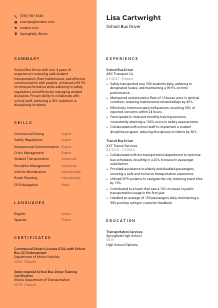
Choose achievements that connect directly to what the employer needs. The sample summary works because it includes a 99.9% on-time record, safety-focused transport, and a 30% reduction in disciplinary incidents. Those details speak to route reliability, student management, and coordination with school staff.
Aim for 3 to 5 lines. Every sentence should reinforce qualifications that matter in school transportation, such as safe operation, regulatory awareness, communication, or current credentials. Save extra detail for the experience section, where you can show the numbers and context more fully.
By the end of the summary, the reader should already understand your driving background, your safety mindset, and your ability to manage the day-to-day demands of transporting students.
A School Bus Driver resume should make the essentials easy to confirm: current licensing, safe driving experience, reliable route performance, student management, and clear communication with parents and school staff.
Use Wozber to build an ATS-friendly resume format, refine wording with its AI resume builder, and check alignment with an ATS resume scanner so the right qualifications appear in the sections where transportation teams expect to find them.
When your resume is tailored well, hiring staff can quickly see that you are prepared to transport students safely and handle the daily responsibilities of the route.




