



Use Wozber and land your dream job
Create Resume
No registration required
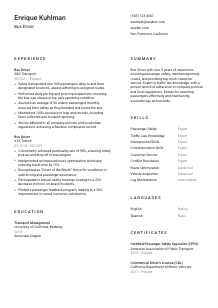
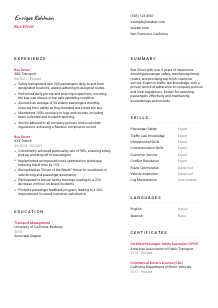
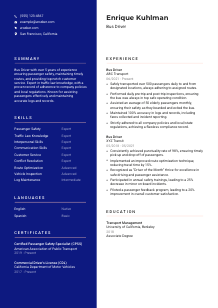
Navigating city streets, but your resume seems off-route? Check out this Bus Driver resume example, created with Wozber free resume builder. Learn how to match your road mastery to job checkpoints, keeping your career journey as smooth as your most scenic routes!
Bus driving work is measured in real-world outcomes every shift. You have to move passengers safely, stay on route, keep to schedule, handle boarding and drop-off with patience, and document what happened if an incident or maintenance issue comes up. A resume for this field needs to make those operating habits visible, especially your driving record, route discipline, inspection routine, and passenger-facing judgment.
When the resume is tailored well, the hiring team can quickly tell whether your background matches the kind of service they run, whether that is school transport, public transit, or shuttle work. Wozber's free resume builder helps you line up your wording with the posting, keep an ATS-compliant resume structure, and surface requirements such as CDL endorsements, safe driving history, and route experience in the places reviewers look first. That makes it easier to see that you can be trusted with passengers, schedules, and compliance.
For a Bus Driver, the top of the resume should remove friction. Hiring teams should be able to confirm your identity, contact information, target role, and location without hunting for details, especially when the posting includes route coverage, licensing, or commute-related requirements.
Set your name in a clear, readable format so dispatch managers or recruiters can identify your application quickly. Keep it professional and straightforward. This role values reliability and clarity, so avoid decorative styling that makes basic details harder to read.
Place "Bus Driver" directly under your name if that is the role you are applying for. This immediately aligns your resume with the posting and helps separate you from candidates coming from adjacent driving roles such as delivery, trucking, or shuttle support. If your current work is close but not identical, the title line helps frame your experience in the right lane from the start.
List a phone number you answer reliably and a professional email address. Bus driving jobs often move quickly once route needs are confirmed, so missed calls or an outdated email can cost you an interview. If you include a website or profile, make sure it supports your application rather than distracting from your driving record and experience.
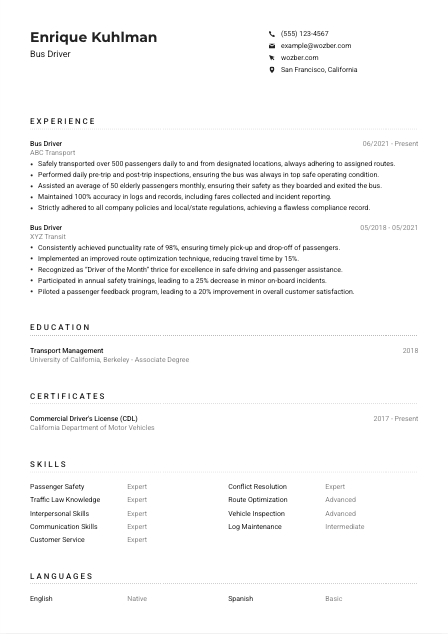
If the employer wants someone based in or near a certain area, show your city and state clearly. In the sample, listing "San Francisco, California" directly supports the employer's local residency preference. That kind of detail is not always essential for every bus driving job, but when proximity affects route coverage, start times, or split shifts, it helps your candidacy immediately.
A LinkedIn profile can help if it mirrors your resume and includes driving experience, endorsements, safety training, or transportation-related work history. If the profile is sparse or inconsistent, leave it off until it is updated. For this profession, accuracy matters more than extra links.
This section should tell an employer, within seconds, who you are, what role you want, how to reach you, and whether you are realistically available for the route or service area. Keep it clean and operational, the same way a well-run shift starts.




The experience section carries the most weight for a Bus Driver. Employers want to see safe operation of large vehicles, punctual service, inspection habits, passenger assistance, and accurate recordkeeping. Generic driving bullets do not do enough here. Your examples should show what you transported, how consistently you operated, and what standards you maintained on the road.
Start by marking the responsibilities and requirements that define the job. For a bus driving role, that usually includes safe passenger transport, route adherence, on-time performance, vehicle inspections, boarding assistance, log accuracy, and compliance with local or state rules. Then rewrite your past work to reflect those same realities using truthful, matching language. That alignment helps both the hiring team and the ATS recognize that your background fits passenger transport rather than general driving alone.
Use reverse chronological order and prioritize jobs involving buses, coaches, shuttles, school transport, paratransit, or other large vehicles. This lets employers quickly confirm whether you meet experience expectations such as 2+ years behind the wheel of a bus or similar vehicle. If you have earlier non-driving work, keep it brief unless it adds something directly useful, such as customer service, safety compliance, or public-facing responsibility.
Each role should show how you performed the work, not just that you held the title. Good bullets for this profession mention passenger volume, route coverage, punctuality, inspection routines, incident prevention, boarding assistance, or clean compliance records. The sample does this well with points such as transporting more than 500 passengers daily, assisting elderly riders, and maintaining perfect log accuracy. Those details show service scope and operating discipline at the same time.
Quantify what employers naturally track in this field. Useful metrics include daily passengers served, on-time rate, reduction in travel time, incident rate, inspection completion, customer satisfaction, or accuracy in reporting and fare logs. Numbers work especially well when they show consistency over time, such as a 98% punctuality rate or a flawless compliance record. They make your reliability easier to judge than broad claims about being responsible or hardworking.
Focus your bullet points on driving large vehicles safely, working assigned routes, helping passengers, and following transport regulations. Leave out older or unrelated details that do not support those themes. For this role, one sharp bullet about pre-trip inspections or incident-free service is worth more than a vague point about being a team player. Keep the section centered on trust, control, and consistency behind the wheel.
A hiring team should finish this section with a clear picture of how you operate day to day: safely, on time, attentive to passengers, and accurate with logs and inspections. When your experience reads that clearly, your value as a Bus Driver is much easier to place.
Education is usually secondary to licensing, safety record, and driving experience in bus transportation. Still, it can strengthen your resume when it shows transportation knowledge, steady training, or a background that supports passenger service and regulated work.
Some bus driving jobs barely mention formal education, while others may prefer training tied to transportation, public service, or safety. In the provided posting, licensing and experience matter more than a degree, so education should support the resume rather than lead it. Use the space accordingly.
List your school, degree or credential, field of study, and graduation year or completion date. Put the most relevant or most recent item first. This section should be quick to read because employers in transportation usually spend more time on your license status, endorsements, and driving history than on academic detail.
If you studied transportation management, logistics, automotive technology, public safety, or a related area, make that visible. In the sample, an Associate Degree in Transport Management adds useful context because it supports route awareness, service operations, and regulated transport work. It is not mandatory for every Bus Driver role, but it is worth featuring when relevant.
If your degree is not directly related, you can mention coursework or training tied to safety, fleet operations, customer service, or compliance. Keep it brief and practical. This is most useful for newer candidates who need to show some preparation beyond a short work history.
Extracurriculars, volunteer work, or school projects belong here only when they reinforce qualities used on the job, such as public responsibility, safe operations, community transport, or service to elderly or school-age passengers. Skip generic campus activities that do not add anything to a transportation resume.
For most Bus Driver applications, education works best as a concise supporting section. Keep the focus on any training or study that adds credibility to your work with routes, passengers, safety procedures, or transport operations.
Certifications are central in bus driving because they speak directly to legal eligibility and passenger safety. Employers need to see, quickly and clearly, that you hold the required license and any endorsements needed for the type of service they operate.
Lead with your Commercial Driver's License and list the passenger and school bus endorsements if you hold them. That is the first qualification many employers will check. If the posting names specific credentials, mirror that wording so there is no ambiguity about your eligibility.
Beyond the CDL, include certificates that support passenger safety, defensive driving, first aid, student transport, accessibility assistance, or transit operations. In the sample, a passenger safety certification adds useful depth because it reinforces the candidate's focus on rider wellbeing, not just vehicle operation.
Include issue dates, expiration dates, or ongoing validity when relevant. Transportation employers need to know that your licensing is current and ready for immediate use. Outdated or unclear certificate entries create unnecessary questions in a field where compliance matters every day.
If you are pursuing additional training, choose programs that strengthen day-to-day bus operations, such as refresher safety courses, emergency response, ADA-related passenger assistance, or updated regulatory training. These additions are especially useful when you want to move into school bus work, municipal transit, or routes with more passenger interaction.
This section should remove doubt about whether you can legally and safely do the job. When your CDL, endorsements, and relevant safety certifications are listed clearly, employers can move on to evaluating your route performance and passenger handling.
A Bus Driver skills section should read like the dashboard of the job. It needs to show the practical abilities that keep service safe, compliant, and steady, from vehicle inspection to passenger communication. Generic strengths alone will not carry this section.
Pull in the language the employer uses when it matches your experience. For bus driving roles, that often means passenger safety, knowledge of traffic laws, communication, route adherence, recordkeeping, and professional conduct. Using the employer's terminology helps with ATS optimization and makes your resume feel immediately relevant to the route and service environment they are hiring for.
Bus driving combines technical control and public interaction. Include hard skills such as pre-trip inspection, fare or log handling, defensive driving, route planning, and compliance awareness, alongside soft skills such as patience, conflict resolution, and clear communication. The sample's mix of vehicle inspection, route optimization, customer service, and interpersonal skills is a solid model for that balance.
Do not overload this section with every ability you have. Lead with the skills that help an employer picture you running a route safely and professionally. If a skill improves punctuality, passenger assistance, reporting accuracy, or incident prevention, it belongs near the top. Keep the list focused enough that each skill reinforces your core value as a Bus Driver.
This section should reinforce what your experience already shows: you can operate the vehicle safely, manage the route, and interact professionally with passengers. Keep the skills practical, job-linked, and easy to scan.
Language ability matters in bus driving because safety instructions, boarding support, and incident communication all depend on being understood. Even when only one language is required, how you present your proficiency can strengthen your application.
If the posting requires strong English, list English clearly with an honest proficiency level. For a Bus Driver, that matters in route communication, policy compliance, passenger instructions, and written logs. The employer needs confidence that you can communicate calmly and accurately in routine and urgent situations.
Extra languages can be a real advantage in cities, school systems, airport transport, and community routes serving diverse riders. In the sample, Spanish is listed as a basic additional language, which can still be useful in simple passenger interactions. That does not make a second language mandatory for every role, but it can add value when your rider population is multilingual.
Use clear labels such as Native, Fluent, Intermediate, or Basic. Avoid overstating your level. In a public-facing transport role, honesty matters because employers may rely on your language ability in live passenger situations or incident reporting.
The language mix that matters most depends on the route and passenger base. Urban transit, school transportation, senior services, and hospitality shuttles may each call for different communication strengths. If you know a second language is especially useful for the routes you are targeting, make sure it is easy to spot.
Improving your language skills can expand the kinds of routes and passenger groups you can serve comfortably. Even modest progress in a commonly spoken local language can improve de-escalation, boarding support, and the overall rider experience. That can make a practical difference in customer-facing transport roles.
For a Bus Driver, language skills matter most when they support safe instructions, respectful passenger service, and accurate reporting. Present them clearly so employers know what level of communication they can count on.
The summary is where you frame your experience before the hiring team reads the rest of the resume. For a Bus Driver, it should quickly establish how long you have driven, what kind of vehicles or routes you have handled, and the operating standards you are known for, especially safety, punctuality, and passenger care.
Review the posting and identify the few themes that show up repeatedly. In this case, that includes safe driving, route reliability, passenger interaction, knowledge of traffic laws, and accurate records. Those are the ideas your summary should emphasize, using wording that matches your actual background.
Start with a direct line that states you are a Bus Driver and notes your experience level. This helps employers quickly separate experienced commercial drivers from candidates who are new to passenger transport. If you have worked across school buses, transit routes, or shuttles, you can briefly signal that scope as well.
After the opener, mention two or three specifics that define how you work. Strong options include a clean driving record, inspection discipline, on-time route performance, passenger assistance, or accurate logging. The sample summary works because it combines years of experience with safety, traffic law knowledge, customer service, and recordkeeping in a compact way.
Aim for a short paragraph that delivers your most relevant qualifications without repeating full bullet points from the experience section. In this profession, a concise summary is more effective than a long personal statement. It should sound like an experienced operator introducing their service record, not a generic objective statement.
A well-written summary should tell the reader, almost immediately, whether you are the kind of driver they can trust with passengers, schedules, and regulated service. Keep it short, specific, and grounded in actual driving performance.
A Bus Driver resume works best when every section supports the same message: you can operate safely, stay on route, handle passengers professionally, and keep the required records straight. If your license details, driving experience, inspection habits, and communication strengths are easy to find, the employer can picture you in service much faster.
Wozber's free resume builder can help you shape that information into an ATS-friendly resume template, align your wording with the posting through its ATS resume scanner and AI resume builder tools, and keep the final document clear for both software and human review. The finished resume should make one thing obvious: you are ready to take responsibility for passengers, schedules, and safe daily transport.




