



Use Wozber and land your dream job
Create Resume
No registration required
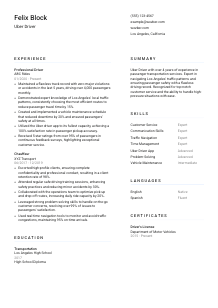
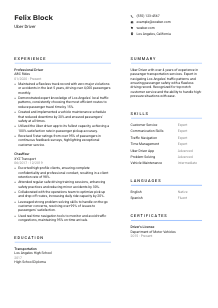
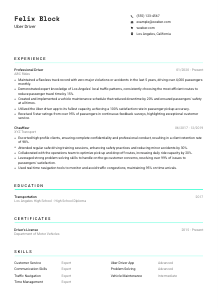
Cruising city streets, but your resume's in traffic? Check out this Uber Driver resume example, created with Wozber free resume builder. It shows how to match your on-demand driving expertise to job specifications, paving the way to career high ratings and surge-worthy opportunities!
Driving for Uber is measured in everyday details: clean pickups, safe decisions in traffic, calm passenger interactions, and a car that is always ready for the next trip. Your resume should make those habits visible. Hiring teams want to see that you can manage the pace of ride requests, follow road rules consistently, and deliver a reliable passenger experience from pickup to drop-off.
A targeted resume changes how quickly those strengths come through, especially when the role is screened through an ATS before a person reads it. Wozber's free resume builder helps you match the language of the posting, keep the layout ATS-friendly, and surface practical qualifications like driving record, route knowledge, app use, and customer service so your resume reads like someone ready to drive professionally from day one.
For an Uber Driver, the top of the resume should answer basic operational questions fast: who you are, how to reach you, and whether you meet key location and communication expectations. Keep this section clean, direct, and easy to scan.
Use your full name at the top in a clear, readable format. For a driving role, there is no need for branding language or extra descriptors here. What matters is a professional presentation that matches the dependable service style the role requires.
Place "Uber Driver" directly under your name if that is the position you are applying for. This makes the resume immediately relevant to both recruiters and ATS screening. If your recent title was "Professional Driver" or "Chauffeur," you can still target the role clearly by using the job title at the top and letting your experience section show the transferable work.
Include a phone number you answer reliably and a professional email address. Since the work depends on timely communication, avoid outdated or overly casual email handles. If you include a website or profile, make sure it supports your application and does not distract from your driving background.
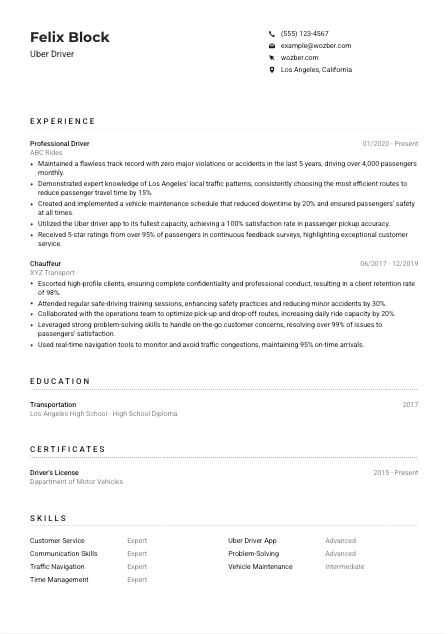
When a posting asks for local availability, include your city and state. In the example, listing Los Angeles, California directly supports the employer's requirement and helps remove any doubt about local route familiarity and shift readiness. Only include location details that are useful for the application.
A LinkedIn profile is optional for many driving roles, but it can help if it reflects transportation work, customer service history, or a stable work record. If your online profile is sparse or inconsistent with your resume, leave it off and keep the focus on the qualifications that matter most for ride-share work.
This section should confirm that you are reachable, local when required, and clearly applying for an Uber Driver role. Keep it simple and accurate so the reader can move straight to your driving record, customer service history, and operating reliability.




This is where hiring managers look for proof that you can manage real trips, real passengers, and real road conditions. Focus on driving volume, safety, punctuality, route decisions, vehicle upkeep, and customer-facing performance. Those are the details that separate general driving experience from ride-share-ready experience.
Start with roles that show passenger transport, delivery under time pressure, chauffeur service, fleet driving, or other work where safety and service were part of the job. If your background includes several kinds of driving, prioritize the positions that involved direct customer contact, navigation, schedule adherence, or app-based dispatch.
List your most recent job first, then work backward. Include employer name, job title, and dates. For Uber Driver applications, recent experience carries extra weight because it shows your current driving habits, familiarity with navigation tools, and ability to work in today's traffic and customer service environment.
Your bullets should show outcomes, not just tasks. Good examples include maintaining a clean driving record, improving on-time arrivals, reducing travel time through route selection, handling a high volume of trips, or earning strong passenger ratings. The sample resume does this well by quantifying monthly passenger volume, route efficiency, and customer satisfaction, which makes the work easier to picture.
If you have limited space, keep the bullets that speak most directly to the role: safe driving, passenger care, local navigation, vehicle condition, schedule discipline, and issue resolution. A bullet about reducing downtime through a maintenance schedule, for example, says more for this job than a generic note about being hardworking.
Each bullet should cover one clear contribution. Avoid long, blended statements that bury the result. A hiring manager should be able to scan your section and quickly see a pattern of safe trips, efficient routing, app fluency, and professional passenger service.
A well-built experience section should make it easy to picture you on the road: punctual, composed, safety-conscious, and good with people. If the reader can see strong trip execution and dependable customer service in your bullet points, this section is doing its job.
Education usually plays a supporting role for Uber Driver applications, but it still helps round out your profile. Keep it concise and accurate, and use it to show completion, consistency, and any training that supports transportation or customer-facing work.
Even when a posting does not emphasize formal schooling, list your diploma or highest completed education. For many driving roles, a high school diploma is enough to establish baseline qualification and a complete employment profile.
Use a simple format with school name, credential, field if relevant, and graduation year or date. The example keeps this section brief, which works well for a role where driving performance matters more than academic detail.
If your coursework touched transportation, logistics, customer service, automotive basics, or technology use, include that detail when it strengthens your application. Do not force a connection if the field of study has little relevance to road safety, service, or operational reliability.
Short courses in defensive driving, road safety, first aid, conflict resolution, or mobile app use can help, especially if you do not have many formal certificates to list elsewhere. Choose training that supports the day-to-day realities of transporting passengers.
Clubs, honors, or activities are optional and usually belong only if they reinforce responsibility, public interaction, or transport-related discipline. For most experienced drivers, this section should stay short so your work history and driving qualifications remain the focus.
Education does not need to carry the application for this role. It should simply confirm your background and, where relevant, add a little context around training, reliability, or service-oriented work.
For an Uber Driver, certification starts with legal eligibility to drive. This section should make your license status easy to find and give added space to any training that strengthens safety, compliance, or passenger service.
The license is the essential credential here, so list it clearly. If the job posting requires a valid license and a minimum number of years on the road, make sure your dates support that requirement. In the example, the license date helps reinforce more than 3 years of driving experience.
Relevant additions can include defensive driving, road safety, first aid, customer service training, or local transportation certifications where applicable. Pick credentials that connect to safe operations, legal compliance, or passenger trust rather than listing unrelated courses.
For anything that expires or must stay current, include the date range or active status. This is especially important for a driver's license because it confirms that you are currently eligible to drive.
If you complete new training in navigation tools, safety procedures, or service handling, update this section. Ride-share work depends on current road awareness and responsible driving habits, so recent training can strengthen your profile.
This section should quickly answer two questions: can you legally drive, and have you invested in safe, professional transportation work. Keep it current, relevant, and easy to scan.
Uber Driver resumes work best when the skills section reflects real trip execution. Focus on the capabilities that affect safety, arrival times, passenger experience, and day-to-day platform use. Generic soft skills alone will not carry this section.
Start with the actual language in the description. For this role, that includes customer service, interpersonal skills, knowledge of local traffic patterns, smartphone and Uber app use, and English communication. Matching those terms naturally improves alignment with both hiring teams and ATS screening.
List a mix of operational and people-facing abilities. Safe navigation, time management, route planning, vehicle maintenance awareness, and app proficiency belong alongside customer service, communication, and problem-solving. The example does this well by combining traffic navigation and Uber Driver App with customer-facing strengths.
Order matters. Lead with the skills that affect core job performance, such as safe driving, route knowledge, customer service, and communication. Lower-priority or supporting skills can follow. This helps the reader identify your most relevant strengths without digging through the list.
Every skill here should connect to something in your experience, summary, or certifications. When the list matches the actual demands of passenger transport, it reinforces that you can deliver safe rides, smooth pickups, and professional service consistently.
Language ability matters in ride-share work because instructions, safety communication, and customer comfort often happen in real time. Keep this section straightforward and make sure it reflects the communication level you can actually use with passengers.
If the posting requires effective English communication, list English at the top with an honest proficiency level. This is not a minor detail for an Uber Driver. It affects pickup coordination, in-app communication, and how you handle questions or concerns during a trip.
Extra languages can strengthen your application, especially in large, diverse cities where passengers come from many backgrounds. In the example, Spanish adds practical value because it can support smoother communication with a wider rider base. Treat extra languages as a service advantage, not decoration.
Use clear levels such as Native, Fluent, Intermediate, or Basic. Overstating language ability can create problems on the job, especially in situations involving directions, safety, or complaints. Honest ratings are more useful than inflated ones.
For passenger transport, language skills improve the ride in practical ways: confirming destinations, clarifying pickup points, answering questions, and reducing friction when plans change. If you speak more than one language well, that can support both customer satisfaction and smoother trip flow.
List only languages you can use with confidence in a passenger setting. A short, credible section is better than a long one filled with low-level proficiency that would not help during actual rides.
This section should show that you can communicate clearly with passengers and handle common ride situations without confusion. For an Uber Driver, language skills are part of service quality, safety, and professionalism.
The summary is your fastest chance to show relevant experience and the kind of service you provide. For this role, it should combine driving background with a few concrete strengths, such as safety record, local navigation, customer ratings, or ride-share app fluency.
Before writing, identify the core themes in the description. For Uber Driver roles, that usually means safe driving, local route knowledge, customer service, communication, app use, and vehicle readiness. Your summary should reflect that mix instead of sounding like a generic transportation profile.
Start with your job title or closest equivalent and your years of relevant experience. A line such as "Uber Driver with 4+ years of passenger transportation experience" gives immediate context and sets up the rest of the summary efficiently.
Choose details that carry weight in this profession. That could be a clean driving record, high passenger ratings, strong knowledge of a local market, or efficient use of navigation and driver apps. The sample summary works because it combines years of experience, Los Angeles route knowledge, and a strong safety and service record without getting too long.
Aim for a short paragraph that a recruiter can absorb in seconds. Avoid vague claims like "hardworking professional" unless you tie them to driving outcomes. Specific language about safety, punctual pickups, passenger satisfaction, or route efficiency will do far more for an Uber Driver application.
Your summary should quickly establish that you can drive safely, navigate efficiently, and treat passengers professionally. When those points are clear in the first few lines, the rest of the resume has a much easier job.
An effective Uber Driver resume makes a few things easy to confirm right away: valid driving eligibility, safe and consistent work habits, local route awareness, and customer service that holds up under real trip volume. That is the combination hiring teams look for when they need drivers who can represent the platform well on every ride.
Use Wozber to tighten that alignment. Wozber's free resume builder, ATS-friendly resume templates, and ATS resume scanner help you match your wording to the posting, organize your experience clearly, and build an ATS-compliant resume that surfaces the qualifications most relevant to passenger transport. The final read should leave no doubt that you are ready to handle pickups, traffic, passengers, and service standards professionally.