



Use Wozber and land your dream job
Create Resume
No registration required
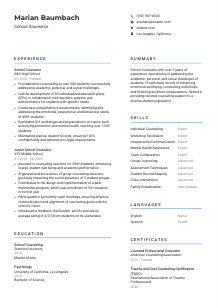
Guiding students, but your resume feels lost in the hallways? Navigate this School Counselor resume example, created with Wozber free resume builder. Learn how to smoothly match your counseling insights to job criteria, paving a career path as clear as a straight-A student's trajectory!
School counseling work sits at the point where academic progress, emotional well-being, and student behavior all meet. Hiring teams want to see whether you can handle one-on-one counseling, group support, school-wide programming, and sensitive documentation without losing sight of student outcomes. Your resume should make that day-to-day range visible, not reduce the role to generic care and communication.
A tailored resume changes how quickly a school can place you in the right lane. When your wording reflects counseling sessions, IEP collaboration, student assessments, workshops, and record confidentiality in the same language the posting uses, ATS screening has a much easier time ranking your application for the actual work involved. Wozber's free resume builder helps you organize that language into an ATS-friendly resume format that makes your counseling scope and school-based experience easier to recognize.
School counseling resumes are read for immediate practical details first. Before anyone gets to your counseling philosophy or student support record, they need to see that you are reachable, professionally presented, and aligned with any location requirement named in the posting.
Use your full name as the clearest visual anchor on the page. Keep the formatting simple and professional so the school can identify your application quickly during a high-volume review process.
Place "School Counselor" directly under your name if that is the role you are pursuing. Matching the posting title helps both ATS parsing and human review, especially when schools are sorting applicants across counseling, social work, student services, and related support roles.
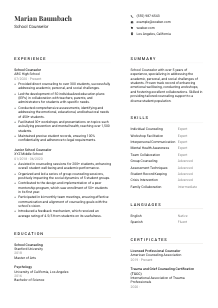
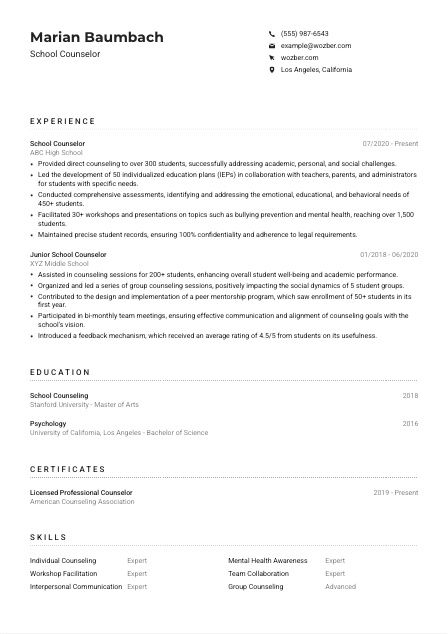
Add a phone number, professional email address, and your city and state. For school-based roles, location can matter early in the process. In the example, listing Los Angeles, California directly supports a posting that asks candidates to be based there.
Include LinkedIn or a professional site only if it strengthens your candidacy with school-relevant information such as counseling experience, certifications, presentations, or community work with students and families. Any linked profile should match the resume closely in dates, titles, and credentials.
Do not add age, marital status, photo, or other non-job-related identifiers. School hiring teams need your qualifications, credentials, and contact information, not personal background details that do not affect counseling practice or compliance.
Your header should answer three questions at a glance: who you are, what role you do, and how the school can reach you. If the posting includes a location filter, this is where you make that easy to confirm.




Experience carries real weight in school counseling because schools need proof that you can support students in live educational settings. The strongest bullets show counseling scope, collaboration with teachers and families, assessment work, workshops, and the care required to manage confidential records.
Read the posting for the operating tasks behind the title. Here, that includes direct counseling, IEP collaboration, student needs assessments, classroom or workshop presentations, and recordkeeping. Those should become the backbone of your experience section, using your own results and setting.
List roles in reverse chronological order with job title, school or employer name, and dates. For counseling roles, this format helps reviewers track your progression from related support work into independent student counseling responsibility.
Avoid repeating job descriptions word for word. Show what changed because of your work. The example does this well with bullets such as supporting more than 300 students and facilitating 30+ workshops, which gives the reader a clearer picture of counseling volume and school-wide reach.
Quantify student caseloads, number of IEPs developed, workshops delivered, groups facilitated, program participation, or improvement indicators when you have them. "Led the development of 50 individualized education plans" is stronger than simply saying you collaborated on IEPs because it shows scope and repeated practice.
If you have experience from private practice, nonprofit youth programs, or behavioral support roles, keep the bullets focused on what transfers directly to a school environment: student counseling, family communication, crisis support, attendance or behavior interventions, and cross-functional collaboration with educators and administrators.
Schools are looking for evidence that you can work with students, coordinate with adults around them, and handle the documentation that comes with student support plans. Shape each bullet to show counseling judgment, collaboration, and measurable scope.
For school counseling positions, education is a qualification screen as much as a background section. If the posting asks for a master's degree in School Counseling or a related field, your degree needs to be easy to spot and labeled clearly.
Put your highest and most relevant degree first. When a posting calls for a master's in School Counseling, that credential should be visible without forcing the reader to search through other academic history.
Include degree type, field of study, school name, and graduation year. In the example, "Master of Arts in School Counseling" immediately answers the educational requirement and gives the hiring team a clean match to the role.
If your degree title directly aligns with the posting, use the full formal wording. That helps ATS matching and avoids ambiguity between school counseling, mental health counseling, psychology, and adjacent disciplines.
Early-career candidates can include practicum placements, internship settings, thesis work, or coursework tied to student development, counseling techniques, crisis response, or special education collaboration. More experienced candidates usually need only the degree unless the academic detail adds something distinctive.
If your counseling license or school certification is essential to eligibility, make sure the education section works in tandem with the certifications section rather than standing alone. The academic foundation and the legal credential should read as one complete qualification picture.
This section should confirm that your training matches the level of counseling work the school needs. For many postings, that starts with a master's degree and continues with specialized preparation relevant to student support.
In school counseling, credentials are often part of basic eligibility, not an extra bonus. Schools need to know whether you hold the required state authorization and whether you have any added training that supports student mental health, trauma-informed care, or related counseling needs.
Start with any state-issued school counseling certification or license named in the posting. If a credential determines whether you can legally serve in the role, it belongs at the top of this section and should be written exactly and accurately.
Beyond the required credential, list certifications that strengthen your counseling profile in areas schools value, such as trauma, grief, crisis response, or youth mental health. In the example, the trauma and grief certification adds useful depth because it connects to real student support situations.
Include the issuing body and the date earned or period of validity. Schools often review credentials with compliance in mind, so current status matters more than decorative wording.
If you have recent training in areas like suicide prevention, SEL, restorative practices, or special education processes, include the most relevant items. Continuing education shows that your counseling methods and legal awareness are current, especially in changing school environments.
A school can admire your counseling experience and still pause if your required credential is unclear. Make licensure and relevant certifications easy to find, current, and directly tied to the students you serve.
A skills section for school counseling should read like a working toolkit, not a personality list. The best selections reinforce the counseling methods, collaboration habits, and student-support tasks already shown in your experience section.
Use the posting to identify the skills tied to day-to-day responsibilities. Here that includes individual counseling, group counseling, assessment, classroom presentations, communication, and collaboration with teachers, parents, and administrators.
Lead with the capabilities that affect student support directly. Skills such as individual counseling, workshop facilitation, assessment techniques, crisis intervention, and record keeping usually carry more value here than broad terms like "hardworking" or "team player." The example skill list stays strongest when it names concrete counseling functions.
Choose skills you can support with examples elsewhere in the resume. If you claim workshop facilitation, your experience should show presentations delivered. If you list family collaboration or IEP support, the bullets should back that up with case volume, meetings, or student plan development.
This section should quickly confirm the counseling methods and school-facing abilities you actually use. Keep it tight, role-specific, and supported by the rest of the resume.
Language ability can matter a great deal in schools, especially when counselors work with multilingual students and families. Even when only English is required, clear language listing helps schools understand how you communicate in counseling sessions, family outreach, and presentations.
If the role specifies clear English communication, list English first with an honest proficiency level. That directly answers a stated requirement and removes doubt about your ability to conduct counseling conversations, write records, and present to classes or families.
Place your strongest required language at the top of the section. For many school counseling roles, that will be English, marked as native or fluent depending on your actual proficiency.
Include additional languages when they are real working strengths. In diverse districts, a language such as Spanish can improve communication with families, support rapport with students, and reduce friction in meetings or outreach. The example's English and Spanish combination is especially relevant in many community-facing school settings.
Be specific about whether you are native, fluent, advanced, conversational, or basic. Counseling work depends on nuance, trust, and precise communication, so overstating fluency can create problems quickly.
If another language has been part of your work with students, family conferences, workshops, or community engagement, include it. Language skills are most persuasive when they support student access, family partnership, or culturally responsive counseling practice.
For school counseling, languages are valuable when they improve communication with students and families in real settings. List them clearly and honestly so the school can understand the practical reach you bring.
Your summary should give a school an immediate sense of your counseling scope, school-based experience, and the student needs you are equipped to handle. Keep it grounded in the actual work, not broad statements about passion or helping others.
Before writing, identify the few responsibilities that define the role most clearly. For this posting, those include direct counseling, IEP collaboration, assessments, student workshops, and strong communication. Your summary should reflect the overlap between those needs and your background.
Start with a direct statement of who you are professionally, such as your title and years of experience in school settings. The example summary works because it quickly establishes more than 5 years of relevant counseling experience instead of opening with vague personal traits.
Use the middle of the summary to name the work you do best, such as academic and social counseling, student assessments, family and staff collaboration, workshop delivery, or mental health support. Mirror the posting's terminology where it accurately reflects your experience.
Aim for a compact paragraph that can be read in seconds. Three to five lines is usually enough to show your school counseling background, a few core strengths, and the student population or support scope you bring.
A hiring team should finish this section with a clear picture of your counseling background and where you add value in a school setting. If it reads like a real snapshot of your practice, the rest of the resume has a strong opening.
A school counselor resume works best when it shows both care and structure: student counseling experience, collaboration with educators and families, accurate records, and the credentials required to practice in a school setting. When those pieces are aligned with the posting, your application reads as someone ready for the daily realities of the job.
Use Wozber's free resume builder and ATS resume scanner to tighten the match between your background and the role, from keywords and phrasing to ATS optimization and section structure. The finished resume should make one thing easy to judge right away: you can support students effectively in a real school environment.