




Use Wozber and land your dream job
Create Resume
No registration required
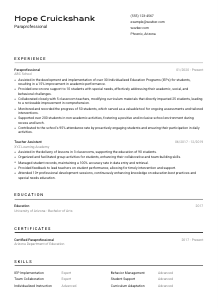
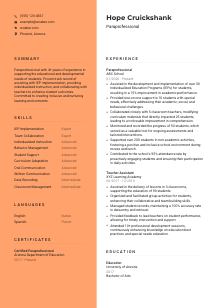
Supporting students, but your resume feels absent from class? Check out this Paraprofessional resume example, made with Wozber free resume builder. Learn how to match your educational talents with job specifications, ensuring your career gets an A+ in helping others!
Paraprofessional work sits close to the daily realities of the classroom. Schools rely on you to help students follow instruction, stay regulated, work through academic challenges, and participate safely in everything from small-group learning to lunch and recess. A resume for this role needs to make that hands-on support visible, especially your experience with student progress, behavior plans, and teacher collaboration.
When that experience is tailored to the posting, schools can quickly tell whether you have worked in the same support environment they need. Wozber's free resume builder helps you build an ATS-compliant resume that reflects the language of the role, from IEP implementation to one-on-one student support, so both the ATS and the hiring team can immediately see your classroom relevance.
School hiring teams start with practical checks. They need to know who you are, how to reach you, and whether you meet any location or communication requirements before they spend time on classroom experience.
Use your full name as the clearest heading on the page. Keep it larger than the rest of the text so your resume feels organized from the first line. In school settings, where applications may be reviewed alongside teaching and support staff files, a clean header helps your resume look professional and easy to process.
Place "Paraprofessional" directly under your name when that is the job you are pursuing. Matching the posted title helps frame the rest of the resume correctly, especially when schools are sorting candidates across support roles such as teacher assistant, instructional aide, and paraprofessional.
List a phone number and professional email address that you check regularly. Written and oral communication are part of the role, so even small details like a clean email format and error-free contact line reinforce professionalism. If you include a website or LinkedIn profile, make sure the content supports your education background or school-based experience.
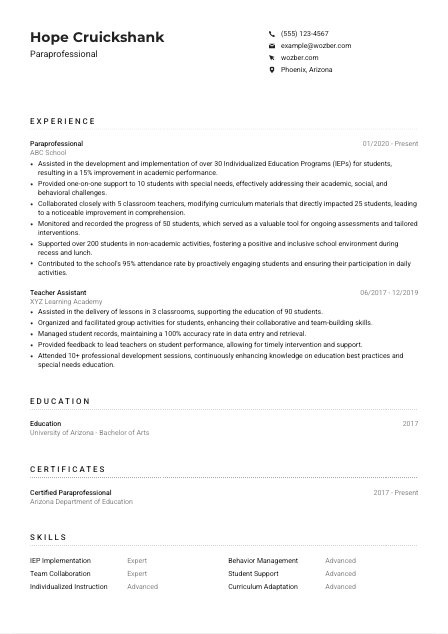
Some openings require local availability. Here, Phoenix, Arizona is specifically requested, so showing Phoenix, Arizona in your personal details removes uncertainty right away. Use location this way when it answers a stated requirement, not as filler.
A LinkedIn profile can help if it includes school experience, certifications, endorsements from educators, or additional volunteer work with children or students with special needs. If it is sparse or outdated, leave it off and keep the focus on the resume itself.
This section should answer the school's first logistical questions without distraction. Clear contact details, the right title, and any required location information help your resume move quickly to the part that matters most, your work with students.




For paraprofessional roles, experience is where schools look for day-to-day proof. They want to see how you supported instruction, adapted to student needs, tracked progress, and worked alongside teachers in a real educational setting.
Before editing your experience section, mark the responsibilities that define the job. In this posting, those include assisting with IEPs, supporting students one-on-one or in small groups, adapting instructional materials, recording progress, and helping during non-academic activities. Those duties should shape which bullets you keep and how you phrase them.
Use reverse chronological order and give the most space to positions closest to the work of the target role. A paraprofessional, teacher assistant, special education aide, or classroom support role should come before unrelated jobs because schools want to see recent experience with students, teachers, and classroom routines first.
Each bullet should show what you actually did in the learning environment. Focus on actions such as implementing IEP accommodations, reinforcing lesson plans, redirecting behavior, documenting performance, or supporting inclusion during transitions and activities. The sample resume does this well by naming one-on-one support, curriculum modification, and progress monitoring rather than relying on broad phrases like "helped students succeed."
Metrics make classroom support easier to understand when they reflect real scope. You might include the number of students supported, teachers partnered with, IEPs assisted, attendance gains, or improvements in academic or behavioral performance. For example, citing support for 10 students with special needs or monitoring progress for 50 students gives hiring teams a clearer picture of workload and trust level.
Keep the section centered on educational support work. If an older role does not connect to student supervision, instructional support, recordkeeping, behavior management, or collaboration with teachers and families, trim it back or remove it. The resume should read like someone already operating effectively in a school support environment.
A strong experience section lets a school picture you in the classroom. By tying your bullets to IEP support, student progress, behavior needs, and teacher collaboration, you make your contribution concrete and immediately relevant.
Education matters here because schools often begin with a baseline requirement, then look for training that supports classroom work. Even when the posting asks only for a high school diploma or equivalent, additional study in education, child development, or special education can strengthen your profile.
Meet the posted minimum first, then show any higher education that adds value. If you hold a bachelor's degree in Education, as in the example, that should appear prominently because it suggests stronger familiarity with instructional methods, student development, and school systems.
Use a simple format with school name, degree, field of study, and graduation year or date. Schools do not need decorative formatting here. They need to find your academic background quickly and connect it to the role without searching through extra detail.
If your studies relate directly to education, special education, psychology, child development, or communication, make that easy to see. A degree in Education naturally supports a paraprofessional application because it connects to instruction, classroom structure, and student learning needs.
Coursework can help if you are earlier in your career or your classes directly support the role, such as behavior intervention, literacy instruction, developmental psychology, or exceptional learner education. If your experience already proves those areas, coursework can stay in the background.
State-approved paraprofessional certification belongs in its own section, but your education section should still reflect any formal preparation that supports the work. Together, these sections show both minimum qualification and profession-specific preparation.
This section should make the school's baseline qualification check easy, then add context that supports your classroom readiness. If your studies connect to instruction or student support, let that connection show plainly.
In many districts, certification is more than a bonus. It can be a hiring requirement or a quick way to separate applicants who are already cleared for student-facing support work from those who are not.
When a job asks for a state-approved paraprofessional certification, place that credential front and center. A certificate such as "Certified Paraprofessional" directly addresses the requirement and tells the school you are prepared for the standards attached to the role.
Choose credentials tied to student supervision, special education support, behavior management, instructional assistance, or school compliance. Relevance matters more than volume. One credential that clearly supports paraprofessional work is more useful than several unrelated certificates.
Add the issuer and date range so schools can quickly tell whether the credential is current. In the example, listing the Arizona Department of Education and the active date range helps confirm both legitimacy and ongoing standing.
If you have recent training in areas like de-escalation, autism support, classroom accommodations, or student behavior intervention, include it when it strengthens your application. Education support roles often evolve with district practices, student needs, and compliance expectations.
This section should make it easy for a school to see that you meet any formal requirements attached to the role. Clear, relevant credentials can move your application forward faster, especially when certification is tied to state or district standards.
Paraprofessional skills are most persuasive when they reflect the actual mechanics of student support. Hiring teams look for a mix of instructional support, behavior awareness, communication, and dependable coordination with teachers and staff.
Pull skill terms directly from the posting where they match your experience. For this role, that includes IEP implementation, behavior intervention support, curriculum adaptation, written and oral communication, and team collaboration. This kind of wording helps both ATS screening and human review without sounding forced.
Order matters. Lead with skills that connect to student support and classroom function before more general strengths. In a paraprofessional resume, "IEP Implementation," "Behavior Management," "Individualized Instruction," and "Curriculum Adaptation" usually carry more weight than broad workplace terms.
Choose skills you can back up with examples in your experience section. If you list "Data Recording," there should be a bullet showing attendance tracking, progress logs, or behavioral documentation. If you list "Team Collaboration," your experience should show work with teachers, specialists, or families. Tight alignment between skills and bullets makes the resume more credible.
A well-built skills section should sound like the real work of supporting students and teachers, not a generic list. Keep it close to the posting and closely matched to what your experience already proves.
Language ability matters in paraprofessional work because communication happens all day, with students, teachers, specialists, and sometimes parents or guardians. If a posting specifies English fluency, your resume should make that easy to see.
If strong English fluency is listed, place English first and mark your proficiency accurately. That requirement is directly tied to instruction support, written notes, behavioral documentation, and communication with school staff.
Order the section by job relevance, not personal preference. English belongs first here because it is essential to the role. This helps the reviewer confirm a required qualification in seconds.
Additional languages can strengthen a paraprofessional resume when they help you communicate with students or families in a diverse district. The example includes Spanish, which may be especially useful in some school communities, but that should be presented as added value rather than a universal requirement.
Use clear labels such as "Native," "Fluent," "Intermediate," or "Basic." Schools need an honest sense of how comfortably you can speak, understand, and possibly write in each language, especially if communication support may become part of the role.
List languages that have a practical connection to the job. In education settings, that means classroom communication, family interaction, and support for inclusive learning environments. If a language would not realistically come up in the role, it does not need space on the page.
For a paraprofessional, language skills matter when they support instruction, documentation, and student relationships. Present them clearly so the school can tell both what is required and what extra communication value you bring.
Your summary should quickly place you in the right school support context. For paraprofessional roles, that means naming your experience level, the kind of students or classrooms you have supported, and the core work you are trusted to handle.
Review the posting and choose the themes that appear repeatedly. Here, those include special needs support, IEP implementation, one-on-one assistance, communication, and collaboration with teachers. Those should shape the wording of your opening lines.
Start with a direct professional identity such as "Paraprofessional with 4+ years of experience." That kind of opening immediately tells the school what level of classroom exposure you bring and matches the way education hiring teams scan resumes.
Use the next sentence to name two or three strengths that matter most for the job, such as implementing accommodations, providing individualized instruction, tracking student progress, or supporting behavioral goals. The sample summary works because it stays close to actual paraprofessional duties instead of leaning on vague enthusiasm.
Aim for a brief paragraph, usually three to four lines. Do not repeat every skill from the resume. Give the reader a fast, accurate sense of your classroom role, then let the experience section carry the detail and metrics.
A clear summary helps the school understand your background before they reach the first bullet point. When it names your experience, student support strengths, and classroom relevance with precision, the rest of the resume lands more effectively.
A paraprofessional resume works best when every section points to the same hiring picture: you can support students consistently, collaborate with teachers, and follow the instructional and behavioral plans already in place. That means using your experience, skills, education, and certification to show how you contribute inside a real school day.
Use Wozber's free resume builder to organize that story in an ATS-friendly resume format, then refine the wording with its ATS resume scanner and AI resume builder features so your resume matches the posting naturally and stays easy for schools to review. The final result should make one thing clear right away: you are ready to step into the classroom and support student progress from day one.




