



Use Wozber and land your dream job
Create Resume
No registration required
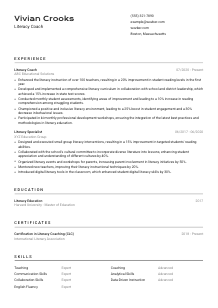
Guiding reading journeys, but feel stuck on your resume's chapter? Check out this Literacy Coach resume example, created with Wozber free resume builder. Learn how to weave your wordsmithing skills to match job calls, scripting a career tale that's as rich as the stories you share!
Literacy Coach resumes are strongest when they show influence beyond a single classroom. Schools want to see how you improve instruction across teachers, shape literacy practice with real student data, and help turn reading goals into classroom results. Your resume should make that broader instructional impact easy to follow.
A tailored resume also helps hiring teams quickly distinguish between an excellent classroom teacher and a coach who can lead adult learning, guide interventions, and support schoolwide literacy work. Wozber's free resume builder helps you organize that experience in an ATS-friendly resume format so the first read surfaces the work that matters most for a Literacy Coach.
For a Literacy Coach, the header should do one practical job well: confirm who you are, how to reach you, and whether any basic logistical requirements are already covered. Keep it clean and professional so the hiring team can move straight to your coaching experience, credentials, and literacy leadership.
Use your full name in a slightly larger font than the rest of the resume. Skip nicknames unless that is how you are known professionally in schools or district settings. The header should feel polished and dependable, much like your communication with teachers, administrators, and families.
Place "Literacy Coach" directly below your name if that is the role you are pursuing and your experience supports it. Matching the posting title helps frame your resume immediately around teacher coaching, literacy instruction, and school improvement work instead of leaving you looking like a general educator.
List a phone number, a professional email address, and if relevant, a website or LinkedIn profile that reflects the same roles, dates, and literacy accomplishments shown on your resume. Consistency matters, especially in education hiring where credentials and employment history are often reviewed carefully.
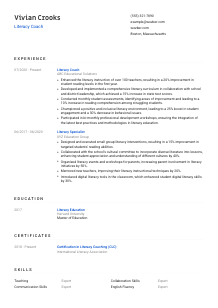
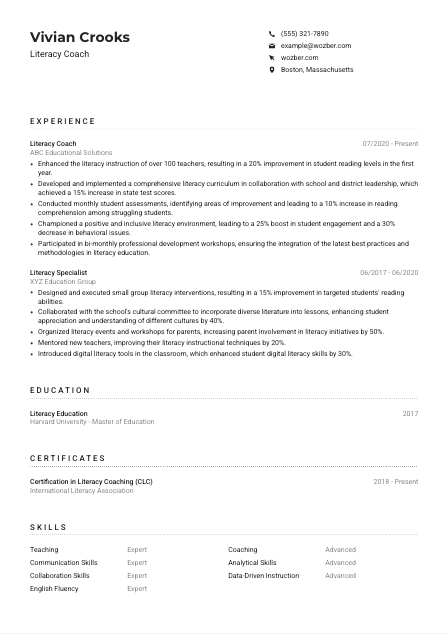
If the role requires local availability, include your city and state. In the example, listing "Boston, Massachusetts" directly supports the employer's stated location requirement. If you are relocating, a brief note can remove uncertainty without taking space away from your instructional leadership experience.
A LinkedIn profile can help if it includes literacy initiatives, professional development work, curriculum leadership, or conference participation that complements your resume. Leave it off if it is outdated or thin. Every item in this section should support a clear, school-ready professional identity.
Your header does not need personality statements or extra detail. It should confirm that you are reachable, professionally presented, and positioned for the Literacy Coach opening without creating basic questions.




This section carries most of the weight for a Literacy Coach. Schools are looking for more than years in education. They want to see how you supported teachers, improved literacy instruction, used assessment data, and contributed to stronger student reading outcomes across classrooms or grade levels.
Before editing your bullets, identify the work this employer is actually hiring for. Here, that includes coaching teachers, partnering with school and district leadership, conducting assessments, and supporting inclusive literacy environments. Those priorities should shape which roles you expand, which bullets you cut, and what language you mirror from your own experience.
List your most recent role first, then work backward. For each entry, include job title, school or organization name, and employment dates. This layout helps hiring teams quickly confirm that you meet the required teaching background and that your literacy work has progressed into coaching, intervention, or curriculum leadership responsibilities.
Focus on accomplishments that show what changed because of your work. Strong Literacy Coach bullets often include professional development delivered, intervention models designed, assessment cycles led, curriculum improvements implemented, or teacher practice strengthened. The sample resume does this well by connecting coaching more than 100 teachers to a 20% improvement in student reading levels.
Quantify results where the outcome is meaningful and credible. That might include gains in reading proficiency, comprehension growth, assessment scores, teacher participation, parent engagement, or reductions in behavior issues tied to stronger literacy routines. Metrics such as a 15% increase in state test scores or a 10% boost in reading comprehension give school leaders a clearer sense of scale and effectiveness.
Not every classroom accomplishment belongs here. Prioritize literacy-specific work, adult coaching, data analysis, intervention planning, and cross-functional collaboration with principals, specialists, or district teams. If a bullet does not help explain your readiness to guide literacy instruction beyond your own classroom, trim it or rewrite it.
The best experience sections connect teacher support to student reading growth. When your bullets show coaching scope, instructional decisions, and measurable literacy outcomes, your resume reads like a candidate ready to lead practice across a school.
Education hiring often starts with minimum qualifications, so your degree details should be immediate and easy to confirm. For a Literacy Coach, the degree line is not just background information. It helps establish subject-matter depth in literacy instruction, curriculum, and educational leadership.
If you hold a master's degree in Education, Literacy, or a related field, list it first. This posting specifically asks for that level of preparation, so do not bury it under older credentials. In the example, "Master of Education in Literacy Education" directly aligns with the requirement and immediately strengthens the match.
Include the institution, degree, field of study, and graduation year. That is usually enough for an experienced educator. A clean format helps school leaders and HR reviewers verify qualifications quickly, especially when they are scanning several applicants against district requirements.
If your degree concentration relates to literacy, reading, curriculum, or language development, spell that out clearly. Specific fields help distinguish a literacy-focused educator from a broader instructional background and reinforce your preparation for coaching reading instruction and intervention design.
Early-career candidates may benefit from including reading assessment coursework, intervention design, child language development, or honors related to education. If you already have several years of literacy coaching or teaching experience, those details are usually less important than your classroom and coaching results.
If you have completed substantial literacy institutes, structured reading training, or district leadership development that does not fit under certificates, it can complement this section or another appropriate part of the resume. Use it selectively. The main purpose here is to make your academic preparation for literacy leadership unmistakable.
Your education section should let a reviewer confirm, in seconds, that you meet the academic bar for the role. Then the rest of the resume can focus on how you apply that training in classrooms, coaching cycles, and literacy initiatives.
Certifications matter in coaching roles because they often signal district compliance, specialized literacy training, or continued professional credibility. List the credentials that support your authority to coach instruction, lead interventions, and work within state or district expectations.
This role asks for certification in Literacy Coaching or an equivalent credential based on state or district requirements. If you have that qualification, place it prominently. The example's "Certification in Literacy Coaching (CLC)" is a strong illustration of the kind of credential that immediately supports the application.
Lead with certificates that strengthen your case for literacy coaching, reading instruction, intervention planning, or state teaching eligibility. A current teaching license and a recognized literacy coaching credential usually matter far more than unrelated professional development certificates.
If the credential expires, renews, or remains active over time, include the date or date range. School systems often need to confirm that a certification is current, especially for licensed instructional roles. That simple detail can prevent follow-up questions later in the review process.
Literacy instruction evolves with new research on phonics, comprehension, intervention frameworks, culturally responsive texts, and assessment practices. Recent certifications or renewals can show that your coaching is grounded in current methods rather than older classroom habits. Keep the focus on learning that affects instructional quality.
The right certificates do more than fill a section. They show that your literacy expertise has been formally developed, recognized, and kept current in ways that matter for coaching teachers and supporting schoolwide reading growth.
A Literacy Coach needs a mix of instructional expertise, data fluency, and relationship-building. Your skills section should reflect the work itself: analyzing reading data, guiding teacher practice, supporting curriculum decisions, and communicating clearly with educators, families, and school leaders.
Use the wording in the job description where it reflects your actual strengths. This posting highlights analytical and data-driven instructional skills, along with interpersonal, communication, and collaboration skills. Including those terms helps both ATS screening and human reviewers connect your background to the role's daily demands.
Prioritize skills such as literacy coaching, reading intervention, assessment analysis, professional development, curriculum implementation, teacher collaboration, and English fluency over broad terms that could apply to any educator. In the example, data-driven instruction and coaching are much more useful than a long generic skill list would be.
A short, well-targeted group of skills is more effective than a crowded list. Choose abilities you can support elsewhere on the resume through accomplishments, credentials, or scope of work. If you list collaboration, your experience section should show work with leadership teams, teachers, or families. If you list assessment analysis, your bullets should reflect how you used student data to guide instruction.
For this role, skills should point directly to literacy leadership, teacher support, and student progress monitoring. When the wording matches your real work, the section reinforces the rest of the resume instead of repeating general educator language.
Language skills can matter in literacy coaching, especially in diverse school communities where family communication, multilingual learners, and culturally responsive instruction shape day-to-day practice. This section should be concise, accurate, and connected to how you work in educational settings.
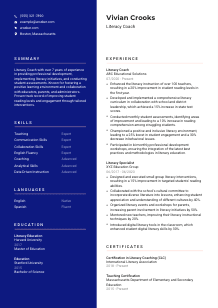
This posting explicitly names English fluency, so list English at the top with an accurate proficiency level such as "Native" or "Fluent." That makes one stated requirement easy to confirm and supports the communication demands of coaching teachers, facilitating PD, and discussing student progress with families.
Additional languages can strengthen your profile when they help with parent engagement, student support, or collaboration in multilingual environments. For example, Spanish may be useful in many districts for family workshops, literacy events, or conversations that build trust around reading support at home.
Stick to familiar terms such as Native, Fluent, Intermediate, or Basic. Hiring teams do not need inflated wording here. They need a realistic sense of whether you can lead professional conversations, communicate with families, or support multilingual literacy settings with confidence.
If you speak more than one language, that can support inclusive literacy work through clearer family outreach, stronger relationships, and better access to culturally relevant texts or programming. Mentioning another language is especially useful when it reflects the communities you have served, though it is not a universal requirement for every Literacy Coach role.
Do not overbuild this section unless languages are central to the role. For most Literacy Coach applications, English proficiency is the key requirement, and any additional language should be presented as a practical asset rather than the centerpiece of the resume.
Handled well, this section supports the communication side of literacy coaching without distracting from your instructional leadership. It should confirm required fluency and, when applicable, show added capacity to serve diverse school communities.
The summary sits at the top of the resume, so it should quickly establish your level, specialization, and impact. For a Literacy Coach, that means leading with coaching scope, literacy outcomes, and the kind of school-facing work you do well, not vague statements about passion for education.
Read the posting closely and choose the two or three requirements that matter most. Here, those include literacy coaching, data-informed instruction, collaboration with leadership, and student progress monitoring. Your summary should reflect that mix so the reader immediately sees a coach, not only a classroom teacher.
Start with your title and level of experience, such as "Literacy Coach with 7+ years of experience" or a similar phrasing that fits your background. This gives immediate context and helps position you within the expected experience range, especially when the employer asks for at least 5 years of teaching experience focused on literacy.
Include a short proof point tied to reading growth, teacher development, curriculum work, or intervention results. The sample summary works because it mentions improving student reading levels and engagement through tailored interventions instead of staying abstract. Choose outcomes that match your own record and the employer's priorities.
Aim for a concise paragraph of about 3 to 5 lines. That is enough room to establish your literacy specialization, coaching experience, and measurable strengths without repeating the full experience section. Focus on the work you want schools to notice first.
A strong summary helps the reader understand your value before they reach the first job entry. For a Literacy Coach, that means a clear statement of coaching experience, literacy expertise, and the results you have delivered through teacher support and student-focused instruction.
A Literacy Coach resume should show how your work improves instruction at the teacher level and reading outcomes at the student level. When your sections line up around coaching, assessment, curriculum support, and literacy growth, the application feels grounded in the realities of the role.
Use Wozber's free resume builder to shape that story into an ATS-compliant resume, then refine it with an ATS resume scanner and ATS-friendly resume template so the final version stays clear, structured, and closely matched to the position you want. The goal is simple: make your readiness to lead literacy practice easy to see.