



Use Wozber and land your dream job
Create Resume
No registration required
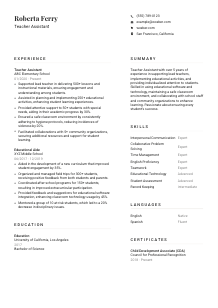
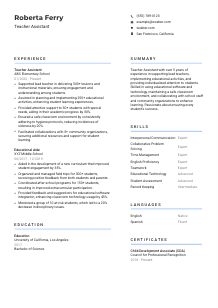
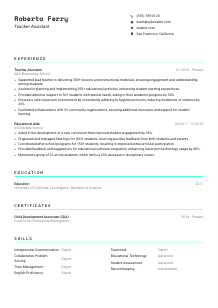
Lending a hand in class, but your resume feels like detention? Check out this Teacher Assistant resume example, created with Wozber free resume builder. Learn how to highlight your educational support skills to match job expectations, making your teaching journey as captivating as storytime!
Teacher Assistant resumes are read through the lens of classroom support. Schools want to see whether you can help a lead teacher keep instruction moving, support students who need extra attention, and contribute to a classroom that stays safe, organized, and calm. If your resume stays broad, it can miss the daily reality of the job.
A tailored resume makes your classroom experience easier to place fast, especially when administrators are sorting candidates through an ATS before the interview stage. Wozber's free resume builder helps you line up your language with the posting and keep an ATS-friendly resume format, so the hiring team can quickly see your experience with lesson support, student needs, and school-based collaboration.
This section should answer the practical questions a school office notices first. Can they reach you easily, are you applying for the right role, and do you meet any location or communication requirements stated in the posting? Keep it clean and direct.
Use your full name as the top line in a slightly larger font than the rest of the resume. In education hiring, that simple choice matters because administrators often review many applications quickly and need the document to feel orderly from the first glance.
Place "Teacher Assistant" directly under your name if that is the role you are pursuing. Matching the title used in the posting helps both ATS parsing and human review, especially when schools are sorting between adjacent roles such as paraprofessional, instructional aide, and classroom assistant.
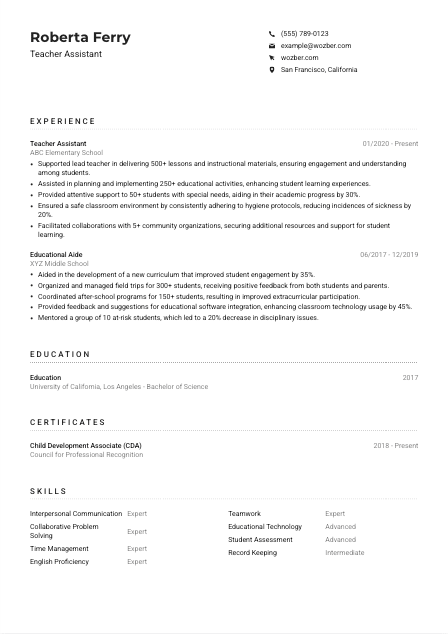
Include a reliable phone number and a professional email address that uses your real name. If a posting includes a location requirement, reflect it here. In the example, listing "San Francisco, California" immediately addresses the employer's stated location filter and removes uncertainty about local availability.
A LinkedIn profile can help if it reinforces your education background, school experience, volunteer work with students, or professional development in classroom support and educational technology. Skip empty or outdated profiles. In education, relevance matters more than having another link.
Do not include marital status, date of birth, photo, or identification numbers unless a formal application system specifically requests them. Your contact section should stay focused on what supports hiring decisions, not personal data that clutters the page.
Your personal details should make you easy to contact and easy to place for the role. When this section is tidy and aligned with the posting, the hiring team can move straight to your classroom experience.




School hiring teams look for more than time served in a classroom. They want to understand how you contributed to instruction, student support, classroom routines, and the wider school community. That is what your experience section needs to make visible.
Start by marking the actions the school repeats or emphasizes. For a Teacher Assistant, that often includes supporting lessons, helping plan activities, assisting students with special needs or learning difficulties, maintaining a safe classroom, and collaborating with staff or families. Those priorities should shape the wording of your bullets so your background lines up with the school's day-to-day needs.
List your most recent position first and give each entry the basics: school name, job title, and dates. Then focus the bullets on contributions tied to instruction and student support. The example does this well by leading with a current Teacher Assistant role and showing direct classroom responsibilities instead of generic task lists.
Schools respond well to bullets that show what you helped deliver and at what scale. Instead of writing "assisted with lessons," write something closer to "supported the lead teacher in delivering 500+ lessons and instructional materials." That tells a hiring team you worked inside the rhythm of real classroom instruction and handled volume over time.
Quantify the parts of the work that can be measured honestly. That may include number of lessons supported, students served, activities planned, attendance improvements, behavior reductions, or progress among students receiving extra help. In the sample, supporting 50+ students with special needs and contributing to a 30% academic improvement gives much more hiring value than a broad claim about being caring or effective.
If an older role is less relevant, keep it brief or remove unrelated bullets. Prioritize experience that shows instructional support, educational technology use, student supervision, collaboration with teachers, and work with diverse learners. Even when your title was different, such as Educational Aide, frame the experience in language that connects clearly to Teacher Assistant work.
By the end of this section, a principal or school administrator should be able to picture you in the classroom. Show the scope of your support, the students you worked with, and the results your work helped produce.
For a Teacher Assistant position, education is usually a screening requirement before anyone studies the finer details of your resume. Present it clearly so the degree match is obvious, then use supporting details only when they strengthen your case.
When a posting asks for a Bachelor's degree in Education or a related field, make sure that information is easy to find. In the example, "Bachelor of Science in Education" directly addresses the requirement and removes guesswork for the reviewer.
List the degree, field of study, school name, and graduation year or completion date. That structure is enough for most Teacher Assistant applications and keeps the section readable for both ATS systems and school staff reviewing resumes manually.
If your degree is in Education, Early Childhood Education, Special Education, Psychology, or another closely related area, name it exactly. The field matters because it helps schools connect your academic preparation to classroom support, child development, or learning needs.
Honors, education clubs, tutoring practicums, classroom observation hours, or student teaching projects can add value if you are early in your career or your experience section is still growing. If you already have several years in schools, keep these additions selective.
Professional development can sit here or in certifications, depending on your format. If you have training in child development, behavior support, special education assistance, literacy intervention, or educational software, it helps show that your learning stays connected to classroom practice.
Your education should quickly confirm that you meet the academic requirement and have relevant preparation for supporting instruction and student development. Once that is clear, the rest of the resume can carry the deeper story.
Certifications are not always mandatory for Teacher Assistant roles, but they can strengthen your profile when they relate to student support, child development, or classroom practice. They are especially useful when several candidates have similar school experience.
Some schools ask directly for specific credentials, while others signal preferred preparation through duties such as supporting special needs students or assisting with learning interventions. Even when not required, a relevant certificate can reinforce that you are prepared for hands-on educational support.
List certificates that speak to classroom assistance, child development, behavior support, special education, literacy programs, or instructional technology. In the example, the Child Development Associate credential fits naturally because it supports the candidate's work with students in a school setting.
Include the issuing organization and the active or completion date. If a credential is current, make that visible. Schools want to know whether your training is recent and still valid, especially for certifications linked to child safety, development, or regulated educational support roles.
If you are working toward another relevant credential, mention it only if it is concrete and underway. That can help when the role involves specialized student support or when the school values staff who keep building their practice through training.
Well-chosen certifications add another layer of trust to your application. They show that your preparation goes beyond degree requirements and stays connected to the practical demands of supporting students in the classroom.
Your skills section should reflect the mix of classroom support, communication, and practical school operations the role depends on. Keep it focused on the abilities a lead teacher or administrator would expect you to use during the school day.
Read the job description closely and note the terms used for communication, student support, and technology. In this case, "effective communication and interpersonal skills" and "strong proficiency in using educational technology and software" should appear if they genuinely match your background. That helps ATS alignment while keeping your wording relevant to the role.
Teacher Assistant resumes should show both relational and practical strengths. Include skills such as classroom support, student supervision, behavior management, educational technology, progress tracking, record keeping, and collaboration with teachers or parents. The example balances interpersonal communication with educational technology and student assessment, which is a solid model.
Do not crowd this section with every ability you have. Choose the skills that connect most clearly to lesson support, diverse student populations, special needs assistance, classroom organization, and school communication. A shorter, targeted list reads as more credible than a long inventory of vague strengths.
Your skills section should show that you can step into a classroom, support instruction, work well with students and staff, and handle the tools that modern schools use. That mix is what makes the section useful.
Language ability matters in education because communication happens across students, teachers, caregivers, and sometimes community partners. If a posting names English proficiency or serves a multilingual school community, your language section can add practical value.
If the role requires English proficiency, list English clearly with an accurate level such as Native or Fluent. For a Teacher Assistant, this matters because classroom directions, parent communication, record keeping, and instructional support often depend on strong written and spoken English.
Additional languages can strengthen your application when they help you connect with students or families. In the example, Spanish is a useful addition because many schools value staff who can support communication across a diverse community. Treat that as an advantage, not a universal requirement.
Use clear levels and stay accurate. If you can hold parent conversations, support classroom communication, or translate basic school information, say so at the right level. Overstating language ability can create problems quickly in an education setting where communication needs to be dependable.
When you know a school works with multilingual families or diverse student populations, relevant language skills deserve stronger placement. They can complement your experience with inclusion, family engagement, and community support without replacing the need for core classroom competence.
If you are currently studying a language that is commonly useful in your school community, mention it only if you can already use it in a limited but real way. This section works best when it reflects communication ability that can support students, families, or staff right now.
Language skills can broaden the ways you support learning and communication in a school. When they are relevant and honestly presented, they add practical depth to your Teacher Assistant profile.
Your summary should give a school a fast, credible sense of your background. In a few lines, show the level of experience you bring, the kind of classroom support you provide, and the strengths most relevant to the job posting.
Before writing, identify the two or three priorities that define the role. For a Teacher Assistant, that may be lesson support, educational activities, help for students with learning difficulties, classroom safety, or collaboration with staff and families. Build your summary around that mix rather than writing a generic statement about loving education.
Start with a direct line such as "Teacher Assistant with over 5 years of experience in school settings." That immediately tells the reader whether you meet the experience threshold and whether your background is close to the role they are filling.
Use the next sentence to mention the classroom functions you handle well, such as supporting lead teachers, implementing educational activities, assisting students with special needs, or using educational software. The example summary works because it stays tied to the actual work of the position instead of drifting into broad personal traits.
Aim for a short paragraph that can be read in seconds. Two to four lines is usually enough. If every phrase points to school-based experience, student support, and classroom contribution, the summary will do its job without taking space from stronger detail in the experience section.
A hiring team should finish the summary with a clear sense that you already understand classroom support work and can contribute from day one. Keep it brief, grounded, and closely tied to the school's priorities.
A well-tailored Teacher Assistant resume should make three things easy to see: your ability to support instruction, your experience helping students with different learning needs, and your readiness to work inside the routines of a school day. When those points come through clearly, the rest of the application process gets much easier.
Wozber's free resume builder, ATS resume scanner, and ATS-friendly resume templates can help you sharpen the language, structure, and ATS optimization of each section so your experience reads clearly to both software and school staff. The finished resume should leave no doubt about your value in the classroom.




