



Use Wozber and land your dream job
Create Resume
No registration required
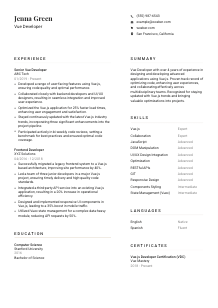
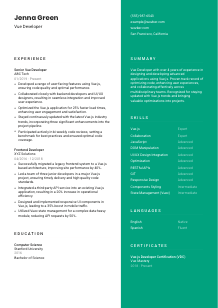
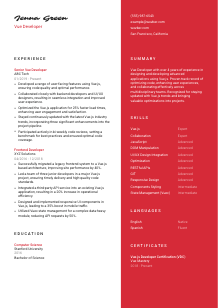
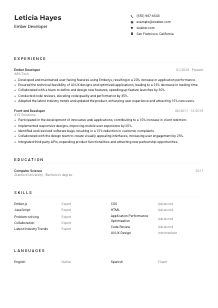
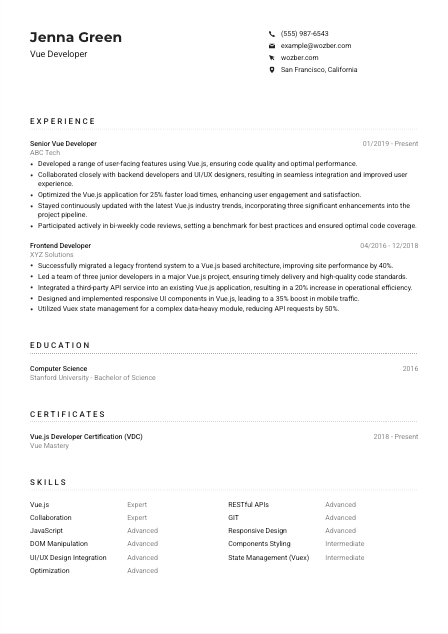
Shaping Vue's frontend magic, but your resume looks a little reactive? Check out this Vue Developer resume example, created with Wozber free resume builder. It shows how to align your Vue.js expertise with job specifications, crafting your career path as seamlessly as a reactive UI component!
Vue development gets judged in the browser long before anyone asks about architecture opinions. Hiring teams want to see that you can turn product requirements into responsive, maintainable interfaces, work comfortably inside component-based systems, and improve performance where users actually feel it, whether that means faster load times, cleaner state handling, or smoother collaboration with design and backend teams.
A tailored resume changes how quickly that frontend story becomes clear. When the language mirrors the job's Vue, JavaScript, performance, and collaboration requirements, Wozber's free resume builder helps shape that experience into an ATS-compliant resume that surfaces the right framework depth first, so reviewers can tell whether you've built production Vue features rather than simply touched frontend code.
For a Vue Developer, the header should establish relevance fast and remove practical questions before anyone reaches your project work. Keep it clean, professional, and aligned with the role you're targeting.
Lead with your full name in a clear, readable format. This is basic, but it matters. A polished header sets the tone the same way a clean component structure does in a production codebase.
Place "Vue Developer" directly under your name when that is the job you're pursuing. Matching the posted title helps recruiters and ATS tools categorize your profile correctly, especially when employers are filtering between broader frontend candidates and developers with hands-on Vue.js experience.
Include a reliable phone number, a professional email address, and, if relevant, a portfolio, GitHub, or personal site that shows shipped UI work. For frontend roles, links to real components, app interfaces, or code samples can reinforce claims about JavaScript, responsive design, and framework usage far better than generic profile links alone.
If the job requires you to be based in a specific area, include that location clearly in your personal details. In this example, listing San Francisco, California immediately answers a stated requirement and avoids unnecessary back-and-forth about availability.
Skip personal information that does not help your candidacy, such as marital status, date of birth, or unrelated personal facts. Use the space for details that support the application, especially role title, contact information, and links to relevant frontend work.
This section should quickly confirm who you are, what role you do, and whether any practical requirement, such as location, is already covered. Then the resume can move straight to your Vue work.




This is the section hiring managers read to understand whether you have shipped frontend features in real environments. For Vue roles, that means showing component work, collaboration with design and backend teams, performance improvements, code quality habits, and the scale or outcomes of what you built.
Before editing your bullets, identify the repeated priorities in the posting. Here, the clearest themes are Vue.js feature development, JavaScript fluency, collaboration, performance optimization, code reviews, and familiarity with server-side rendering and styling. Your experience bullets should answer those themes directly instead of listing generic frontend duties.
Use reverse chronological order and make each entry easy to scan with job title, company, and dates. That structure helps reviewers quickly track how long you've worked with Vue, whether your experience is recent, and how your scope has grown from implementation to ownership, mentoring, or review responsibilities.
Each bullet should describe shipped work, collaboration surface, or measurable technical impact. Mention user-facing features, component libraries, API integrations, state management, rendering decisions, or UI performance improvements where relevant. The sample resume does this well by tying Vue feature delivery to backend and UI/UX collaboration instead of leaving the work at "developed frontend applications."
Numbers make engineering contributions easier to trust. Use metrics that fit frontend delivery, such as load-time reduction, mobile traffic growth, lower API request volume, release cadence, defect reduction, or engagement improvements. A bullet like "optimized the Vue.js application for 25% faster load times" gives concrete weight to performance claims in a way broad statements about optimization never will.
If you have broader frontend history, keep the emphasis on work that proves Vue depth. Migration work, reusable component development, Vuex or Pinia state management, SSR exposure, styling systems, and code review participation usually matter more here than older unrelated UI tasks. Tailoring means deciding which accomplishments best match the employer's stack and delivery expectations, then moving those to the top.
By the end of this section, a hiring manager should understand what you built in Vue, how you worked with adjacent teams, and what improved because of your code. That is the level of clarity that moves a frontend resume forward.
Education usually plays a supporting role for experienced Vue Developers, but it still matters when the posting names a degree requirement. Present it clearly so the reviewer can confirm the baseline quickly and return to your technical experience.
If the role asks for a Bachelor's degree in Computer Science or a related field, make that match visible without forcing the reader to infer it. In the example, a Bachelor of Science in Computer Science aligns directly with the requirement and supports the technical foundation behind frontend and JavaScript work.
List the degree, school, field of study, and graduation year in a consistent format. Hiring teams typically spend only a few seconds confirming education, so clarity matters more than decoration here.
When your degree is directly related to software engineering, computer science, or a similar field, name it in full. That helps especially when the employer has specified formal education as part of the screening criteria.
Coursework can help early-career candidates who need more proof of technical grounding. If you are light on professional experience, classes in algorithms, web development, software engineering, human-computer interaction, or distributed systems can support your story. If you already have several years of Vue work, keep this section lean.
Add standout projects, honors, or technical extracurricular work only when they strengthen your candidacy. A capstone involving frontend architecture, a collaborative software build, or a UI-focused engineering project can be useful if it connects naturally to the role you're applying for.
This section does not need much space, but it should make the degree requirement easy to verify. Once that box is checked, your resume can stay focused on shipped Vue work and engineering outcomes.
Certifications are rarely the main hiring decision for a Vue Developer, but they can strengthen your profile when they reflect current framework knowledge, frontend practices, or continued technical learning.
List certificates that connect directly to Vue, JavaScript, frontend architecture, testing, performance, or related tooling. A Vue-specific certification can reinforce your specialization, particularly when the role asks for several years of focused framework experience.
Do not crowd the section with every course completion badge you've earned. Prioritize certifications that add useful context to your application and support the actual work the employer needs, such as component development, state management, or frontend engineering practices.
Include issue or active dates so employers can see whether the learning is recent. In fast-moving frontend ecosystems, timing matters because best practices around Vue patterns, styling approaches, and rendering strategies evolve.
A current or recently earned certification can support the point that you keep up with framework updates and engineering standards. That aligns well with postings that mention staying current with industry trends and best practices, especially for teams that expect developers to contribute through code reviews and technical discussions.
Relevant certifications can add credibility, but they work best as reinforcement for the experience section. Use them to show current learning and framework commitment, not to replace real project outcomes.
For frontend roles, the skills section should work like a fast technical snapshot. It needs to confirm framework depth, supporting JavaScript knowledge, and the collaboration skills required to ship interfaces with product, design, and backend teams.
Pull the technical terms the employer uses and include the ones you genuinely have. For this role, Vue.js, JavaScript, DOM manipulation, component styling, collaboration, and communication should be easy to spot. If you have relevant SSR experience, include that explicitly rather than assuming Vue alone covers it.
Vue work is rarely done in isolation. Alongside framework and frontend skills, include collaboration, code review participation, cross-functional communication, and any workflow strengths that matter in real product teams. The sample resume handles this well by pairing Vue.js and JavaScript with collaboration and UI/UX design integration.
Order your skills so the most relevant ones appear first. You can cluster framework, language, state management, API, styling, and collaboration skills to make the section easier to parse for both recruiters and ATS tools. Keep the list targeted. Ten to twelve relevant skills usually says more than a long inventory of loosely related tools.
This section should quickly confirm that you can build in Vue, write strong JavaScript, and work effectively inside a product team. If a reviewer can see that in a few seconds, the skills section is doing its job.
Language fluency matters most when it affects day-to-day collaboration, documentation, code reviews, and discussions with product or design partners. Keep this section practical and aligned with the communication demands of the role.
If the job requires fluent English, list it clearly with an honest proficiency level such as Native or Fluent. For development roles, that supports expectations around standups, documentation, pull request comments, and cross-functional communication.
If you speak additional languages, include them after the required one and rank them by proficiency. Extra languages are not usually core hiring criteria for Vue roles, but they can be useful in global teams, distributed product environments, or customer-facing engineering contexts.
Choose levels you can comfortably support in real work settings. If you can discuss technical tradeoffs, read documentation, and collaborate in meetings, say so honestly. Inflated language claims become obvious very quickly in interviews.
Some engineering teams work across regions or collaborate with offshore developers, product managers, or support teams. In those cases, an additional language can strengthen your profile, especially when communication is part of delivery velocity.
Language skills should add real context, not filler. If another language helps you collaborate across teams or markets, include it. If not, keep the section brief and accurate.
For this kind of frontend position, language proficiency matters because the work depends on clear communication with engineers, designers, and stakeholders. Make that capability easy to see and keep it credible.
Your summary should quickly tell the reader what level of Vue developer you are, what kind of work you have handled, and what strengths define your contribution. It works best when it sounds grounded in shipped frontend work rather than broad self-description.
Review the posting before writing this paragraph. If the role centers on Vue feature development, JavaScript strength, performance, and collaboration, those themes should shape your opening lines. Avoid generic frontend language that could apply to any framework.
Start with your title and years of experience in a direct, factual way. For example, "Vue Developer with 4+ years of experience building production web applications" immediately establishes framework focus and seniority better than a vague statement about passion for frontend development.
Choose strengths that match the job and are supported by your experience section. Good options include building user-facing features in Vue, optimizing performance, collaborating with backend and UI/UX teams, or improving code quality through reviews and best practices. The sample summary works because it ties optimization, user experience, and collaboration together in terms that match the role.
Aim for a short paragraph that can be read in seconds. Skip buzzwords and focus on what you build, how you work, and what kind of results you tend to produce. A concise summary with real technical focus gives the rest of the resume a stronger opening.
When this paragraph is doing its job, the reader already understands your Vue focus, your delivery strengths, and the kind of engineering value they'll see in the experience section. Wozber's AI resume builder can help refine that wording and strengthen ATS optimization so your summary reflects the same Vue, JavaScript, and collaboration priorities the role calls for.
A Vue Developer resume should make one thing easy to judge: whether you can build and improve production interfaces with Vue in a team setting. If your experience shows shipped features, performance gains, collaboration with design and backend partners, and solid JavaScript fundamentals, the core hiring questions are already being answered.
Use Wozber to tighten structure, align your wording with the job description, and present everything in an ATS-friendly resume format. The result should give hiring teams a clear read on your frontend depth and your readiness to contribute from day one.




