



Use Wozber and land your dream job
Create Resume
No registration required
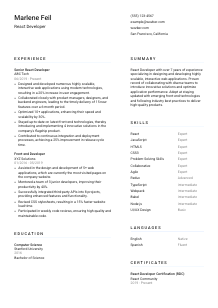
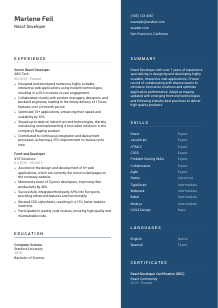
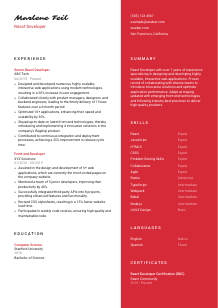
Crafting dynamic UIs, but your resume feels stuck in the virtual DOM? Check out this React Developer resume example, built with Wozber free resume builder. Learn how to present your component-driven skills to match job requirements, so your career stays as responsive and cutting-edge as your web apps!
Front-end hiring moves quickly when a resume shows the kind of React work that actually matters in production. Hiring teams want to see how you build interactive interfaces, manage state, improve performance, and work with design, product, and backend partners to ship features that hold up at scale. If those details stay vague, even solid candidates can look interchangeable.
A tailored React Developer resume helps your core stack and delivery history surface early, especially when an ATS is scanning for tools like React, Redux, TypeScript, Webpack, or Agile collaboration. Wozber's free resume builder makes that alignment much easier by helping you shape an ATS-compliant resume around the language of the role, so reviewers can quickly see whether you've built fast, scalable web applications in a real team environment.
For a React Developer, the top of the resume should confirm who you are, what role you do, and whether you meet any practical screening filters before a reviewer gets into code, architecture, or delivery examples. Keep it clean, direct, and easy to scan.
Use the name you work under on LinkedIn, GitHub, and your portfolio so your professional footprint is easy to match. Keep it visually prominent and consistent across platforms, especially if recruiters may cross-check your open-source work, personal projects, or published front-end case studies.
Place "React Developer" directly under your name if that matches your target role and recent work. This immediately anchors your profile around the React ecosystem rather than a broader label like "Software Engineer" or "Front-end Developer," which can blur your specialization during ATS screening.
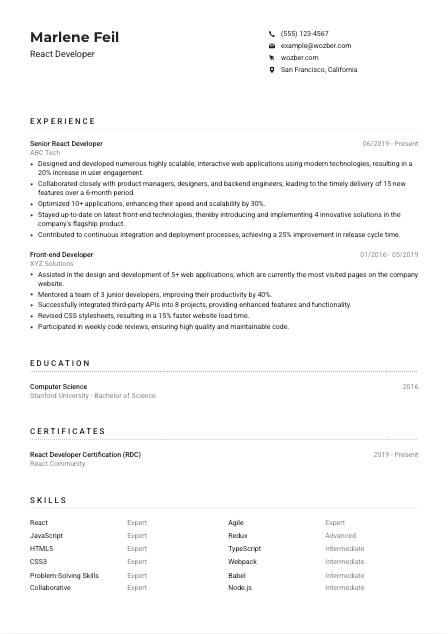
If a posting includes a location requirement, list your city and state clearly. In this example, San Francisco, California matters because the employer explicitly asks for it. Treat location this way when it is a real requirement, not as a universal rule for every React role.
A portfolio, GitHub profile, or personal site can strengthen a React application when it shows components, app architecture, performance thinking, or shipped UI work. Link it only if the projects are current, usable, and relevant to the kind of web applications you want to build professionally.
This section should confirm your identity, role focus, and any immediate screening requirement in seconds. Once that is clear, the rest of the resume can concentrate on React delivery, performance, and collaboration.




This is where a React Developer resume earns attention. Hiring managers look for shipped features, front-end architecture decisions, performance work, collaboration with cross-functional teams, and signs that you can contribute inside a modern delivery workflow rather than just write components in isolation.
List your positions in reverse chronological order and prioritize titles that show direct front-end or React ownership. If your official title was broader, use the bullet points to make your React scope unmistakable through component development, state management, routing, testing, or interface performance work.
Use metrics tied to how front-end work is judged: engagement, load time, feature throughput, release speed, or app responsiveness. The example does this well with outcomes like a 20% increase in user engagement, 15 new features delivered in six months, and a 30% speed and scalability improvement across 10+ applications.
Read the job description closely and make sure your bullets reflect the same categories of work. For a React opening, that usually means scalable web applications, interactive UI development, optimization, and use of the surrounding ecosystem. If the posting emphasizes React Router, Redux, TypeScript, or build tools, mention them where you genuinely used them rather than leaving the stack implied.
React developers rarely work in a vacuum. Write bullets that show how you collaborated with product managers, designers, QA, and backend engineers to define requirements, resolve edge cases, and ship features on schedule. The sample bullet about working closely with product, design, and backend teams is effective because it ties teamwork to a delivery result, not just a soft-skill claim.
Beyond shipping interfaces, show that you improved the codebase or delivery process. That can include performance tuning, component reuse, CI/CD contributions, API integrations, code reviews, or introducing newer front-end approaches. In the example, adding innovative solutions and improving release cycle time helps show value beyond day-to-day ticket work.
The best bullets show what you built, how you built it, who you worked with, and what changed because of it. That gives hiring teams a clearer read on whether you can contribute to a React codebase from day one.
Education usually sits behind experience for mid-level and senior React roles, but it still helps frame your technical background. A clear education section supports your front-end profile, especially when your degree connects to computer science, software engineering, or related technical study.
Include your degree, field of study, school, and graduation year in a simple format. For front-end roles, a Computer Science degree naturally supports your grounding in software fundamentals, even when your strongest selling points come from shipped products and real-world engineering work.
Recruiters and hiring managers should be able to find your education in one quick pass. Avoid over-formatting. A straightforward entry is enough unless academic work adds direct value to your React profile.
Many React jobs do not require a specific degree, but related technical education still helps when it supports your understanding of JavaScript, browser behavior, data structures, or software engineering practices. In the example, a Computer Science degree from Stanford reinforces the candidate's technical foundation without needing extra explanation.
If you are early in your career, relevant coursework or projects can help. Highlight projects involving web applications, front-end frameworks, responsive design, or JavaScript architecture. Once you have substantial professional React experience, keep academic detail brief unless it is unusually strong.
Front-end development changes quickly. If you've added coursework in TypeScript, testing, accessibility, performance optimization, or modern tooling, include it when it sharpens your fit for the target role. Keep the focus on learning that maps to current React work, not unrelated platform exposure.
A concise education section strengthens your technical profile without distracting from the work that matters most. Let it confirm foundation, then return the spotlight to your React experience.
Certifications are not mandatory for most React Developer roles, but they can help when they support current front-end skills or show continued investment in the ecosystem. The key is relevance. A short, targeted list does more than a long catalog of unrelated credentials.
List certificates that connect directly to React, JavaScript, TypeScript, web performance, testing, or related front-end practices. A React-focused credential, like the example's React Developer Certification, works because it supports the role rather than competing with it.
Choose certifications that strengthen the story your experience already tells. If a certificate does not help explain your value as a React developer, leave it off. Hiring teams will care far more about front-end depth than about generic technical badges.
Recent dates can show that your knowledge is current, which matters in an ecosystem that keeps changing. If a certification has an active period or renewal cycle, include that information in a clean format so it reads as current and relevant.
When your recent work does not fully cover a tool or practice named in the posting, a well-chosen certificate can help close that gap. This works best for topics like TypeScript, testing libraries, accessibility, or build tooling that often sit alongside React in modern front-end teams.
Certificates should reinforce your front-end credibility, not carry the resume. If they are relevant and current, they add useful depth to your React profile.
The skills section should read like an accurate snapshot of the stack you can use in production. For React roles, that usually means core front-end languages, the React ecosystem, build tooling, and a few work-style skills that matter in collaborative product delivery.
Start with the stack and practices the employer explicitly names. In this posting, that includes React, Redux, React Router, JavaScript or TypeScript, HTML5, CSS3, modern front-end tools, problem-solving, collaboration, and Agile. Put your strongest matches near the top.
Order the list around tools and capabilities you have used in real delivery work. React, JavaScript, HTML5, CSS3, Redux, TypeScript, Webpack, and Babel are stronger signals than filler terms. If you include problem-solving or collaboration, make sure your experience bullets back them up with concrete examples.
Avoid turning this section into an inventory of every tool you've touched once. A tighter list helps both ATS parsing and human review. For a React resume, group your stack around front-end development, state management, tooling, testing if applicable, and delivery methods such as Agile rather than mixing in unrelated technologies without context.
This section should make it easy to see whether your technical toolkit matches the codebase and workflow. Relevance matters more than volume.
Language skills matter more in development hiring than many candidates assume. React developers spend a good part of the week discussing requirements, reviewing pull requests, writing tickets, explaining tradeoffs, and collaborating across functions, so communication can affect delivery as much as code quality.
If the job asks for strong English, list English clearly with an honest proficiency level. In this case, "superior English language skills" is an explicit requirement, so it should be easy to find.
Extra languages can be useful on distributed teams, global products, or customer-facing platforms. The example includes Spanish, which adds value without distracting from the technical profile.
Stick to recognizable levels such as Native, Fluent, Intermediate, or Basic. Avoid vague terms that leave reviewers guessing how well you can handle meetings, documentation, or written collaboration.
Some engineering jobs are deeply collaborative across time zones, business units, or client groups. In those cases, language skills can support smoother sprint planning, design reviews, or technical handoffs even when only one language is formally required.
Do not overstate proficiency. If you can comfortably participate in standups, planning sessions, and technical discussions in a language, say so. If not, use a lower level. Precision here matters for team communication expectations.
For a React role, language skills should help confirm that you can collaborate clearly in planning, delivery, and review cycles. Keep the section brief, honest, and relevant to how software teams work.
Your summary should quickly establish the kind of React developer you are. In a few lines, show your experience level, technical focus, and the business outcomes your front-end work tends to influence, whether that is performance, feature delivery, usability, or scalable application development.
Start with a direct statement of tenure and specialization, such as React development experience across production web applications. The example's "over 7 years of experience" works because it gives immediate context before moving into technical scope.
Use the summary to name the kind of work you do best: building scalable interactive applications, collaborating across product and engineering, improving performance, or working inside modern front-end workflows. Keep the wording close to your actual track record and aligned with the posting.
A small amount of measurable detail makes the summary more credible. You do not need a dense list of metrics, but a phrase tied to feature delivery, performance gains, or user engagement can help distinguish you from candidates whose summaries stay generic.
Aim for a short paragraph that reads like a focused professional profile, not a biography. For React roles, four lines are often enough to establish your stack, your level, and the kind of product impact your experience supports.
A strong summary gives hiring teams a fast read on your React focus before they reach the detailed experience bullets. If it is specific, technically grounded, and aligned with the role, it does its job well.
A React Developer resume works best when every section supports the same message: you can build and improve modern web applications in a production team. That means clear role alignment in the header, measurable delivery in experience, a relevant front-end stack in skills, and a summary that quickly connects your background to interactive product work.
Use Wozber's free resume builder to organize that story in an ATS-friendly resume format, refine wording around the target stack, and strengthen ATS optimization without losing technical accuracy. When the resume is tailored well, hiring teams can quickly judge whether you are ready to contribute to a React codebase, collaborate across functions, and ship features that perform at scale.




