



Use Wozber and land your dream job
Create Resume
No registration required
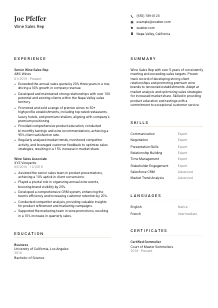
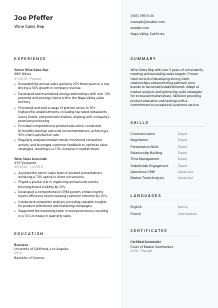
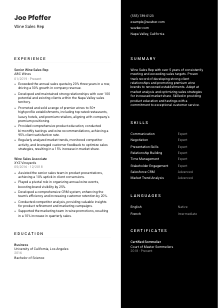
Uncorking new opportunities, but your resume feels as dry as a Chardonnay? Pour into this Wine Sales Rep resume example, made with Wozber free resume builder. Learn how to put your sales flair into words that taste like the finest vintage, positioning your career as richly as a well-aged Bordeaux.
Wine sales is relationship-driven work with clear commercial pressure behind it. Buyers expect a rep who can move cases, protect brand positioning, and speak confidently about the portfolio in front of restaurant groups, retailers, and hospitality teams. Your resume needs to show that mix of sales performance and product fluency early, especially through territory growth, account development, tastings, and quota results.
When those details are tailored to the target role, hiring teams can quickly tell whether your background is built around wine distribution and account growth or around adjacent sales work with less portfolio depth. Wozber's free resume builder helps shape that story into an ATS-compliant resume by aligning your language with the posting and keeping the structure easy to scan, so your track record in client education, forecasting, and territory execution is clear from the start.
In wine sales, the header does more than identify you. It tells the employer whether you are easy to contact, professionally presented, and positioned for the territory they need covered. Keep this section clean and practical.
Use your full name as the most visible line at the top of the page. A hiring manager scanning several territory sales resumes should be able to find and remember it quickly, especially when they are comparing candidate follow-ups after interviews or portfolio reviews.
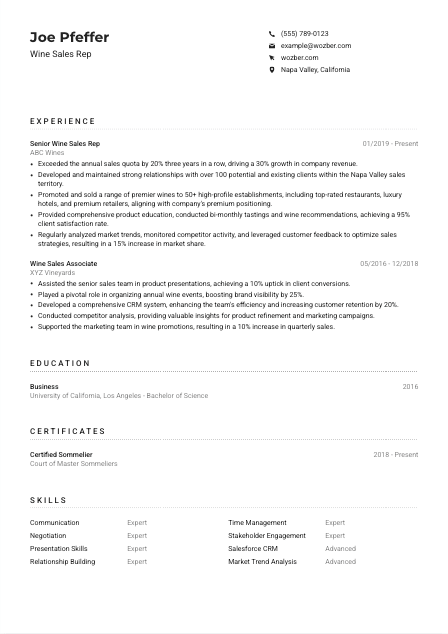
Place "Wine Sales Rep" directly under your name if that is the role you are pursuing. Matching the posted title helps frame your background correctly, particularly when your previous titles vary, such as Wine Sales Associate or Senior Wine Sales Rep.
Include a reliable phone number and a professional email address. Wine sales hiring often moves through quick outreach for interviews, ride-alongs, or tasting discussions, so make it easy for employers to reach you without second-guessing your contact information.
If the role has a location or territory requirement, include your city and state. Here, Napa Valley, California matters because the job specifically asks for it. In other searches, only add location details that support the employer's coverage needs or travel expectations.
Include LinkedIn or a professional website only if it supports your candidacy with consistent, up-to-date information. For a Wine Sales Rep, that might reinforce account-management experience, industry certifications, event work, or winery and distributor background.
This section should confirm that you are a real, reachable sales professional who is ready for the territory. Clean contact details and the right location cue help the employer move straight to your sales record.




This is the section that carries the most weight for a Wine Sales Rep. Employers want to see account growth, quota performance, buyer relationships, portfolio education, and day-to-day territory management, not just general sales activity.
Read the job description with a sales lens. Mark the business needs behind the wording, such as hitting quota, growing an assigned territory, educating accounts through tastings, tracking competitors, and reporting forecasts. Then shape your bullet points around those same realities using examples from your own work.
Start with your most recent job and include company name, title, and dates. Keep the sequence easy to follow so the reader can see your progression from supporting sales activity to owning accounts, territory results, and higher-value client relationships.
Each bullet should show what you handled and what changed because of your work. For this profession, that often means growing placements, retaining restaurant and retail accounts, improving conversion from tastings or presentations, or expanding the reach of a premium portfolio. The example resume does this well by pairing client development with outcomes such as serving more than 100 clients and selling into 50+ establishments.
Quantify results whenever you can. Strong metrics in wine sales include quota attainment, revenue growth, account count, retention rate, satisfaction scores, market share, conversion lift, or event-driven sales increases. "Exceeded annual sales quota by 20%" and "increased market share by 15%" are stronger than broad claims about success because they show how your territory performed.
Keep the focus on wine, beverage, hospitality, distribution, or account-based sales experience that maps to the job. If you include broader sales work, tie it back to negotiation, client education, CRM use, forecasting, or channel development so the relevance is obvious.
A hiring manager should finish this section knowing what you sold, who you sold it to, and how consistently you produced results. That is what makes experience persuasive in wine sales.
Education is usually a supporting section for this role, but it still matters when the employer asks for a bachelor's degree in business, sales, marketing, or a related field. Present it clearly and let it reinforce your commercial foundation.
Check the posting for the exact education baseline and make sure your resume reflects it in straightforward language. In this case, a bachelor's degree in Business, Sales, Marketing, or a related field is requested, so a Bachelor of Science in Business aligns well.
List the degree, field of study, school, and graduation year. That is usually enough for a Wine Sales Rep resume unless you are early in your career or your academic background is especially relevant to beverage business, hospitality, or marketing.
If your degree directly supports selling, brand development, or customer strategy, make that easy to see through the field name. The sample's business degree works because it connects naturally to territory planning, account management, and sales execution.
Most experienced candidates can skip course lists. Include them only if they strengthen a limited work history or connect closely to the job, such as consumer behavior, marketing analytics, hospitality management, or sales strategy.
Honors, leadership roles, or relevant student organizations can help if they show initiative or industry interest. Keep them brief and only include them when they add something your experience section does not already cover.
For most Wine Sales Rep roles, education confirms that you meet the stated requirement and understand the business side of selling. Once that is clear, let your territory results and client work lead the conversation.
Certifications can strengthen a Wine Sales Rep resume because they show product knowledge that goes beyond basic selling ability. They are especially useful when the role involves tastings, buyer education, or premium portfolio positioning.
Look for optional or preferred certifications before deciding what to feature. Here, certification from the Court of Master Sommeliers or the Society of Wine Educators is listed as a plus, so related credentials deserve space on the page.
List the wine credentials most relevant to your current target role. A Certified Sommelier credential, for example, supports your ability to speak credibly about varietals, pairings, tasting notes, and portfolio recommendations during client meetings or events.
Name the certification, the issuing body, and the year earned or active date range. That gives hiring teams a quick read on both relevance and recency, especially in a field where education and tasting knowledge continue to develop.
If you are actively adding credentials, that can be worth showing. Ongoing certification work tells employers you take product knowledge seriously and can represent the brand well in front of demanding restaurant, hotel, and retail buyers.
A wine credential is most effective when it supports the work described elsewhere on the resume. It should strengthen your case as someone who can both move volume and guide buyers with confidence.
A Wine Sales Rep skills section should feel grounded in account work, product presentation, and territory execution. Generic soft-skill lists are easy to ignore. Focus instead on the abilities that show up in buyer meetings, forecasts, CRM updates, and sales targets.
Pull skills from the job description, then keep only the ones you can support through experience. For this role, communication, negotiation, presentation skills, relationship building, market analysis, and forecasting all map directly to how the job is performed.
Balance interpersonal skills with operational ones. A Wine Sales Rep often needs persuasive tasting-room or on-premise presentation skills, but also CRM discipline, pipeline management, competitor tracking, and demand forecasting. The sample resume pairs relationship building and stakeholder engagement with Salesforce CRM and market trend analysis, which is the right kind of mix.
Do not overload this section with every capability you have. Choose the skills that support account growth, portfolio education, and territory planning. A shorter list of relevant strengths is far more credible than a long inventory of general workplace traits.
The best skill lists read like a summary of how you win business and manage accounts. If the section aligns with your experience bullets, it strengthens the full resume.
Language ability matters in sales when it affects client communication, presentations, and relationship building. For wine sales, this section is usually straightforward, but it still needs to reflect the employer's stated needs and your actual proficiency.
If the employer names a required language, list it first and state your level clearly. Here, command of English is essential, so your resume should show that immediately rather than assuming it will be inferred.
Lead with the language needed for the role, then include others that could support account coverage, winery relationships, tourism-heavy markets, or international portfolio work. Relevance matters more than quantity.
Extra languages are a plus when they help you communicate with a broader client base or represent imported wines more effectively. They are not required for every Wine Sales Rep role, but they can add useful context.
Use clear labels such as Native, Fluent, Intermediate, or Basic. In client-facing sales, overstating language ability can quickly become a problem during tastings, negotiations, or account visits.
If you speak more than one language, think about where it actually helps. It may improve communication with distributors, hospitality teams, or international customers, which can be a practical advantage in certain territories and portfolio mixes.
This section does not need to be long. It just needs to show that you can communicate at the level the territory and buyer relationships require.
For a Wine Sales Rep, the summary should quickly establish commercial credibility. In a few lines, show how long you have sold, the kind of accounts or portfolio you have handled, and the business results you are known for.
Before writing, identify the few points the employer cares about most. In this posting, those are wine sales experience, quota attainment, buyer relationship management, product education, and market awareness. Your summary should reflect that mix without turning into a keyword list.
Start with a direct line that states who you are and how much relevant experience you bring. "Wine Sales Rep with over 5 years of experience" works because it establishes role alignment immediately and sets up the rest of the summary.
Mention the strengths that define your work, then anchor them in real outcomes. The example summary does this effectively by combining sales-target performance, client relationship building, premium wine promotion, and market-share growth. That gives the reader both capability and business impact.
Aim for three to five lines. Focus on the parts of your background that matter most for this opening, such as territory sales, tastings, on-premise and retail relationships, and demand forecasting. Leave the detail for the experience section.
Your summary should tell the employer, within seconds, that you understand wine, can manage accounts, and have the numbers to support that claim. If it does that, the rest of the resume has the right setup.
A Wine Sales Rep resume works when it reads like someone who can walk into a buyer meeting, present the portfolio with confidence, and deliver territory results month after month. Keep your sections focused on quota performance, account relationships, product education, and the market insight that shapes smarter sales decisions.
Use Wozber's free resume builder to organize that experience in an ATS-friendly resume template, then refine the wording with its ATS resume scanner so the final version matches the role's language and priorities. The finished resume should make one thing easy to judge: you can sell the wine, grow the accounts, and represent the portfolio well.




