



Use Wozber and land your dream job
Create Resume
No registration required
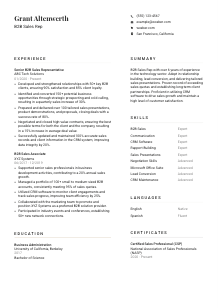
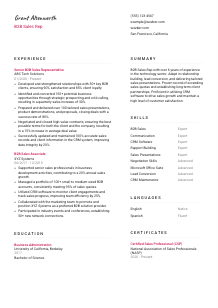
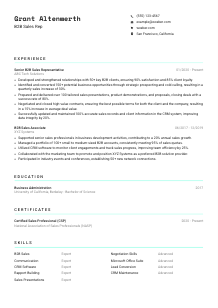
Sealing deals in the B2B realm, but your resume isn't converting? Check out this B2B Sales Rep resume example, created with Wozber free resume builder. Learn how to pitch your bottom-line results to match the job blueprint, making sure your career trajectory always points to profit!
B2B sales resumes are read through a revenue lens. Hiring teams want to see whether you can open doors, run discovery, tailor presentations, handle objections, and close business while keeping accounts engaged after the signature. If those results are buried under generic relationship language, your resume will miss what matters most in a quota-carrying role.
The first pass often comes down to whether your background clearly matches the selling motion in the job ad, especially around prospecting, CRM discipline, presentations, and deal performance. Wozber's free resume builder helps you shape that story into an ATS-friendly resume format, so the hiring team can quickly see where you've hit quota, managed B2B accounts, and sold in environments similar to theirs.
Sales roles move fast, and your contact section should make outreach easy from the start. For a B2B Sales Rep, this area is less about personality and more about showing you're accessible, professional, and aligned with any practical screening requirements listed in the posting.
Use your full name as the most visible text at the top of the page. Keep it clean and easy to scan, the same way a prospect should be able to identify you instantly in an email signature or sales deck.
Place your current or target title directly under your name. If the role is "B2B Sales Rep," use that wording when it reflects your background. This immediately frames your experience around business development, account growth, and closing activity rather than leaving the reader to infer your sales focus.
Include a reliable phone number and a professional email address. Sales hiring often moves from resume review to phone screen quickly, so avoid casual email handles and make sure recruiters can reach you without friction.
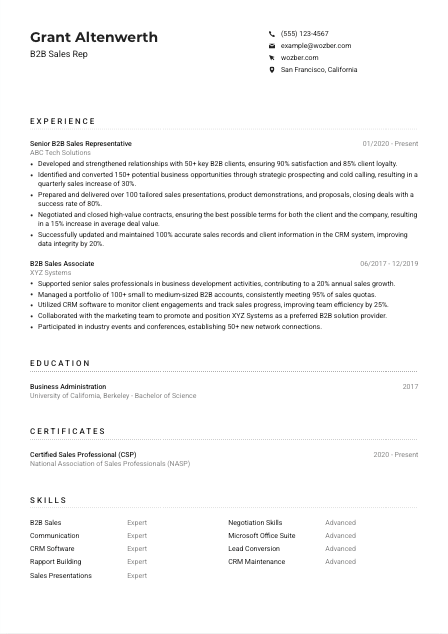
If a job requires you to be based in a specific market, show that clearly in your city and state. In the example here, listing San Francisco, California directly supports a stated location requirement. That kind of detail is only necessary when the employer calls for it, but when they do, it belongs in plain view.
A current LinkedIn profile or professional website can reinforce your sales background, especially if it reflects the same employers, titles, and achievements shown on your resume. For B2B sales candidates, this can also support credibility around industry network, account scope, and technology-sector experience.
This section should remove basic doubts before anyone reaches your experience bullets. Clear contact details, the right title, and any required location information make it easier to move you into the next stage of the process.




This is the section that carries the most weight for a B2B Sales Rep. Hiring managers look for pipeline generation, quota performance, deal quality, client retention, and how well you operate inside a sales process. Your bullets should read like commercial results, not like a generic list of duties.
Before writing or editing bullets, identify the operating priorities in the posting. Here, that includes prospecting, cold calling, tailored presentations, negotiation, closing, CRM accuracy, and client relationship management. Build your experience section around those activities so your background lines up with the employer's sales motion.
List jobs in reverse chronological order with title, company, and dates. For sales candidates, titles matter because they show progression from support or associate work into full-cycle selling, account ownership, or senior client responsibility.
Each bullet should show what you did and what came from it. Instead of stopping at "managed client relationships," show the portfolio size, retention result, or expansion outcome. The example resume does this well with achievements such as strengthening relationships with 50+ key B2B clients and tying that work to satisfaction and loyalty metrics.
Sales resumes benefit from concrete performance measures. Include quota attainment, revenue growth, conversion rate, average deal size, number of accounts managed, meeting volume, qualified leads generated, or proposal win rate where you can support them. Metrics like a 30% quarterly sales increase or 80% close rate quickly tell the reader how your work performed.
Prioritize experience that shows business development, relationship management, product presentations, negotiation, or CRM-driven follow-through. Leave out bullets that do not help explain your performance in a B2B revenue role. The tighter your relevance, the easier it is to see your value in the territory, segment, or industry being hired for.
By the end of this section, the reader should have a clear picture of how you generate pipeline, move deals forward, and deliver results. For a B2B Sales Rep, that means measurable commercial performance supported by the right client and sales-process experience.
Education rarely outweighs sales results, but it still matters when a posting names a degree requirement. Present it clearly, and if your degree aligns with business, marketing, or a related field, make that match easy to spot.
When an employer asks for a bachelor's degree in Business, Marketing, or a related field, use the formal wording of your degree and field exactly as they appear on your records. That helps both ATS screening and human reviewers confirm you meet the baseline requirement quickly.
List your degree, school, and graduation year or date. B2B sales resumes do not need a long academic section unless you are early in your career or your coursework directly supports the market, product, or industry you sell into.
If your major supports commercial work, put it in plain sight. In the example, "Bachelor of Science in Business Administration" closely supports a business-focused sales role. That kind of direct alignment helps when the employer is screening for foundational business knowledge.
Coursework can be useful if you are newer to B2B sales or if classes in marketing, negotiation, business communication, or analytics strengthen your positioning. Mid-career candidates with strong quota history usually do not need this extra detail.
Honors, leadership roles, or competition work are worth adding when they show initiative, communication, or commercial thinking. Keep them brief and relevant so they support, rather than crowd, the sales story told in your experience section.
Your education section should confirm that you meet the posted requirement and, when relevant, reinforce your grounding in business or market-facing work. In most B2B sales resumes, that is exactly enough.
Certifications are not mandatory for many B2B sales jobs, but they can strengthen your profile when they support how you sell. The most useful ones reflect sales methodology, client communication, negotiation, or tools that matter in your target market.
Even when no certification is required, the job description still tells you what kind of expertise matters. Look for clues such as negotiation, CRM use, technology-sector selling, or presentation skills, then choose certifications that reinforce those areas.
Prioritize certifications that connect to the work of a B2B Sales Rep, such as professional sales training, account management, consultative selling, or negotiation programs. In the example, the Certified Sales Professional credential adds credible support to a resume already centered on quota and client results.
Include the year earned and, if relevant, the active date range. In sales and technology environments, recency matters because methods, tools, and buyer expectations change quickly.
Ongoing training helps if you are moving into a more complex market, selling a technical product, or trying to show continued growth beyond your last role. Add only the certificates that sharpen your positioning for the kind of accounts and sales cycle you want next.
A well-chosen certification will not replace sales results, but it can add weight to your experience by showing formal training in the skills employers care about. For this role, that means credentials that support client conversations, deal execution, and commercial judgment.
A B2B Sales Rep skills section should mirror how the job is actually performed. That usually means a mix of prospecting, presentation, negotiation, account management, CRM use, and communication strong enough to move deals through a pipeline.
Read the job ad for the skills embedded in day-to-day execution. Here, terms such as CRM software, communication, negotiation, and client relationship management are central. These are useful for ATS optimization when they accurately reflect your background and appear naturally across the resume.
List the capabilities you can back up in your experience section. If you claim lead conversion, your bullets should show lead volume or win rate. If you list CRM software, your resume should also show disciplined record maintenance, forecasting support, or pipeline tracking. The example skills list works because items like B2B Sales, CRM Software, and Sales Presentations are supported by measurable achievements elsewhere.
Put the most role-critical skills first. For most B2B sales jobs, start with core commercial strengths and tools, then add supporting interpersonal skills. Keep the list focused so the reader sees the capabilities most tied to prospecting, account growth, and closing activity right away.
The best skills sections feel consistent with the rest of the resume. If your top skills match the language of the job description and the results in your experience section, the whole application becomes more convincing.
Language ability matters in sales when it affects how you communicate with prospects, clients, and internal teams. If the posting requires clear English communication, make that visible first. Additional languages can help when they match the customer base or territory, but they should stay secondary to your core sales qualifications.
When a posting says you must express ideas clearly in English, list English prominently with an honest proficiency level. For a sales role built around calls, presentations, proposals, and negotiation, this is a practical requirement, not a formality.
If you speak another language used in your market, include it. In the example, Spanish adds potential value for relationship building and outreach across a broader client base, even though it is not a stated requirement.
Do not over-explain language skills unless they directly affect the role. A short list is enough. The point is to show communication range where it may help with account development or cross-regional business conversations.
Use clear labels such as Native, Fluent, Intermediate, or Basic. In sales, overclaiming communication ability can create immediate issues during calls, demos, or client-facing interviews, so accuracy matters.
If the company sells across regions or serves multilingual buyers, language skills can strengthen your profile. If the role is domestic and English-only, keep this section simple and let your sales results remain the main story.
For most B2B Sales Rep applications, English proficiency is the essential point. Any additional language should support a realistic business advantage, whether that is prospecting reach, account communication, or market familiarity.
Your summary needs to establish commercial credibility fast. In a few lines, show your sales tenure, market context, core strengths, and the kind of results you deliver. Save broad personality claims for the interview and use this space to frame your value in revenue terms.
Start by identifying the priorities the employer repeats or implies most strongly. For this posting, that includes B2B sales experience, technology-sector exposure, quota achievement, communication, and CRM proficiency. Those are the themes your summary should cover first.
Lead with your title or closest equivalent, followed by your years of experience and, when relevant, sector focus. A line such as "B2B Sales Rep with over 6 years of experience in the technology sector" works because it gives the reader immediate context on seniority and market fit.
Follow your opening with two or three strengths tied to outcomes. Mention quota attainment, client retention, lead conversion, presentation strength, or CRM-driven pipeline management if those define your track record. The example summary is effective because it links relationship building and tailored presentations to exceeding sales quotas and sustaining long-term client partnerships.
Aim for three to five lines with no filler. Every phrase should help explain what you sell, how you work, or what results you produce. If a sentence could describe almost any professional, cut it and replace it with language that fits a B2B sales desk, pipeline, or account portfolio.
A solid summary gives the reader your sales profile before they reach the first bullet point. When it is tailored well, it makes your experience feel more coherent and your fit for the role easier to understand from the first screen.
A B2B Sales Rep resume should make one thing clear quickly: you know how to win business, manage client relationships, and keep your pipeline organized. When your sections reflect the language of the job description and back it up with metrics, hiring teams can connect your background to their sales targets much faster.
Use Wozber's free resume builder to shape that experience into an ATS-compliant resume with cleaner structure, stronger keyword alignment, and sharper role-specific phrasing. The finished resume should make it easy to judge your quota history, client-facing strengths, and readiness for the market you want to sell into.




