



Use Wozber and land your dream job
Create Resume
No registration required
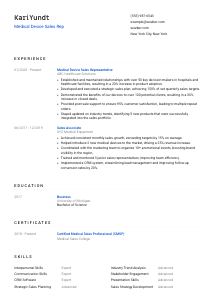
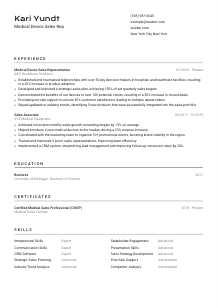
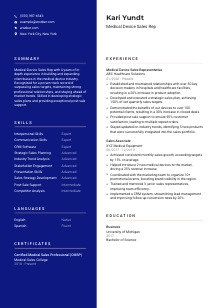
Pitching cutting-edge devices, but your resume feels outdated? Stay in the loop with this Medical Device Sales Rep resume example, created with Wozber free resume builder. Learn how to sync your sales skills with relevant requirements, making your career pulse as strong as your best sales quarter!
Medical device sales resumes are strongest when they show commercial performance and clinical credibility in the same document. Hiring teams want to see that you can earn trust with surgeons, administrators, and procurement contacts, explain product value clearly, and keep momentum after the sale through follow-up, training, and account growth.
When that experience is tailored to the posting, the first read becomes much clearer. Wozber's free resume builder helps you align your language with the role's sales targets, hospital relationship focus, and CRM expectations while keeping the document in an ATS-friendly resume format. That makes it easier for a reviewer to see whether your background matches the pace and account responsibility of medical device sales.
This section does not need flair. It needs accuracy, professionalism, and the few details that remove friction from the hiring process. For medical device sales, that means clear contact information, a matching title, and when relevant, location details that support territory coverage or relocation requirements.
Use your full name in a larger, clean font so it reads as the header of a professional sales document. In a field built on credibility and first impressions, your resume should open with the same polish you would bring to a hospital meeting or product presentation.
Place "Medical Device Sales Rep" directly below your name if that is the role you are pursuing. This helps recruiters and ATS tools classify your background quickly, especially if your previous titles vary between "Sales Representative," "Account Executive," or "Territory Manager."
List a phone number you answer, a professional email address, and only links that support your candidacy. Check every character. In sales hiring, a missed call or bounced email can cost you an interview just as surely as a missed follow-up can cost a deal.
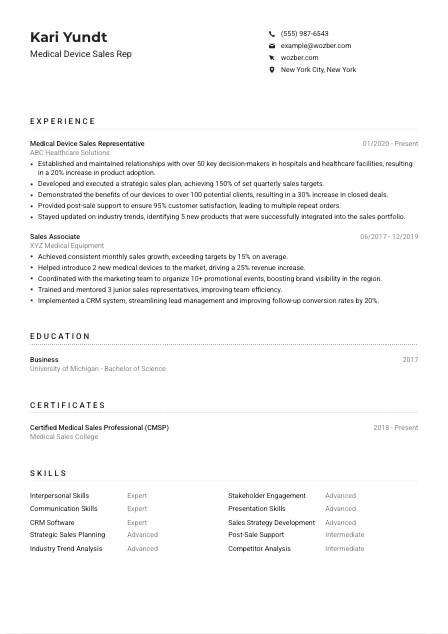
If the employer needs someone based in New York City or open to relocating there, include that directly in your personal details. That kind of territory requirement is often used as an early filter. In the example resume, listing New York City, New York immediately removes any doubt on that point.
A LinkedIn profile or personal website can be useful if it supports your sales story with consistent titles, measurable wins, recommendations, or industry involvement. Keep it aligned with your resume. If it is outdated or thin, leave it off until it reflects the same standard as the rest of your application.
A clean personal details section tells the employer you are reachable, professionally presented, and viable for the territory. That is all it needs to do, and in medical device sales, doing that cleanly matters.




This is the section that carries the most weight. Medical device sales hiring is heavily influenced by account growth, quota attainment, product adoption, client retention, and your ability to work with clinical and administrative stakeholders. Your experience should read like a record of revenue impact and relationship management, not a generic list of sales duties.
Read the posting closely and map your experience to its core asks. Here, the employer wants direct medical device or healthcare sales experience, strategic sales planning, strong communication, post-sale support, and relationship building with decision-makers. Mirror those priorities in your bullets using your real work, not copied phrasing.
List each role with title, company, and dates in reverse chronological order. This lets a hiring manager quickly trace your progression from broader sales work into more specialized medical device selling, territory ownership, or hospital account management.
For each position, focus on what changed because of your work. Strong bullets show results such as increased product adoption, stronger close rates, higher customer retention, or expansion into new accounts. The sample resume does this well with bullets tied to adoption growth, closed deals, and repeat orders rather than vague statements about client outreach.
Numbers are native to sales hiring. Include quota attainment, revenue growth, deal volume, number of accounts managed, adoption rates, repeat business, or satisfaction scores where you have them. "Achieved 150% of quarterly target" and "maintained relationships with 50+ decision-makers" immediately tell a reader how you performed and at what scale.
Prioritize experience that supports medical device sales performance. Healthcare sales, device demonstrations, CRM-driven pipeline management, launch support, and post-sale account care all belong here. Older or unrelated roles can be shortened unless they add something useful such as territory development, complex B2B selling, or presentation-heavy client work.
A hiring team should be able to scan your experience and quickly understand your market exposure, sales performance, and account management style. If those three points are clear, your experience section is doing its job.
Education matters here because employers often want a bachelor's degree that supports both commercial and technical conversations. You do not need to overwork this section, but you should present the degree clearly and make any relevant field of study easy to find.
If you have a bachelor's degree in Business, Science, or a related field, list it clearly and in standard format. That directly addresses a common screening requirement in medical device sales roles and helps your resume pass early review.
Include your degree, field of study, school, and graduation year. Keep the structure clean so the information is easy to scan. In most cases, that is enough to confirm you meet the employer's baseline education requirement.
Business degrees point to sales strategy, communication, and commercial planning. Science-related degrees can strengthen your credibility when discussing product function, clinical applications, or technical benefits with healthcare buyers. The example's Bachelor of Science in Business works because it supports the role's sales focus without overexplaining it.
If you are early in your career or your coursework is especially relevant, include a short note on classes such as sales management, healthcare marketing, anatomy, physiology, or biomedical sciences. This is optional, and only worth adding when it helps explain your fit for the product category or industry.
Honors, scholarships, leadership roles, or relevant student organizations can add value if they show initiative, discipline, or early commercial exposure. Keep these details brief. Once you have several years of sales experience, they should stay secondary to quota performance and account results.
This section should confirm that your academic background supports the role without stealing space from your sales record. Clear degree information and a relevant field of study are usually enough.
Certifications can strengthen a medical device sales resume when they show industry knowledge, product fluency, or continued professional development. They are especially useful if they reinforce your credibility in a competitive market or support a move into a more specialized device category.
List certifications that are directly relevant to medical device sales, healthcare selling, or product knowledge. A credential like "Certified Medical Sales Professional (CMSP)" tells employers you have invested in industry-specific training beyond general sales experience.
A short list of targeted certifications is stronger than a long list of generic learning badges. Focus on credentials that support selling into healthcare environments, understanding regulated products, or navigating clinical conversations with confidence.
Show when the certification was earned and, if relevant, whether it is current. This matters when a credential requires renewal or signals ongoing professional engagement. The example resume handles this well by showing the CMSP with an active date range.
Medical device portfolios change, competitors evolve, and buyer expectations shift. Adding updated certifications in product specialties, healthcare compliance, or advanced sales training can support your candidacy for more technical territories or higher-value accounts.
Certifications will not replace a sales track record, but they can sharpen your profile by showing current industry commitment and deeper product credibility.
The skills section should reflect how you actually sell. For medical device sales, that means a mix of relationship management, presentation ability, territory planning, pipeline discipline, and enough technical comfort to explain device benefits accurately. Keep the list tight and tied to the role.
Use the employer's language where it matches your real strengths. In this case, that includes interpersonal communication, CRM software, strategic sales planning, and relationship management with healthcare decision-makers. Mirroring those terms helps both ATS matching and human review.
Include both people-facing and execution-focused capabilities. A solid list might combine stakeholder engagement, product demonstrations, objection handling, territory development, CRM usage, pipeline management, and reporting tools such as MS Office. That balance reflects how the work actually gets done.
Put the most important capabilities first. If the role emphasizes communication, hospital relationships, and hitting targets, those should appear before less central skills. The example resume is strongest where it foregrounds interpersonal skills, CRM software, strategic planning, and stakeholder engagement, all of which match the hiring need closely.
Your skills section should reinforce the way you win business, manage accounts, and move opportunities through the pipeline. If the list sounds like your real day-to-day work, it is likely in good shape.
Language skills are not always central in medical device sales, but they can matter when the posting specifies communication requirements or the territory serves diverse patient populations and care teams. Present them clearly and without exaggeration.
If the role calls for strong English, list English first and state your proficiency clearly. That immediately addresses a stated requirement and supports the communication-heavy nature of hospital and clinic sales work.
Use straightforward labels such as "Native" or "Fluent." Medical device sales involves presentations, follow-up emails, negotiations, and product explanations, so language clarity matters in practical ways, not just as a checkbox.
Additional languages can be valuable when working across diverse provider networks or patient-facing environments. Spanish, for example, may strengthen your profile in some territories even when it is not explicitly required.
Choose realistic levels for each language. If you can handle business conversations, say so. If your ability is conversational or basic, label it accurately. Hiring managers may test this informally during interviews or client-facing discussions.
Territory needs vary. Some roles center on a narrow hospital network, while others involve broader regional coverage and more diverse account contacts. List languages that genuinely support how you build relationships and communicate product value in your target market.
Language skills should support the territory and the communication demands of the role. Clear, honest ratings are enough to make that value visible.
Your summary should quickly place you in the market. In medical device sales, that means naming your years of experience, your sales results, and the kind of accounts or products you handle. A short, specific summary helps the reader understand your level before they get into the details of your experience.
Start with your title and level of experience, such as medical device sales, healthcare sales, or a closely related specialty. This gives immediate context and helps position you for the right level of role.
Choose achievements that show how you sell. Quota attainment, product adoption growth, account expansion, launch success, or customer retention are all strong options. The example summary works because it points to surpassing targets and expanding client relationships rather than relying on general ambition.
Mention a few strengths that match the role's priorities, such as strategic sales planning, hospital relationship management, CRM proficiency, or post-sale support. This connects your track record to the employer's day-to-day needs.
Aim for 3 to 5 lines. Avoid broad claims that any salesperson could make. A concise summary with real market context and role-specific language is more persuasive than a paragraph full of generic descriptors.
After reading your summary, a recruiter should already understand your sales background, your results, and the kind of medical accounts you know how to manage. That is the standard to aim for.
A medical device sales resume should make three things easy to find: your quota performance, your ability to build trust with healthcare buyers, and your command of the tools and follow-through that keep accounts growing. When those points are clear across your summary, experience, and skills, the document starts working like a strong sales conversation.
Use Wozber's free resume builder to shape that story into an ATS-compliant resume, then refine it with targeted ATS optimization and Wozber's ATS resume scanner so the language matches the role without sounding forced. The finished resume should make it easy to judge your ability to win business and manage healthcare relationships from first contact through repeat orders.




