



Use Wozber and land your dream job
Create Resume
No registration required
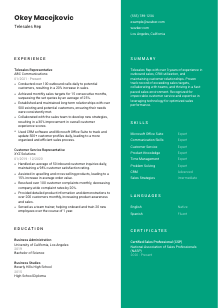
Pitching through the phone, but your resume seems on hold? Check out this Telesales Rep resume example, created with Wozber free resume builder. Learn how to present your persuasive prowess to match call criteria, guiding your sales career to always ring true!
Telesales hiring moves quickly because the work is measurable. A hiring team wants to see whether you can handle call volume, build rapport fast, keep product knowledge sharp, and convert conversations into revenue. Your resume should make those patterns visible early, especially through quota performance, follow-up discipline, and the way you manage customer relationships over time.
For this kind of role, vague sales language gets filtered out fast. Using Wozber's free resume builder helps you shape an ATS-compliant resume around the terms that matter in telesales, from outbound calling and CRM usage to target attainment and customer follow-up. That gives the reader a clearer view of whether you can produce consistent pipeline activity and hit the numbers attached to the role.
In telesales, responsiveness matters. Your contact section should make it easy for a recruiter or sales manager to reach you quickly and confirm that you meet any practical requirements tied to the role.
Use your full name at the top of the page in a clean, readable format. Skip nicknames or decorative styling. Sales resumes work best when the first thing a reader sees is a clear professional identity.
Place "Telesales Rep" directly under your name if that is the role you are applying for. This immediately connects your resume to the job ad and helps both recruiters and ATS systems categorize your application correctly.
List a reliable phone number and a professional email address you check often. For a call-driven role, this matters more than it does in many other jobs. If your email looks outdated or casual, replace it with a simple version based on your name.
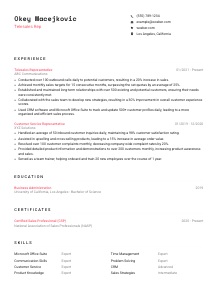
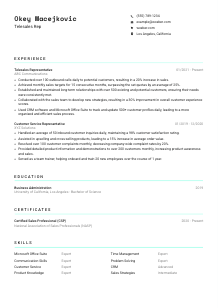
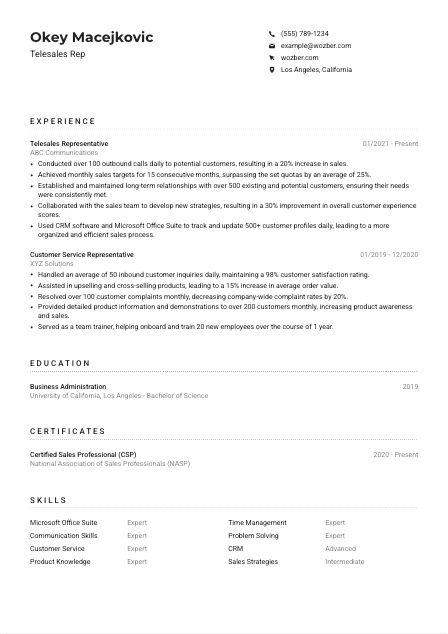
Some telesales jobs are remote, some are hybrid, and some require you to be based in a specific market. If the posting names a location, show it. In the example, "Los Angeles, California" confirms a stated requirement without taking up much space.
A LinkedIn profile or personal website can support your application if it reinforces your sales background, client-facing experience, or performance history. Keep it updated so dates, titles, and achievements match your resume.
This section does not need personality tricks. It needs accuracy, professionalism, and any detail that removes doubt about your availability for the role.




This is the section most sales leaders read first. They want to know how you handled outreach, what targets you carried, how you used CRM tools, and whether your activity translated into results.
Read the posting closely and build your experience around the work it emphasizes. For a telesales role, that usually means outbound calls, follow-up cadence, quota attainment, product knowledge, CRM usage, and teamwork with broader sales operations. Your bullet points should echo those themes using your real history.
Start with your most recent position so the reader sees your current sales environment first. Include job title, company, and dates clearly. This structure also helps ATS parsing and gives context for how your responsibilities and sales scope have grown over time.
Anyone can say they made calls or spoke with customers. What matters is what happened because of that work. In the example, "Conducted over 100 outbound calls daily, resulting in a 20% increase in sales" is effective because it connects activity to revenue impact.
Telesales performance is often measured through quotas, conversion, call volume, customer retention, upsell rate, and account follow-up. Use those metrics wherever you can. "Achieved monthly targets for 15 consecutive months" tells a hiring manager far more than "responsible for meeting goals."
If part of your background comes from customer service or another adjacent role, keep the bullets focused on transferable strengths such as upselling, issue resolution, product explanation, or customer retention. The example's customer service role works because it highlights satisfaction scores, complaint resolution, and cross-sell impact rather than unrelated tasks.
A telesales resume gets stronger when your experience section reads like a record of production. Prioritize call activity, customer follow-up, CRM discipline, and sales results the team can picture you repeating in their environment.
Education usually plays a supporting role for telesales positions, but it still helps frame your business foundation, communication skills, and professional development. Keep it concise and relevant to where you are in your career.
Some telesales jobs ask for a degree, while others focus almost entirely on sales performance and customer handling. If no strict education requirement appears, include your academic background without overexpanding it and let your results carry more weight.
List each school, degree, field of study, and graduation year or date. Put the most recent education first. Straightforward formatting works best here and keeps the attention on information that can support your candidacy without distracting from your experience.
Fields such as business, marketing, communications, or management can strengthen your positioning for a telesales role. In the example, a Business Administration degree adds useful context because it aligns naturally with sales process, customer communication, and commercial awareness.
If you are early in your career, coursework in sales, consumer behavior, negotiation, business communication, or marketing can help fill out the picture. If you already have several years of quota-carrying experience, this detail is usually optional.
Debate, leadership roles, student business clubs, or presentation-heavy projects can support your case if they point to persuasion, confidence, teamwork, or communication under pressure. Keep these mentions brief and include them only when they strengthen the story your resume is already telling.
For most telesales candidates, education should support the resume, not dominate it. Present it cleanly, connect it to communication or business skills where relevant, and keep the spotlight on sales performance.
Certifications are not always required in telesales, but they can strengthen your profile when they show formal sales training, customer service development, or continued learning in tools and communication methods.
If the employer mentions a telesales or customer service certification, mirror that requirement directly when you have it. If certification is optional, include only credentials that genuinely relate to selling, customer communication, or account handling.
Choose certifications that support the actual responsibilities of the job, such as sales process knowledge, customer relationship management, service excellence, or phone-based selling. The example's Certified Sales Professional credential works because it reinforces a sales-specific profile rather than adding unrelated training.
List the issue date and, if relevant, the validity period. This is especially useful for credentials that need renewal or show recent professional development. Current dates tell the employer that your training is active rather than outdated.
Short courses in CRM platforms, objection handling, negotiation, customer retention, or sales communication can be useful additions over time. In a field where scripts, systems, and buyer expectations change quickly, ongoing training shows that you take performance seriously.
A relevant certification will not replace a weak track record, but it can strengthen an application that already shows strong outreach, customer handling, and quota performance.
The best telesales skills sections do more than repeat generic strengths. They reflect the tools, communication habits, and commercial abilities that shape daily performance on the phone and inside the CRM.
Start with the job description and mark the skills that are explicit. Here, that includes CRM software, Microsoft Office Suite, written and verbal communication, customer service, and a record of meeting sales targets. Those terms belong on the resume if they accurately describe your background.
If the posting asks for CRM proficiency, use that wording rather than a vague phrase like "tech savvy." If it asks for strong written and verbal communication, include communication in a way that fits your experience. Exact phrasing improves ATS alignment and makes your relevance easier to read.
Prioritize a compact list of skills that matter in telesales, such as outbound sales, objection handling, relationship management, CRM, follow-up, product knowledge, upselling, and time management. The example balances hard and soft skills well by pairing CRM and Microsoft Office with communication, customer service, and problem solving.
Choose skills that reflect how you actually sell, track activity, and manage customer conversations. When this section matches the language of the posting, it strengthens both human review and ATS optimization.
Language ability matters in telesales because every call depends on clarity, pace, listening, and trust. If a posting names a required language, treat it as a core qualification rather than an extra detail.
If the role asks for high proficiency in English, list English clearly with an accurate proficiency level. This immediately addresses a stated requirement and avoids any ambiguity about your ability to handle customer conversations, follow-up emails, and product explanations.
Additional languages can be valuable when a business serves diverse customer groups or regional markets. For example, Spanish can strengthen a telesales application in many U.S. markets because it supports broader customer coverage and smoother rapport-building.
Describe each language with straightforward terms such as native, fluent, intermediate, or basic. That gives hiring teams a realistic view of whether you can handle live calls, written communication, or only limited customer interaction in that language.
Even when a second language is not required, it can still be commercially useful. Multilingual reps may help with customer retention, smoother handoffs, and stronger connection in high-volume outreach settings where comfort and clarity affect conversion.
For a telesales resume, language skills are strongest when they point back to the work itself. Show how they support customer conversations, product explanation, and relationship management, rather than listing them as a personal extra.
If language skills help you connect with more customers or communicate more effectively, they deserve a place on the resume. Present them clearly and tie them to real selling value.
Your summary should quickly answer the question every sales manager has: can this person generate conversations, manage follow-up, and hit target? Keep it short, specific, and grounded in your actual track record.
Start with your title, years of experience, and core area of strength. For example, a line mentioning outbound sales, CRM use, and customer relationship management works well because it frames the kind of telesales work you have actually done.
Include performance details that matter in phone-based sales, such as quota attainment, conversion gains, call volume, or customer retention. The example summary works because it points to exceeding targets and working effectively in a fast-paced sales setting instead of relying on broad claims.
Aim for three to five lines. That is enough room to establish your background, mention your strongest sales outcomes, and highlight a few role-relevant strengths without repeating the full experience section.
One employer may care most about outbound prospecting, another about customer follow-up and service quality, and another about CRM discipline and team collaboration. Shift the wording so the summary reflects the priorities of the role you are targeting.
A well-written summary gives the reader your sales profile in a few seconds. It should point straight to the kind of pipeline activity, customer handling, and target performance they need from a Telesales Rep.
A strong Telesales Rep resume shows more than enthusiasm for sales. It shows call activity, target attainment, customer follow-up, CRM discipline, and the communication skills needed to turn conversations into revenue.
Use Wozber to tighten the wording, align your content with the posting, and build an ATS-friendly resume format that keeps your results easy to read. When the resume is tailored well, a hiring team can quickly see whether you are ready to perform in a live sales environment.