



Use Wozber and land your dream job
Create Resume
No registration required
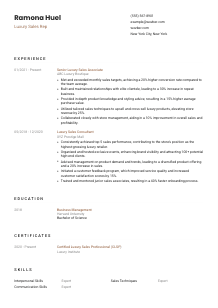
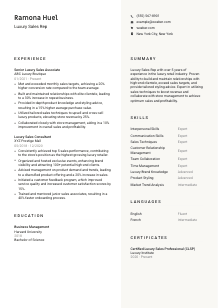
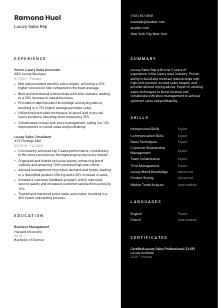
Selling opulence, but your resume feels underdressed? Check out this Luxury Sales Rep resume example, created with the Wozber free resume builder. It shows how easily you can present your exquisite sales flair to match the high standards of luxury job descriptions, ensuring your career shines as brilliantly as the gems you showcase!
Luxury sales work is built on trust, taste, and commercial discipline. Hiring teams want to see more than product enthusiasm. They look for proof that you can build repeat business with high-value clients, guide purchases with credible styling advice, and consistently move revenue through upselling, cross-selling, and clienteling.
A tailored resume changes how quickly that commercial story comes through, especially in ATS screening and first-pass review. Wozber's free resume builder helps you align your wording with the posting, surface luxury-retail keywords naturally, and create an ATS-compliant resume that makes your sales results, client relationships, and brand knowledge easier to read at a glance.
In luxury retail, presentation matters from the first line. Your personal details should feel polished, current, and easy to process, while also confirming practical requirements such as title alignment and location when the employer asks for it.
Your name should be one of the easiest elements to find on the page. Use a clean, professional format that matches the brand-conscious environment of luxury retail. You do not need decorative styling. You need a presentation that feels polished and intentional, the same way a high-end sales floor should.
Place "Luxury Sales Rep" under your name if that matches the role you are pursuing. This immediately frames your background around luxury sales rather than broader retail work, and it helps ATS systems connect your resume to the exact opening. If your previous title was "Luxury Sales Associate" or "Luxury Sales Consultant," keep those in your experience section and use the target title here for alignment.
List a reliable phone number and a professional email address with no distractions. Luxury sales is a relationship-driven field, so recruiters expect responsiveness and polish even in basic details. If you include a website or LinkedIn profile, make sure it reflects the same client-facing standard as your resume.
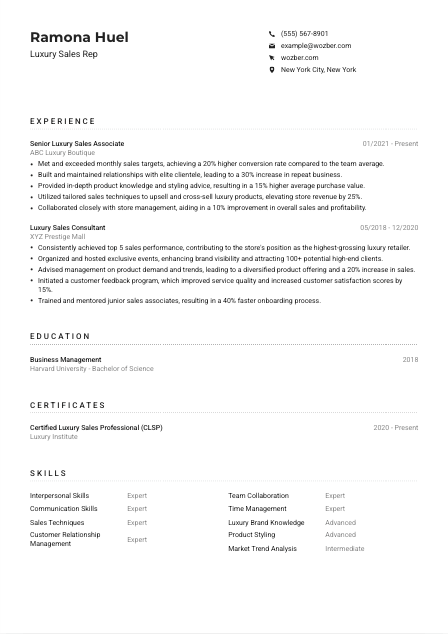
When an employer asks for a specific city, show it clearly in this section. In the example, listing "New York City, New York" answers a stated requirement right away. That is useful when stores need someone already positioned for the local market, client base, and schedule demands. If your target role does not name a location requirement, city and state are usually enough.
A LinkedIn profile can support your resume if it shows luxury retail experience, premium brand exposure, event selling, or client-development achievements. Keep the content consistent across both places. If your online profile is sparse or outdated, leave it off until it reflects the same level of professionalism as the rest of your application.
This section should confirm that you are easy to contact, aligned with the role, and professionally presented from the start. In luxury sales, that first layer of polish matters because the job itself depends on credibility and client confidence.




For a Luxury Sales Rep, experience is where hiring teams look for commercial proof. They want to see the client relationships you built, the sales targets you hit, the average ticket you influenced, and the way you contributed to store revenue and brand presentation.
Start by identifying the actions the employer cares about most, then shape your bullets around those themes. For luxury sales roles, that usually means clienteling, repeat business, styling guidance, target attainment, upselling, and collaboration with management. The sample resume does this well with lines such as "Provided in-depth product knowledge and styling advice, resulting in a 15% higher average purchase value," which mirrors the need for tailored product guidance and revenue impact.
Use reverse chronological order and make each role easy to scan: job title, employer, location if useful, and dates. Put the most relevant luxury retail positions first. If you have broader retail experience, keep it concise unless it includes premium selling, VIP service, event-based selling, or strong target performance that carries over into luxury environments.
Numbers matter in sales, especially in high-margin environments. Quantify conversion rate, repeat business, average purchase value, revenue growth, ranking, event turnout, or customer satisfaction where you can do so honestly. The example's 20% higher conversion rate, 30% increase in repeat business, and 25% revenue lift give hiring managers a direct read on performance without making them guess.
Avoid bullets that only say you assisted customers or maintained the sales floor. Focus on behaviors that are distinct to luxury retail, such as advising on product fit and styling, managing long-term client relationships, handling high-value purchases, supporting exclusive events, and tracking demand trends. Those details separate a luxury profile from a general sales background.
Luxury sales is individual and team-based at the same time. Mention how you worked with store management on profitability goals, merchandising feedback, client events, product demand, or onboarding newer associates. In the example, collaboration with management is tied to a 10% improvement in overall sales and profitability, which makes teamwork relevant because it connects directly to business performance.
Your experience section should make it easy to understand the level of clientele you served, the revenue you influenced, and the kind of luxury selling environment where you performed well. When these points are concrete, your resume reads like someone who can contribute on the floor quickly.
Education usually plays a supporting role in luxury sales hiring, but it still adds context. A degree can reinforce business judgment, brand literacy, communication skills, or commercial training, especially when your experience is already closely aligned with premium retail.
Include your highest relevant degree first. For luxury sales, business management, marketing, communications, fashion, merchandising, or hospitality can all support your profile, depending on the brand and store setting. In the example, a Bachelor of Science in Business Management complements the candidate's sales results and management collaboration.
Use a simple structure with school, degree, field of study, and graduation year. This section does not need long explanations unless you are early in your career. Clear formatting helps the reader move quickly from education into the more decisive parts of the resume, especially experience and skills.
If your coursework or degree focus connects directly to client service, merchandising, retail operations, consumer behavior, or brand management, make that connection visible through the field of study. Do this only when it adds useful context. Luxury sales roles are usually hired on selling ability first, so keep the emphasis proportional.
If you are a recent graduate or transitioning into luxury retail, relevant coursework, honors, or retail-focused projects can help fill out the section. For a more experienced seller, those details are usually less important than client retention, basket size, and target performance. Include them only if they sharpen your positioning.
Once you have several years of luxury sales behind you, education should stay concise. Let it confirm foundation and professionalism while your work history carries the heavier proof. That balance keeps the resume focused on what luxury retailers typically prioritize in interviews and hiring decisions.
Education should reinforce your commercial background without distracting from your sales record. A clean, relevant entry is usually enough to support the stronger proof already shown in your client work and revenue results.
Certifications can strengthen a Luxury Sales Rep resume when they deepen your credibility in premium selling, service standards, or product knowledge. They are especially useful when the employer mentions a preferred credential or when you want to show continued development in a competitive retail segment.
Choose certifications that directly relate to luxury retail, client service, styling, brand knowledge, or advanced sales technique. In the example, the Certified Luxury Sales Professional credential fits the posting well because the employer explicitly prefers it. When a certificate matches the language of the job description that closely, it deserves a visible place.
A short, relevant certificate section is stronger than a long list of unrelated training. Focus on credentials that support premium client interaction, luxury product positioning, relationship selling, or revenue growth. If a certificate does not help explain how you sell in a high-end environment, it can usually be left out.
Add the certificate name, issuing organization, and date earned or validity period where relevant. This makes the credential easier to assess and shows whether your training is current. For customer-facing retail roles, recency matters because sales methods, brand standards, and client expectations continue to evolve.
Luxury retail changes with brand portfolios, client demographics, and shopping behavior. Ongoing learning in areas such as personal styling, CRM usage, luxury service, or category expertise can keep your profile current. Even when certificates are preferred rather than required, they can strengthen your positioning against other experienced sellers.
A well-chosen certification section shows that your luxury sales knowledge is current and intentional. When the credentials clearly support premium client service and revenue performance, they add useful weight without taking over the resume.
The skills section should reflect how luxury sales actually happens on the floor. Hiring teams want to see a mix of relationship-building, product fluency, commercial technique, and day-to-day collaboration that supports both customer experience and store revenue.
Start with the capabilities named in the job description, then add closely related skills you can genuinely support with experience. In this case, interpersonal communication, luxury brand knowledge, styling advice, upselling, cross-selling, and collaboration with store management all belong near the top because they map directly to the work.
Luxury retailers need people who can do both. Include relationship-focused skills such as clienteling, communication, and service recovery alongside commercial strengths like target achievement, sales techniques, product positioning, and customer relationship management. The sample skills list does this effectively by combining interpersonal strengths with luxury brand knowledge and styling expertise.
Do not overload this section with broad traits that could belong on any resume. Prioritize skills that show how you sell in a high-end environment, such as product styling, trend awareness, CRM, event selling, or premium customer service. A tighter list gives a clearer view of your day-to-day value on the sales floor.
The right skills section should sound like someone who understands luxury clients, knows the merchandise, and can convert service into revenue. If every skill listed connects back to how you perform in store, the section is doing its job.
Language ability can be a practical advantage in luxury retail, particularly in stores that serve international shoppers, traveling clients, or multicultural local markets. Even when only one language is required, additional fluency can expand the kind of clientele you can support.
If the job posting names a required language, include it exactly and show your proficiency clearly. Here, fluent English is a stated requirement, so it should appear first. That removes doubt early and prevents a basic qualification from being overlooked in screening.
Additional languages can be valuable when they support sales conversations, product explanation, appointment-based selling, or relationship building with international customers. In the example, French adds useful context because it can be relevant in luxury retail settings with global clientele, even if it is not required for every opening.
Describe your level with terms such as "Fluent," "Advanced," "Intermediate," or "Basic." Be accurate. In a customer-facing role, overstating language ability can become obvious quickly during client interaction, team collaboration, or interview conversation.
Some luxury roles are more local, while others serve a highly international customer base through flagship locations, tourism traffic, or brand events. When extra languages support the type of clientele a store attracts, they deserve space on the resume. When they do not add much to the target role, keep the section brief.
If you are actively developing a language that supports your market, mention it only if you can describe the level honestly. This can be useful in luxury retail where cultural fluency and client comfort matter, though it should stay secondary to your sales record and product knowledge.
Languages should clarify how you can serve the store's customer mix, not just decorate the resume. Lead with required fluency, then add any additional language ability that could strengthen client relationships in the target market.
Your summary needs to establish commercial credibility within a few lines. For a Luxury Sales Rep, that means stating your level of experience, your selling environment, and the client and revenue outcomes you are known for before the reader reaches the work history.
Use the posting to decide which points belong in the opening lines. For luxury sales, that often includes years of experience, high-end clientele, target attainment, product knowledge, styling guidance, and relationship building. The example summary works because it reflects the role's core needs instead of using generic sales language.
Start with a direct statement such as "Luxury Sales Rep with 5+ years of experience in luxury retail" or a close equivalent that matches your background. This gives immediate context and helps separate you from general retail candidates whose experience may not include premium products, high-touch service, or repeat-client development.
Choose the selling strengths that matter most for the target role, such as exceeding sales goals, increasing repeat business, advising clients on product selection, or lifting average purchase value. Keep the focus on outcomes and client impact. A summary should sound like a concise commercial profile, not a soft introduction.
Aim for three to five lines with role-relevant terminology and no filler. Every phrase should earn space by clarifying your sales environment, client approach, or measurable contribution. In luxury retail, a concise summary with terms like "high-end clientele," "styling advice," and "sales targets" is more persuasive than broad statements about passion or people skills.
A strong summary gives the reader a fast, accurate view of your luxury sales background and the results you tend to produce. When it is tailored well, the rest of the resume feels like proof rather than explanation.
Your resume should now show the parts of luxury sales that matter most in hiring: client relationships, product credibility, sales performance, and the ability to raise store results through thoughtful service and strong commercial instincts.
Use Wozber's AI resume builder, ATS-friendly resume format, and ATS resume scanner to tighten wording around the job description, map requirements to the right sections, and improve ATS optimization without losing the polished tone luxury retail calls for.
When those details are in place, your application gives hiring teams a much clearer read on whether you can step into a premium selling environment and perform.




