




Use Wozber and land your dream job
Create Resume
No registration required
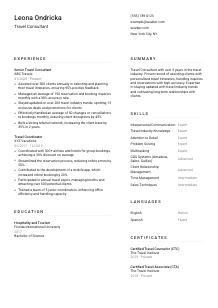
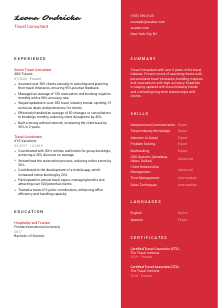
Mapping dream destinations, but your resume feels lost? Check out this Travel Consultant resume example, created with Wozber free resume builder. It shows how to chart your globetrotting expertise to match job expectations, setting your career compass for the next great adventure!
Travel consulting is judged in the details. Hiring teams want to see that you can turn a client request into a workable itinerary, manage reservations without costly errors, and keep the experience smooth when flights shift, rates change, or plans fall apart. Your resume should make that operational reliability visible from the start.
A tailored resume also helps separate broad customer service experience from actual travel coordination work. Using Wozber's free resume builder to shape an ATS-compliant resume lets you match the employer's language around itineraries, bookings, GDS tools, and client communication, so your background reads as travel consulting experience rather than generic service support.
This section is simple, but it carries a few early checks that matter in travel hiring. A recruiter should be able to confirm your target role, reach you quickly, and see any location requirement without hunting through the page.
Use your full name as the clearest text at the top of the resume. Keep the formatting clean and professional so the header feels like the start of a client-facing document, which matters in a role built on trust and communication.
If you are applying for a Travel Consultant position, place "Travel Consultant" directly under your name. This helps ATS matching and immediately frames your background around itinerary planning, bookings, and client service rather than a broader hospitality or administrative label.
Include a reliable phone number and a professional email address. Travel work often involves quick follow-up on interviews and role discussions, so accuracy here matters as much as it would when confirming reservation details for a client.
Some postings include a firm location requirement, as this one does for New York City, NY. If you already meet that requirement, list your city and state clearly in the header so there is no doubt about your eligibility.
A LinkedIn profile or professional site can help if it reinforces your travel background, certifications, client-facing experience, or industry affiliations. Make sure the dates, titles, and achievements match your resume exactly.
Your header should answer the first practical questions fast: who you are, what role you do, how to contact you, and whether you meet any stated location requirement. That keeps the focus on your travel experience instead of avoidable omissions.




For a Travel Consultant, experience is where the hiring decision usually starts to sharpen. Employers want to see client volume, booking accuracy, familiarity with itinerary changes, and the kind of service judgment that keeps travelers loyal when plans get complicated.
Read the posting closely and mark the work that appears in daily practice: itinerary planning, reservation handling, booking changes, promotion awareness, and long-term client relationships. Those are the themes your bullets should reflect because they map directly to the service and coordination load of the job.
Use reverse chronological order and lead with positions tied to travel coordination, reservations, hospitality, or client itinerary support. If your background includes unrelated jobs, give most of the space to roles that show booking workflows, supplier coordination, customer communication, or travel sales activity.
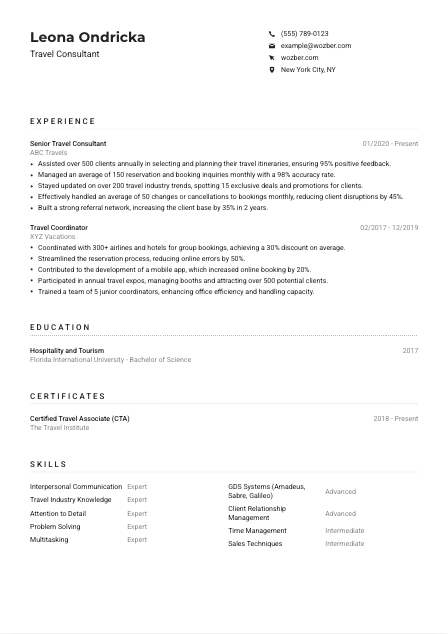
Avoid generic statements like "responsible for bookings." Show what you handled and how well you handled it. The sample resume does this effectively with points like assisting more than 500 clients annually with itineraries and managing 150 booking inquiries per month at 98% accuracy. That tells a hiring manager about scale, pace, and quality in one line.
Metrics are especially persuasive here because they show booking volume, client satisfaction, discount negotiation, referral growth, or disruption reduction. Figures such as positive feedback rates, number of cancellations resolved, or percentage growth in repeat business make your service impact concrete.
Keep bullets that strengthen your case for handling reservations, client requests, supplier coordination, itinerary changes, and relationship management. A transferable role can stay if it proves useful skills, but the emphasis should remain on travel work that resembles the target job.
By the end of this section, a recruiter should be able to picture you handling real client itineraries, booking activity, and last-minute changes with confidence. That is far more convincing than a list of general responsibilities.
Education tends to play a supporting role in travel consulting, but it still matters when the posting asks for a specific degree background. Use this section to show you meet the baseline and that your studies connect naturally to tourism, hospitality, or travel operations.
Start with the credential the employer asked for. Here, the posting calls for a bachelor's degree in Hospitality, Tourism, or a related field, so that degree should appear clearly and without extra wording getting in the way.
List your degree, school, field of study, and graduation year. A straightforward format works best because this section is usually reviewed quickly after experience and certifications.
If your degree matches the role closely, make that obvious. In the example resume, "Bachelor of Science" in "Hospitality and Tourism" immediately supports the employer's requirement and reinforces industry-specific preparation.
You do not need to turn this into a transcript. Add relevant coursework only if it strengthens your case, such as tourism management, hospitality operations, customer experience, or international travel services, especially when you are early in your career.
Honors, travel-related student projects, or extracurricular involvement can be helpful if they show service, coordination, or industry interest. Keep them brief and relevant so the section stays focused.
This section should confirm that your academic background fits the role without pulling attention away from your booking and client service experience. When the degree aligns, let it do that job plainly.
Certifications carry real weight in travel consulting because they show formal commitment to the field and familiarity with industry standards. When a posting lists preferred credentials, this is the place to make them easy to spot.
If the employer mentions CTA or CTC, list those first when you hold them. These credentials are directly relevant to travel advising work and can help distinguish you from candidates whose experience is mostly adjacent customer service.
Keep the focus on credentials that support itinerary planning, travel sales, destination knowledge, or professional travel counseling. Relevance matters more than volume.
Travel certifications often carry more value when the employer can see they are current. The sample resume handles this well by showing ongoing CTA and CTC credentials, which suggests continued professional standing in the field.
Travel policies, supplier offerings, and destination requirements shift constantly. If you have recent training in booking systems, destination specializations, or updated industry programs, include it when it helps show current knowledge.
Relevant credentials reinforce that your travel knowledge is formal as well as practical. For employers weighing similar levels of experience, that extra professional grounding can make the difference.
A Travel Consultant skills section should read like the toolkit behind successful bookings and repeat clients. That means balancing technical travel systems with the communication and judgment needed to guide travelers through options, changes, and service issues.
Start with the skills named in the job description. For this role, that includes GDS proficiency, interpersonal communication, written and verbal client service, and industry knowledge. Pulling these terms into your skills section improves alignment with both ATS filters and recruiter expectations.
Do not stop at "computer skills" or "reservation systems." If you use Amadeus, Sabre, Galileo, or other GDS platforms, name them directly. The example resume groups these systems clearly, which immediately tells the employer the candidate can work inside common travel booking environments.
Travel consulting depends on both system fluency and service quality. Pair hard skills such as GDS systems, booking coordination, and travel industry knowledge with role-relevant soft skills like relationship management, problem solving, multitasking, and communication under pressure.
A hiring manager should be able to glance at this section and see that you can both process the travel details and handle the client side of the job. That combination is what keeps itineraries accurate and customers coming back.
Language skills matter in travel because they affect how clearly you can guide clients, explain options, and manage issues across destinations, suppliers, and traveler preferences. Even when only one language is required, this section can still strengthen your profile.
If the job requires English proficiency, list English clearly and state your level accurately. Since travel consultants spend much of their day handling calls, emails, confirmations, and itinerary discussions, language proficiency is part of service delivery, not a minor detail.
Extra languages can broaden the client base you can serve and improve communication with international travelers. They are especially useful in markets with diverse leisure and business travel demand.
Choose straightforward labels such as Native, Fluent, Intermediate, or Basic. This gives a realistic picture of whether you can manage casual conversation, detailed itinerary discussions, or written client communication.
Speaking more than one language can help with rapport, personalization, and smoother communication during travel changes or disruptions. In the sample resume, English and Spanish together suggest broader client coverage without overstating the point.
Think about the travelers, destinations, or supplier networks most common in the roles you want. Languages become more valuable when they connect directly to the kind of clientele or travel products you handle.
This section should show that you can communicate clearly with the clients your target employer serves. If you bring multilingual ability on top of that, frame it as added service capacity.
The summary is your chance to frame your background before the reader reaches the bullets. For travel roles, it should quickly establish experience level, booking and itinerary strengths, system knowledge, and the kind of client results you deliver.
Before writing, identify the few points the employer is emphasizing most. In this case, those include travel coordination experience, itinerary planning, reservation handling, GDS proficiency, and client relationship management.
Start with your title or professional identity, then add your years in travel-related work and your core strength. The sample summary does this well by leading with more than 5 years in the travel industry and immediately connecting that experience to personalized itineraries and reservations.
Include one or two specifics that matter in this field, such as GDS systems, high booking accuracy, repeat client growth, or strong satisfaction scores. That gives the summary practical weight instead of sounding like a generic customer service profile.
Aim for 3 to 5 lines. Every phrase should help explain why you can manage travel planning, bookings, and client needs effectively. If a sentence could describe almost any service role, replace it with travel-specific language.
A good summary tells the reader, in a few lines, that you already understand the pace, systems, and client expectations of travel consulting. It should make the rest of the resume feel like proof of that claim.
When each section points to the same story, your resume becomes much easier to trust. It shows that you can plan itineraries, manage bookings, work with GDS platforms, and keep clients informed when details change.
Use Wozber to tighten that alignment, strengthen ATS optimization, and present your experience in an ATS-friendly resume format that keeps the focus on your travel consulting background. The finished resume should make it easy to see that you can handle both the logistics and the client relationship side of the role.




