



Use Wozber and land your dream job
Create Resume
No registration required
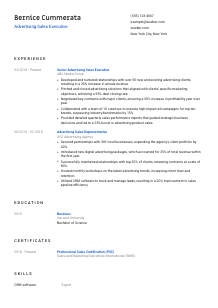
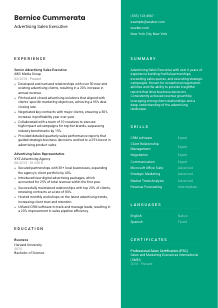
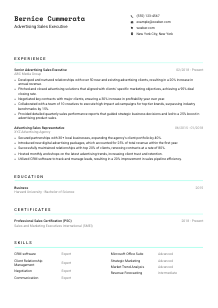
Closing deals, but your resume isn't getting the nod? Check out this Advertising Sales Executive resume example, created with Wozber free resume builder. Learn how to spotlight your sales strengths to match job requirements, and get your career in the advertising spotlight it deserves!
Advertising sales hiring moves quickly when a resume makes commercial performance easy to read. Teams want to see who can open doors, hold client relationships, shape proposals around campaign goals, and turn conversations into signed advertising revenue. If your resume stays vague about quota results, renewal wins, profitability, or collaboration with creative teams, it undersells the way this work is actually measured.
A tailored resume helps hiring teams separate general sales experience from ad sales experience, where client objectives, campaign fit, and deal margin matter. Wozber's free resume builder helps you build an ATS-compliant resume that mirrors the language of the role without sounding forced, so your background reads clearly for both ATS screening and the people deciding whether you can bring in business and grow accounts.
Advertising sales is a relationship-driven role, so the top of your resume should feel clean, direct, and easy to act on. This section does not need personality copy. It needs accurate contact details, a clear professional label, and any location information that matters for the opening.
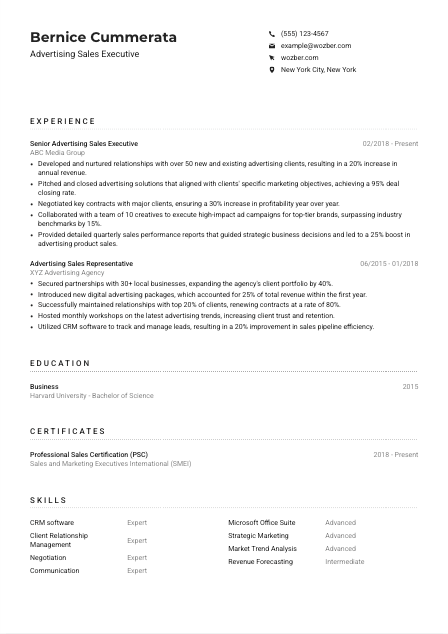
Place your name at the top in a clear, readable format, then follow it with the title you want to be considered for. Using "Advertising Sales Executive" immediately frames you around revenue generation, client management, and campaign selling rather than broader sales work.
If your background aligns with the posting, use the same job title as the role or a very close variant. That makes it easier for both ATS systems and hiring teams to recognize your relevance quickly. In this case, using "Advertising Sales Executive" connects your profile to advertising clients, media solutions, and sales ownership right away.
Include a phone number you answer regularly and a professional email address. Add a website or LinkedIn profile only if it supports your candidacy with consistent sales experience, client-facing credibility, or industry presence. Broken links and outdated profiles create friction you do not need.
Some advertising sales roles are tied to a market because client meetings, local business development, or office presence still matter. The example posting asks for someone based in New York City, New York, so listing that location clearly removes an avoidable screening question. Use this only when it reflects your actual situation or target-market plan.
A LinkedIn profile, portfolio site, or professional page can help if it shows media sales experience, client industries, campaign examples, or recommendations. Keep the information aligned with your resume. If your online presence does not add anything beyond what is already on the page, leave it out.
This section should confirm who you are, how to reach you, and whether you meet any location-based requirement. In advertising sales, that kind of clarity supports the same confidence clients expect in a pitch.




For an Advertising Sales Executive, experience carries most of the hiring weight. This is where you show account growth, deal execution, campaign alignment, client retention, and the revenue impact of your work. Generic sales bullets will not do the job if the role calls for advertising solutions and collaboration across commercial and creative teams.
Before rewriting your experience, mark the phrases that define the work. Here, that includes building relationships with new and existing advertising clients, pitching solutions tied to marketing objectives, negotiating profitable deals, collaborating with creative teams, and reporting sales performance. Those are the themes your bullets should answer directly.
List your most recent position first, along with employer, title, and dates. For advertising sales, your job titles already say a lot about seniority and account ownership, so make them easy to scan. A progression from Advertising Sales Representative to Senior Advertising Sales Executive, like in the example, quickly shows growth in responsibility and results.
Each bullet should show what you sold, who you worked with, and what changed because of your work. Revenue growth, quota attainment, close rate, renewal rate, account expansion, profitability, and campaign performance are all useful metrics in this field. The sample does this well with results such as a 20% annual revenue increase, a 95% deal closing rate, and a 30% profitability gain from negotiated contracts.
Prioritize experience that involves media packages, campaign proposals, client presentations, prospecting, renewals, CRM pipeline management, or cross-functional work with creative and account teams. If you have broader sales experience, pull forward the parts that connect to advertising, marketing objectives, or consultative selling instead of listing unrelated responsibilities.
The posting asks for a proven track record of meeting or exceeding sales quotas, so your resume should make that visible through outcomes, not claims alone. Mention quota attainment, portfolio growth, retained accounts, upsell results, or product revenue gains. Even a bullet about introducing a new digital advertising package that produced 25% of total revenue tells a stronger story than saying you were "results-driven."
Your experience section should read like a record of revenue, relationships, and commercial judgment. When hiring teams can see how you win clients, close deals, and support campaign delivery, they can picture you doing the same in their market.
Education usually is not the deciding factor in advertising sales hiring, but it still matters when the posting names a degree requirement. Present it cleanly, keep it relevant, and let it support the commercial experience doing the heavier lifting elsewhere on the page.
Start with what the employer asked for. This posting calls for a bachelor's degree in Business, Marketing, or a related field, so your education section should confirm that quickly and without extra wording. Make it easy to spot on the first pass.
List your degree, field of study, school, and graduation year or date range. That is usually enough for an experienced Advertising Sales Executive. A simple format keeps attention on the qualification itself instead of adding clutter.
If your degree is in Business, Marketing, Communications, or another related discipline, show the field clearly because it connects well to client strategy, market positioning, and commercial communication. The example's Bachelor of Science in Business fits the stated requirement directly.
If you are earlier in your career, a relevant project, sales competition, media planning coursework, or marketing research work can add context. For more experienced candidates, these extras are usually unnecessary unless they reinforce a specific angle such as digital advertising, brand strategy, or analytics.
Additional academic distinctions, honors, or training can stay if they support your sales story, but they should not crowd out recent quota-carrying work. For a candidate with several years in advertising sales, the education section should confirm foundation, not carry the application.
This section should quickly show that you meet the baseline academic requirement and have relevant grounding in business or marketing. Then let your client wins and sales results do the rest.
Certifications are rarely the core filter for advertising sales roles, yet they can strengthen your profile when they sharpen your commercial credibility. Focus on credentials that support selling, account growth, negotiation, digital media knowledge, or market strategy.
Review the job description to see whether certifications are required, preferred, or simply optional. This example does not demand one, so certificates should support your case rather than dominate it. Keep the emphasis on relevance, not volume.
List certifications that reinforce the kind of selling the job involves. Sales certifications, digital advertising credentials, media buying coursework, or account management training can all help when they align with the role. The Professional Sales Certification in the sample works because it supports negotiation, client management, and closing ability.
Dates help hiring teams understand whether your training is current, especially for credentials connected to changing ad platforms, digital products, or modern sales practice. If a certificate is ongoing or renewed periodically, show that clearly.
Advertising products, channels, and buyer expectations change fast. A thoughtful certificate section can show that you continue to build your commercial toolkit, whether through consultative selling, CRM usage, digital ad formats, or account strategy. Keep it selective so each item adds weight.
A short, relevant certificate section can sharpen your profile. It works best when it reinforces the same message as your experience section: you understand the sales process, the client conversation, and the business side of advertising.
Advertising sales skills need to show both commercial ability and client-facing execution. A useful skills section balances hard tools, such as CRM software and reporting tools, with the selling strengths that drive deals, renewals, and collaboration on campaigns.
Use the job description as your filter for what belongs here. This one clearly points to negotiation, communication, interpersonal skills, CRM software, and Microsoft Office Suite. Those are not filler keywords. They reflect daily work such as managing pipelines, pitching ad solutions, reporting performance, and handling client conversations.
List the capabilities most tied to winning and growing business first. Client relationship management, prospecting, negotiation, proposal development, CRM use, sales reporting, market analysis, and campaign coordination are all stronger here than broad traits like "hardworking." The sample skill list gets this right by combining CRM software, client relationship management, negotiation, and strategic marketing.
Lead with the skills most likely to matter on day one of the job. For many advertising sales roles, that means relationship building, closing ability, consultative communication, and pipeline management before secondary tools. If you use proficiency labels, keep them honest and consistent.
The best skills lists reflect how the job is actually done, from managing accounts in a CRM to negotiating profitable campaigns. That makes this section useful for both ATS matching and human review.
Language ability matters in advertising sales because the work depends on clear communication, persuasive presentations, and day-to-day relationship management. When a posting names a language requirement, your resume should state it plainly so there is no ambiguity.
Read the posting carefully before deciding how much space to give this section. Here, English communication is described as crucial, so English should appear clearly and early. That is a requirement, not a nice extra.
If English is your native language or you work at a fully professional level, say so clearly with a standard label such as "Native" or "Fluent." For a sales role built around pitches, negotiation, and reporting, vague wording is less helpful than a direct proficiency level.
Other languages can strengthen your profile when they support market coverage, relationship building, or work with diverse client bases. In some markets, being able to conduct sales conversations in another language can support prospecting and account growth. The example's Spanish fluency is a useful extra because it widens potential client communication.
Use consistent terms such as Native, Fluent, Intermediate, or Basic. Hiring teams may connect language skills to presentations, client calls, or written communication, so accuracy matters. Do not overstate your level if you could not comfortably use it in a sales setting.
If the role focuses on a local market, the required language may be enough. If the employer sells across regions or industries with multilingual clients, additional languages can become a differentiator. Include them when they support the actual client environment you are targeting.
For advertising sales, language skills should tell an employer whether you can handle client communication confidently. State the required language clearly, then add others only when they strengthen your commercial reach.
Your summary should read like the opening of a client pitch: focused, credible, and grounded in results. In a few lines, show your level, your sales specialty, and the kind of outcomes you deliver in advertising environments.
Start with the business priorities in the posting. Here, those include client relationship development, advertising solutions aligned to marketing objectives, strong negotiation, and performance reporting. Use those themes to shape your opening instead of writing a generic sales introduction.
State your title and years of experience near the start so the reader immediately understands your seniority. A line such as "Advertising Sales Executive with 6+ years of experience" works because it places you in the right lane before moving into results or specialties.
Mention the abilities that define your value in this field, such as growing advertiser relationships, closing consultative deals, improving profitability, or supporting campaigns that perform. The sample summary is strongest where it connects negotiation skill, quota performance, and revenue growth rather than relying on broad self-description.
Aim for a short paragraph that can be read in seconds. The summary should frame the rest of the resume, not repeat it. Strong wording here often combines one identity statement, one sales-performance point, and one line about client or campaign impact.
A well-written summary gives hiring teams a fast read on the kind of advertising seller you are. By the time they reach your experience section, they should already expect to see client growth, closed business, and clear sales judgment.
Your Advertising Sales Executive resume should show how you win business, keep clients, and connect advertising solutions to measurable commercial outcomes. When the language reflects real ad sales work, ATS screening and human review both become much more favorable.
Use Wozber's free resume builder, ATS-friendly resume template, and ATS resume scanner to tighten the structure, align your wording with the posting, and surface missing requirements before you apply. The finished resume should make one thing easy to judge: whether you can grow accounts and close profitable advertising deals.




