



Use Wozber and land your dream job
Create Resume
No registration required
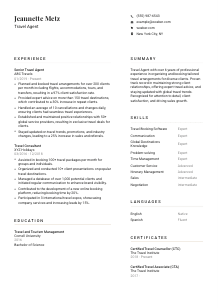
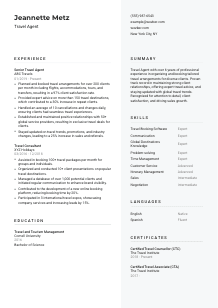
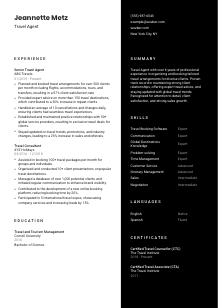
Guiding globetrotters, but feeling lost on your resume? Navigate this Travel Agent resume example, created with Wozber free resume builder. Learn how to match your itinerary planning prowess with job criteria, ensuring your career journey is as seamless as a first-class ticket!
Travel agents are hired on trust. Clients hand over flights, hotels, connections, documentation questions, and often high-stakes changes when plans fall apart. Your resume needs to show that you can manage bookings accurately, give sound destination advice, and keep communication steady when itineraries shift.
A tailored resume also helps separate travel sales experience from full-service travel planning. With Wozber's free resume builder and an ATS-compliant resume structure, you can match the posting's language around booking software, global destination knowledge, and client service so hiring teams can quickly see whether you can handle real itineraries, supplier coordination, and last-minute disruptions.
In travel hiring, the top of the resume should answer a few practical questions fast: who you are, what role you do, and whether you're easy to reach for a client-facing position. Keep this section clean and professional, and make sure it reflects any explicit requirement from the posting.
Your name should sit at the top in a clear, readable format. Travel roles are often fast-moving, especially when agencies are hiring for immediate client demand, so avoid decorative styling that distracts from the essentials.
If you're targeting a Travel Agent opening and your background supports it, place "Travel Agent" directly under your name. That immediate alignment matters when the employer is sorting applicants across nearby titles such as Travel Consultant, Leisure Consultant, or Reservations Specialist.
List a reliable phone number and a professional email address. Since this work depends on timely communication with clients and suppliers, your contact details should look dependable and current. A simple email based on your name works best.
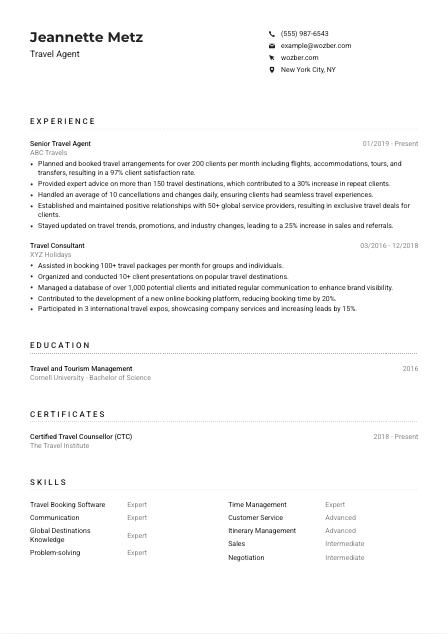
Some travel roles have office, market, or relocation requirements. Here, the employer specifies New York City, NY, so including that location directly addresses a stated condition. If you are relocating, make that clear instead of leaving the employer to guess.
A LinkedIn profile or professional website can support your application if it reinforces your travel background, certifications, destination expertise, or client-facing experience. Only include it when the content is polished and consistent with your resume.
This section should remove friction, not add it. When your title, contact details, and location are clear, the reader can move straight to your booking experience, client work, and travel knowledge.




For travel agents, experience is where hiring managers look for day-to-day proof. They want to see booking volume, destination knowledge, supplier coordination, client retention, and how you handle cancellations or urgent changes without losing accuracy or service quality.
Start by marking the core duties and terms in the job ad. For a travel agent, that usually includes booking flights and accommodations, managing itineraries, advising on destinations, and handling changes or emergencies. Use those same work terms where they truthfully match your background so your resume reads as directly relevant.
List your most recent position first, then work backward. For each role, include your job title, company name, and dates. This makes it easy to track your progression from support or consultant work into higher-volume booking, destination advisory, or senior client management responsibilities.
Generic bullets like "booked travel" miss what matters. Show scope, service level, and outcomes. The example resume does this well with details such as planning travel for more than 200 clients per month and maintaining a 97% client satisfaction rate. That tells the employer far more than a task list.
Travel hiring responds well to metrics tied to bookings and service: monthly client volume, repeat-client rate, sales growth, referral growth, supplier relationships, booking turnaround time, or the number of daily changes handled. Figures like a 30% increase in repeat clients or a 20% reduction in booking time make your contribution easier to judge.
Prioritize experience that shows booking systems, itinerary management, destination recommendations, documentation awareness, service recovery, or vendor coordination. If you have broader customer service or sales experience, frame it through travel-relevant outcomes such as upselling packages, resolving disruptions, or maintaining strong provider relationships.
A hiring team should be able to see how you manage bookings, advise travelers, and keep trips on track when conditions change. If your bullets show scope, pace, and client results, your experience section is doing its job.
Education matters differently in travel than in highly regulated fields. Many employers do not require a specific degree, but relevant study can strengthen your profile by showing grounding in tourism, hospitality, geography, business, or customer service.
Some travel agent postings focus almost entirely on experience, software familiarity, and destination knowledge. Others value formal study in travel and tourism or hospitality. Read the ad carefully so you know whether education is a supporting detail or a stronger selling point.
List the school, degree, field of study, and graduation year or date range. Keep formatting simple. A degree such as a Bachelor of Science in Travel and Tourism Management immediately connects with agency work, tour planning, and industry knowledge.
If your studies covered tourism operations, hospitality management, geography, business communication, or international travel, make that visible through the field of study. You do not need to over-explain, but relevant academic grounding can reinforce your expertise in destinations and traveler needs.
If you are early in your career or moving into travel from another client-service field, a few targeted courses can help. Focus on subjects that support the role, such as itinerary planning, customer experience, world geography, or travel operations. Skip long course lists if you already have solid industry experience.
Honors, travel-related projects, student leadership, or tourism internships can be useful when they point to real professional value. If an achievement does not connect to travel planning, client service, or industry knowledge, leave it out.
Your education section should support the case that you understand the travel business and can learn quickly in a client-facing environment. Let it add context, not distract from stronger booking and service experience.
Certifications carry real weight in travel because they show commitment to the profession and familiarity with industry standards. When a posting mentions credentials like CTC or CTA, move them out of the background and make them easy to spot.
If the employer mentions credentials such as Certified Travel Counselor or Certified Travel Associate, list those clearly. In this example, both CTC and CTA fit the role well and immediately reinforce professional standing in travel advising and client service.
Keep this section relevant. Travel certifications, supplier training, destination specialist programs, or credentials tied to booking systems are more useful here than unrelated general certificates. Each item should point back to better client guidance, stronger booking knowledge, or deeper destination expertise.
Many certifications involve active status, renewal, or continuing education. Show the issuer and dates clearly so employers can tell whether the credential is current. Clean, accurate dating matters in a profession that depends on up-to-date information and compliance awareness.
Travel changes constantly through supplier policies, entry rules, customer preferences, and destination demand. Ongoing certification or training helps you stay credible, especially if you want to move into luxury travel, group travel, corporate travel, or destination-specific advisory work.
When listed well, certifications show that your travel knowledge is formalized and current. That can strengthen your resume quickly, especially when several applicants have similar booking experience.
A travel agent skills section works best when it reflects the actual flow of the job. Employers are looking for someone who can use booking tools, communicate clearly, handle changes calmly, and guide travelers with practical destination knowledge.
Review the posting for explicit requirements and implied strengths. Here, booking and itinerary management software, communication, interpersonal ability, destination knowledge, and understanding of travel regulations all belong near the top because they directly affect how well you can serve travelers.
Lead with abilities tied to booking execution and traveler support. Strong examples include travel booking software, itinerary management, global destinations knowledge, customer service, and problem-solving. The sample resume also includes negotiation and sales, which can be useful when your role involves packages, upgrades, or supplier coordination.
Do not overload this section with every soft skill you have ever used. A shorter list of relevant skills is stronger, especially when your experience bullets back it up. If you claim expert communication or itinerary management, the rest of the resume should show client volume, presentations, repeat business, or change handling that supports that claim.
This section should tell the reader that you can book accurately, advise confidently, and manage client expectations throughout the trip lifecycle. Relevance matters more than volume.
Language ability can be a real advantage in travel, especially when you serve international travelers, work with global suppliers, or sell to multilingual client bases. Even when only English is required, your language section can still strengthen the resume if it is honest and relevant.
This posting asks for fluency in English, both spoken and written, so that should appear clearly. For a travel agent, language ability is not just a checkbox. It affects itinerary accuracy, client communication, issue resolution, and coordination with hotels, carriers, and tour operators.
Additional languages can expand the range of clients you can support and make communication smoother with overseas partners. In the example, Spanish is a useful addition because it can support both customer relationships and destination-related communication.
Use straightforward levels such as Native, Fluent, Advanced, or Conversational. Overstating language ability can become a problem quickly in travel work, where a misunderstanding about documentation, transfers, or schedule changes can affect the entire client experience.
If languages have helped you serve a market segment, improve sales, support group travel, or manage international bookings, make sure the rest of the resume reflects that context. Language skills stand out most when they connect to real client or supplier interactions.
If you are actively improving a language that matters for your market, update your proficiency as it changes. In travel, even incremental improvement can expand the destinations, clients, or partnerships you can handle comfortably.
For travel roles, language skills matter when they improve communication and expand the kinds of travelers or providers you can work with. Keep the section accurate, and let it support the broader story of client care and global awareness.
The summary should quickly establish your level, your travel focus, and the kind of results you deliver. In a few lines, show that you can handle bookings, advise clients well, and manage the moving parts that make travel work run smoothly.
Start with your title and years of relevant experience. For example, "Travel Agent with 6+ years of experience" gives immediate context. If your background leans toward leisure travel, corporate travel, luxury itineraries, or group bookings, add that if it is relevant to the target role.
Use one or two accomplishments that match how travel performance is measured. The sample summary references tailored travel arrangements, client relationships, and sales growth, all of which fit the job well. You can also mention client volume, repeat business, satisfaction scores, or booking efficiency if those are your strongest results.
Your summary should echo the job's real needs, not generic strengths. Mention booking and itinerary management, destination guidance, travel regulations, supplier relationships, or change handling when those are central to your background. Keep it concise and tied to actual experience.
Close by showing what your work leads to, such as seamless travel experiences, repeat clients, stronger referrals, or higher package sales. That final line should leave a clear impression of how you support both customer satisfaction and commercial results.
A well-written summary gives the reader a quick, accurate picture of your travel background before they reach the detail below. It should make your booking experience, client focus, and destination expertise easier to recognize from the start.
A travel agent resume works best when it shows how you book accurately, guide clients confidently, and respond well when plans change. Tailor each section to the role's actual priorities, from booking software and destination knowledge to client communication and service recovery.
Use Wozber's free resume builder to structure the content clearly, strengthen ATS optimization, and align your wording with the target posting. The finished resume should make it easy to judge whether you can manage itineraries, protect the client experience, and contribute to repeat business from day one.




