




Use Wozber and land your dream job
Create Resume
No registration required
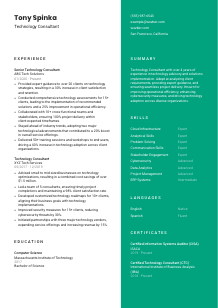
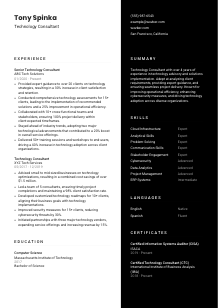
Navigating complex systems, but your resume feels like a buggy program? Check out this Technology Consultant resume example, created with Wozber free resume builder. It shows how to align your tech know-how with client needs, positioning your career to receive constant five-star reviews from both users and recruiters!
Technology consulting sits at the point where business problems meet technical decisions. Hiring teams want a resume that makes your consulting judgment visible, not just your familiarity with tools. They need to see how you assess client needs, recommend workable solutions, and move implementation forward with stakeholders who may not share the same technical depth.
A tailored resume changes how quickly that story comes through, especially when an ATS is screening for consulting language, domain expertise, and delivery experience. Wozber's free resume builder helps you align your wording with the job description and keep an ATS-compliant resume clean and structured, so a hiring team can quickly recognize your strength in advisory work, solution selection, and client adoption.
The Personal Details section is straightforward, but it still does important work for a Technology Consultant. Client-facing roles depend on accessibility, professionalism, and, in some cases, location readiness. Keep this section clean so the reader can move quickly to your consulting background.
Place your name at the top in a clear, readable format. Skip decorative styling. Technology consulting resumes are usually reviewed for substance, and a simple header keeps the focus on your advisory experience, domain knowledge, and project results.
Use the job title directly beneath your name when it reflects the role you are pursuing. "Technology Consultant" is the clearest choice here because it aligns with the posting and immediately frames your background around client strategy, assessments, and implementation guidance.
Your contact information should read like that of someone who can be trusted in front of clients and stakeholders. Accuracy matters here as much as polish.
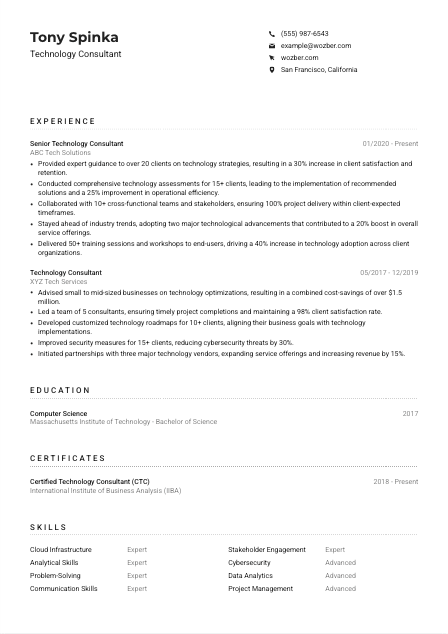
Some consulting jobs care about delivery coverage, client proximity, or local market presence. In the example posting, being based in San Francisco, California is a stated requirement, so showing San Francisco in the header removes an immediate screening question. For other roles, include location only when it helps confirm your availability or fit for the engagement model.
Include LinkedIn or a professional website if it reinforces your consulting work. Useful additions might include certifications, technology domain focus, case-study style project summaries, or speaking and workshop experience. A generic link with no added value is easy to leave out.
Keep the header practical and complete. For consulting roles, it should confirm that you are reachable, professionally presented, and positioned for the kind of client-facing work the posting describes.




Experience carries the most weight on a Technology Consultant resume because this is where employers see how you operate with real clients, real systems, and real constraints. The strongest entries show more than technical exposure. They show how you diagnosed needs, shaped recommendations, coordinated delivery, and improved business results.
Read the posting for the verbs that define the work. In this case, the priorities include guiding clients on technology strategy, conducting assessments, recommending solutions, collaborating across teams, and training end-users. Build your bullets around those same consulting activities when they reflect your actual work. That alignment helps both human reviewers and ATS screening pick up the right experience quickly.
List your positions in reverse chronological order with title, company, and dates clearly shown. For consulting roles, titles matter because they show progression from execution to advisory ownership. A move from Technology Consultant to Senior Technology Consultant, as in the example, signals increased scope in client leadership, solution design, and delivery accountability.
Replace task lists with outcomes tied to consulting work. Good bullets show what you assessed, what you recommended, and what changed after implementation. The example does this well with results such as a 25% improvement in operational efficiency after technology assessments and a 40% increase in adoption after training sessions. Those outcomes tell a hiring team that your advice translated into execution.
Quantify your work with measures that fit the role. Client count, cost savings, adoption rates, retention, efficiency gains, delivery timelines, revenue growth, and security improvements are all useful when they are true to your work. "Advised SMB clients on technology optimizations, saving $1.5 million" or "reduced cybersecurity threats by 30%" lands far better than a generic claim about adding value.
Prioritize experience that shows consulting judgment, technical depth, and stakeholder management. If you have work outside consulting, keep bullets that support the target role, such as solution implementation, business analysis, systems assessment, change management, or workshop delivery. Remove detail that does not help explain your ability to guide clients toward better technology decisions.
Your experience section should make it easy to picture you in front of a client, inside a discovery session, and across the life of an implementation. Keep the emphasis on decisions made, outcomes delivered, and the business impact of your recommendations.
Technology consultants are often expected to translate between business goals and technical realities. Your education section helps establish the baseline knowledge behind that work, especially when the posting asks for a degree in computer science, information technology, or a related field.
If the role asks for a bachelor's degree, make sure yours is easy to find. A Bachelor of Science in Computer Science, Information Technology, Information Systems, or a similar field directly supports consulting work that involves assessments, architecture discussions, data analysis, or security recommendations.
List school, degree, field of study, and graduation year in a simple structure. That is usually all an employer needs, and it keeps the section readable in an ATS-friendly resume format. The example does this effectively with a straightforward Computer Science degree entry from MIT.
When your degree closely matches the requirement, use the formal wording. "Bachelor of Science in Computer Science" is stronger than an abbreviated or casual version because it mirrors the language many recruiters and systems are scanning for.
Coursework is most useful if you are early in your career, moving into consulting from another path, or applying to a role with a specialized domain focus. Classes in cloud architecture, information security, data analytics, ERP, systems design, or business process analysis can reinforce your technical base when your work history is still developing.
Honors, capstone projects, research, or technical leadership activities can add value if they connect to consulting work. For example, a systems implementation project or leadership in a tech club can support your ability to solve problems, communicate recommendations, and work across groups. Keep these details brief once your professional experience is established.
Education does not need much space, but it should clearly support your technical credibility. For a consulting role, the reader should come away with no doubt that you have the academic grounding to handle client discussions and solution evaluation.
Certifications matter in technology consulting because they show current knowledge in areas clients often pay for directly. They can strengthen your case in cloud, cybersecurity, audit, analytics, or ERP work, and they also help when a posting names preferred credentials.
If a role calls out specific certifications, place matching ones prominently. Here, CTC and CISA are listed as preferred, so candidates who hold them should make sure they are visible. That kind of direct match can help your resume clear early screening and support your credibility with hiring managers.
Choose certifications that reflect the kind of problems you solve for clients. A cybersecurity consultant might emphasize CISA or security-specific credentials. A cloud-focused consultant might lead with AWS, Azure, or Google Cloud certifications. The point is to show depth in the technology domain you advise on, not to create a long list of unrelated badges.
Add the year earned and, when relevant, note that the certification is active. In consulting, currency matters because clients expect up-to-date guidance. The example's date ranges make it clear that the certifications are ongoing and still relevant.
Technology consulting changes quickly, so your certifications should reflect continued learning. Periodic additions in security, cloud, data, governance, or change management can show that your recommendations are informed by current practice rather than old frameworks.
Use this section to support the technical authority behind your recommendations. A short, relevant certification list can sharpen your positioning, especially when it lines up with the employer's preferred domains or client environment.
A Technology Consultant needs a skills section that reads like an accurate map of how they solve client problems. That means balancing domain expertise with the consulting capabilities that keep projects moving, such as analysis, communication, and stakeholder management.
Start with the technologies and consulting capabilities named in the posting. Here, that includes at least one major domain such as cloud infrastructure, cybersecurity, data analytics, or ERP systems, along with analytical, problem-solving, and communication skills. Use those terms where they truthfully reflect your experience so your resume matches both the role and ATS expectations.
Technology consultants are hired for both domain expertise and client-facing execution. A well-built list might pair cloud infrastructure, cybersecurity, or ERP with stakeholder engagement, workshop facilitation, requirements analysis, and project management. The example handles this mix well by pairing technical areas with communication and problem-solving strengths.
Do not treat every skill equally. Lead with the capabilities that are most central to the job you want. If the role leans toward security assessments, move cybersecurity and risk analysis higher. If it focuses on digital transformation, emphasize roadmap development, cloud platforms, data analytics, or enterprise systems. Keep the list relevant rather than exhaustive.
Your skills section should quickly clarify where you can advise with confidence and how you work with clients and teams. When the list is focused, it reinforces your consulting niche instead of reading like a collection of disconnected keywords.
Communication sits at the center of technology consulting. You may be presenting recommendations to executives, translating technical tradeoffs for operations teams, or leading training sessions for end-users. Language proficiency matters when it affects how clearly you can do that work.
If the posting requires fluency in English, make that explicit. This role does, so English should appear clearly in the section. For a consulting position, this is not a minor detail. It speaks directly to workshops, written recommendations, stakeholder meetings, and day-to-day client communication.
List your strongest language first and use clear labels such as Native, Fluent, Professional, or Conversational. "English - Native" or "English - Fluent" is easy to scan and avoids ambiguity for roles where verbal and written communication are essential.
Additional languages can be useful in consulting environments with regional clients, multilingual teams, or international delivery. The example includes Spanish, which could be a practical advantage in some client settings. Treat extra languages as supporting strengths, not filler.
Do not overstate fluency. If a hiring manager switches into that language during an interview or expects client-facing use, inflated claims become obvious quickly. Accurate labels protect your credibility.
If an additional language helps with workshops, training, stakeholder interviews, or cross-border collaboration, it is worth including. If not, keep the section brief. As with the rest of the resume, relevance matters more than length.
For technology consultants, language skills support trust, clarity, and adoption. List them in a way that tells the employer how comfortably you can communicate in the environments their projects require.
Your summary should frame the kind of consultant you are before the reader reaches the first job entry. In a few lines, it should establish your experience level, technical focus, and the business outcomes your work tends to influence.
Open with your title and years of experience in a direct sentence. "Technology Consultant with 4+ years of experience" works because it immediately places you in the right professional category and gives the reader a sense of level.
Choose two or three areas that reflect the posting and your track record. That might include technology strategy, solution assessment, implementation guidance, cybersecurity improvement, cloud advisory, or end-user adoption. The example summary works because it combines advisory work with outcomes such as improved efficiency and stronger security.
Aim for three to five lines. Use those lines to name your consulting value clearly rather than repeating generic traits. Strong summaries reference the kinds of clients served, the domain worked in, or the results driven, without drifting into buzzwords.
Shift the emphasis depending on the position. One application may need more focus on cloud infrastructure and implementation. Another may need stronger language around assessments, stakeholder engagement, training, or cybersecurity. This is one of the fastest places to mirror the employer's priorities in an authentic way.
Your summary should make a hiring manager expect consulting depth before they read any further. When it is tailored well, it frames the rest of the resume around the kind of advisory work, technical domain, and client impact you want to be hired for.
A Technology Consultant resume should leave little guesswork about how you operate. It needs to show that you can assess business needs, recommend the right technology path, work across stakeholders, and help clients adopt the solution successfully.
As you revise, keep the language close to the work itself. Use metrics that reflect consulting outcomes, keep your technical domain clear, and mirror the posting where it matches your experience. Wozber's AI resume builder can speed up that process by surfacing missing requirements, improving phrasing, and helping you strengthen ATS optimization without losing specificity.
When each section points to the same story, your resume becomes much easier to evaluate for client-facing advisory roles. That is the standard to aim for.




