



Use Wozber and land your dream job
Create Resume
No registration required
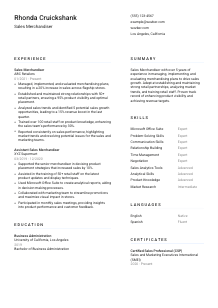
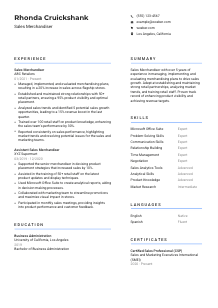
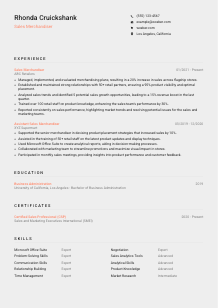
Merchandising wins, but your resume isn't selling? Check out this Sales Merchandiser resume example, built with Wozber free resume builder. Learn how to combine merchandising magic and job specs savvy, charting a sales career that stands front and center!
Sales merchandising sits where store execution meets revenue. Hiring teams want to see how you turn shelf space, product placement, promotions, and retailer relationships into measurable sales lift. A resume for this role should quickly show that you can read in-store performance, respond to market movement, and keep product visibility aligned with broader sales goals.
When the resume mirrors the language of the posting, it becomes much easier to sort a true merchandising candidate from someone with only general retail experience. Wozber's free resume builder helps you shape that alignment in an ATS-friendly resume format, so terms like merchandising plans, retail partner relationships, sales trends, and staff training connect clearly to the work you have already done. That helps the employer see your commercial impact faster.
This section should identify you cleanly and remove avoidable friction. For a Sales Merchandiser, that means showing professional focus, contact details that are easy to use, and any location match the employer has stated.
Place your name at the top in a clear, readable format. Keep it slightly larger than the body text so it anchors the page without looking styled for style's sake. In a field where hiring managers often scan fast, simple presentation works better than decorative formatting.
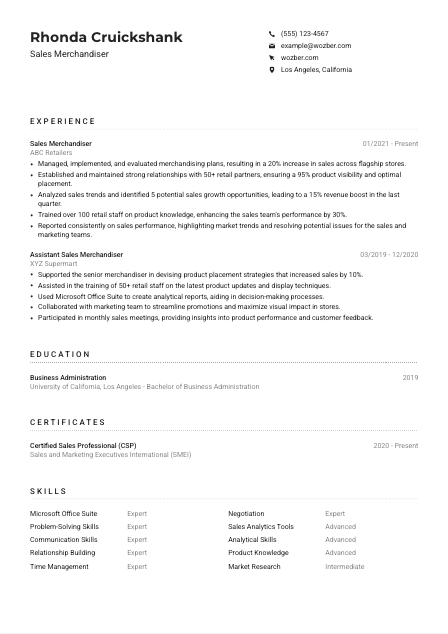
Add "Sales Merchandiser" directly under your name when that is the role you are pursuing. This immediately frames the rest of the resume around merchandising execution, retail support, and sales growth rather than leaving your background open to guesswork.
If the posting asks for a candidate in a specific area, include your city and state. Here, listing Los Angeles, California directly supports a stated requirement and saves the employer from wondering whether relocation is involved.
Include LinkedIn or a professional portfolio only if it supports your merchandising work. A current LinkedIn profile can reinforce your retail history, employer names, promotions, and endorsements in areas like category support, sales analysis, or account relationships.
Your personal details should confirm who you are, where you are, and which role you are targeting. When that information is clean and relevant, the reader can move straight to your merchandising results.




This is the section that usually decides whether a Sales Merchandiser gets serious consideration. Hiring teams are looking for proof that you can improve product visibility, work with retail partners, train store staff, and turn sales data into better execution.
Read the job description for the work patterns behind the wording. In this case, the employer is asking for merchandising plan execution, partner relationship management, sales trend analysis, retail staff training, and regular reporting. Those priorities should shape which achievements you surface first and what language you mirror.
Start with your most recent merchandising or retail sales position and include job title, company, and dates. A straightforward timeline helps the employer track your progression from support work into independent ownership of displays, store relationships, promotions, and reporting cadence.
Replace generic task descriptions with bullet points that show what changed because of your work. "Managed merchandising plans" is stronger when it becomes "Managed and evaluated merchandising plans that increased sales by 20% across flagship stores." The sample resume handles this well by tying day-to-day merchandising work to a concrete sales result.
Quantify your scope wherever you can. Sales lift, revenue growth, number of retail partners, staff trained, store count, compliance rate, or display placement improvements all help the reader judge scale. Metrics like 50+ retail partners, 95% product visibility, or a 15% revenue boost show the difference between participation and performance.
Prioritize experience that reflects merchandising, sell-through support, plan implementation, retail collaboration, or market analysis. If you include adjacent retail work, frame it in terms that support the target role, such as promotion execution, store feedback, inventory presentation, or cross-functional coordination with sales and marketing.
A Sales Merchandiser resume should make your field execution easy to picture. When your bullets connect placement, analysis, retailer support, and staff training to revenue outcomes, your experience reads as commercially useful from the first scan.
Education will rarely carry the whole application for a Sales Merchandiser, but it can reinforce the business side of your background. Present it clearly, especially when the employer prefers a degree in business, marketing, or a related field.
When the posting mentions a preferred degree, make sure your education section answers it directly. A bachelor's degree in Business, Marketing, or a related field supports the analytical and commercial side of merchandising work, from reporting to retail planning.
List your degree, field of study, school, and graduation year in a consistent format. Hiring teams should be able to confirm your academic background in seconds, especially when they are comparing multiple candidates with similar store-side experience.
Use the exact degree title as awarded. A line such as "Bachelor of Business Administration" gives the employer a direct match to the business-focused preference in the posting and avoids vague wording.
If you are early in your career, a short mention of coursework in marketing, consumer behavior, retail management, sales analysis, or merchandising can add context. For more experienced candidates, job results usually matter more than class detail.
Add honors, leadership roles, or major projects only if they connect to commercial thinking or retail execution. For example, a market research project or leadership in a business association can support the analytical and communication strengths expected in merchandising roles.
Keep this section straightforward and relevant. When your degree aligns with the employer's preference, it quietly strengthens the case that you can handle both the store-facing and analytical demands of sales merchandising.
Certifications are not always required for Sales Merchandiser roles, but the right one can support your credibility in sales, retail execution, or account-facing communication. Include credentials that sharpen your profile rather than pad the page.
List certifications that connect to selling, merchandising, retail operations, or customer-facing execution. A credential like Certified Sales Professional can support your profile because it reflects structured training in sales effectiveness and relationship management.
Only include certificates that strengthen your case for the target role. If a credential does not relate to merchandising performance, retail collaboration, reporting, or commercial communication, leave it off and give the space back to stronger experience.
Show when the certification was earned and who issued it. Those details help the employer judge recency and credibility, especially in roles where ongoing product knowledge and sales training matter.
Sales merchandising changes with shopper behavior, retail programs, and reporting tools. Relevant courses, workshops, or continuing education can show that you stay current on display strategy, sales analytics, and in-store execution standards.
A short, relevant certifications section can strengthen your profile, especially when it backs up your sales judgment or retail execution skills. Keep it focused on credentials that add real context to your experience.
The best Sales Merchandiser skills sections look practical. They reflect how the work gets done, from analyzing sales reports to building retailer relationships and training store staff on product presentation.
Start with the skills the employer chose to name. Here, that includes analytical and problem-solving ability, communication, Microsoft Office Suite, and familiarity with sales analytics tools. Those phrases matter for ATS optimization when they accurately reflect your background.
List skills you can support with examples from your work history. If you rate yourself as advanced in sales analytics tools or expert in relationship building, your experience section should show reporting, trend analysis, retailer coordination, or negotiation outcomes that back it up.
Put the most relevant capabilities first. For a Sales Merchandiser, that often means sales analysis, product visibility, retailer communication, training, Microsoft Office, market research, and problem-solving before broader soft skills. The section should read like a snapshot of how you perform the job.
A useful skills list should sound like the actual day-to-day toolkit of a Sales Merchandiser. When the terms match the posting and your experience proves them, this section supports both ATS alignment and human review.
Language ability matters in sales merchandising when the role depends on clear reporting, retailer communication, and staff training. List languages that genuinely expand how well you can work across stores, teams, or customer communities.
If the posting specifies English proficiency, show it clearly. Sales Merchandisers write reports, explain display standards, communicate with retail partners, and relay market feedback, so strong written and spoken English is a practical requirement, not a formality.
Lead with the languages that matter most for the target market. In this opening, English is essential, and Spanish can be a useful added strength in parts of Los Angeles where store teams or customer bases are multilingual.
Extra languages are worth listing when they support store visits, local market communication, or broader territory coverage. If they do not have a realistic connection to the role, they do not need to take space from stronger qualifications.
Use honest labels such as native, fluent, conversational, or basic. If you may need to train staff, communicate with buyers, or write client-facing updates, overstating your level will create problems quickly.
For some merchandising roles, language ability can help with regional coverage, retailer trust, or smoother in-store communication. Mention it as a practical advantage, especially if it supports territory-based work or diverse retail environments.
List languages with the same discipline you use elsewhere on the resume. When they support communication in the field, team training, or local market coverage, they add real value to your candidacy.
Your summary should quickly establish the kind of Sales Merchandiser you are. Focus on the blend of retail execution, analysis, and relationship management that defines the role, then support it with a few concrete strengths or outcomes.
Before writing the summary, note the few themes that appear repeatedly in the job description. Here, those are merchandising plan execution, retail partner relationships, sales analysis, staff training, and communication with sales and marketing teams. Your summary should center on that mix rather than trying to mention everything.
Start with a direct line that tells the reader who you are professionally. A phrase like "Sales Merchandiser with 5+ years of experience" works because it immediately establishes your lane and your level.
Add two or three strengths that connect to the target role, such as improving product visibility, identifying growth opportunities from sales trends, or training retail teams on display standards. The sample summary works because it ties merchandising plans, retail partnerships, and revenue outcomes into one compact statement.
Aim for 3 to 5 lines with no filler. This section should read like a concise business case, not a personal statement. If a sentence does not clarify your merchandising impact, your market insight, or your store-facing value, cut it.
A well-written summary should tell the employer, within seconds, what kind of sales and merchandising results you are used to delivering. Keep it specific enough that the rest of the resume feels like proof, not explanation.
A Sales Merchandiser resume should show that you can connect store execution to business results. If your sections clearly cover merchandising plans, retail relationships, sales analysis, staff training, and reporting, the employer can quickly see where you add value.
Use Wozber to shape that story into an ATS-compliant resume with focused wording, role-matched structure, and faster tailoring for each application. The final result should make your readiness for the next merchandising assignment easy to judge.




