



Use Wozber and land your dream job
Create Resume
No registration required
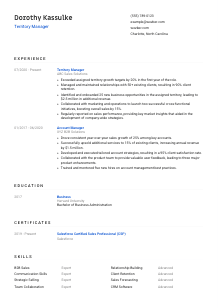
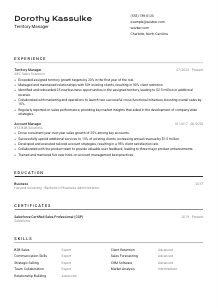
Drawing borders, but your resume feels out of place? Check out this Territory Manager resume example, created with Wozber free resume builder. Learn how to map your strategic insight and market know-how to match job geographies, making sure your career footprint covers all the right ground!
Territory management is judged in real business terms. Can you grow revenue in a defined region, protect existing accounts, and keep a steady flow of new opportunities moving through the pipeline? Hiring teams look for candidates who can balance field sales, account stewardship, and territory planning without losing sight of quota, retention, or market movement. Your resume needs to make that commercial scope visible early.
A tailored resume helps separate broad sales experience from true territory ownership. When your document mirrors the language of regional growth, client retention, business development, and reporting, it becomes easier for both recruiters and ATS filters to recognize the kind of candidate who can run a book of business, not just support one. Wozber's free resume builder helps you shape that alignment into an ATS-compliant resume that shows how you drive results across a territory.
For a Territory Manager, the top of the resume should establish professional credibility fast. Contact details are simple, but they still carry useful signals, especially when the role involves regional coverage, travel, and location-specific hiring needs.
Place your full name prominently, then use the exact job title you are targeting. If the role is Territory Manager, say that directly under your name. It gives immediate context and helps position your background around territory growth, account ownership, and field sales performance from the first line.
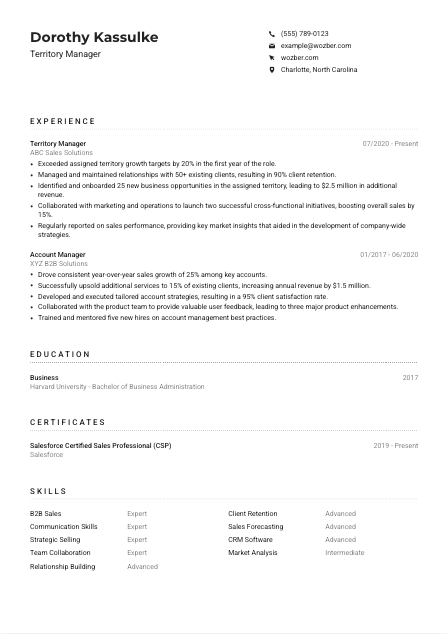
If the employer wants someone based in a specific market, include your city and state clearly. In the example, listing "Charlotte, North Carolina" immediately addresses a stated requirement. That does not make location equally important in every Territory Manager search, but when a territory is tied to a region, geography belongs near the top.
Include LinkedIn or a professional website if it reinforces your sales background. Make sure it reflects the same employers, dates, and performance story shown on the resume. For territory-based sales roles, a consistent online profile can reinforce account growth, industry coverage, and career progression.
Skip details such as age, marital status, or a full street address. Keep the focus on information that helps an employer contact you and place you in the right territory. Clean, relevant headers also support ATS readability.
Your header should tell the employer who you are, what role you are pursuing, and whether basic logistics such as location and availability line up with the territory.




This is the section that carries the most weight for a Territory Manager. Hiring teams want to see how you handled a region, grew revenue, retained accounts, opened new business, and worked across teams to keep client delivery on track.
Read the posting closely and map your experience to its commercial priorities. For this role, that means territory growth, account management, new business development, cross-functional coordination, and performance reporting. The example does this well by showing 20% territory growth, 50+ managed clients, and 25 new business wins. That kind of overlap tells a hiring team you have already done work with similar scope.
Generic lines such as "managed accounts" or "worked with clients" waste valuable space. Show what changed because of your work. Strong Territory Manager bullets usually mention growth against target, account retention, expansion within existing customers, prospect conversion, or market penetration. In the sample resume, client retention, revenue from new business, and cross-functional sales lift all show operational value, not just activity.
Territory sales is measured. Use percentages, revenue figures, account counts, renewal rates, average deal growth, or year-over-year gains when you have them. Metrics such as "$2.5 million in additional revenue," "90% client retention," or "25% year-over-year growth" are exactly the kinds of data points that help a hiring manager gauge whether you can carry a region.
Prioritize experience that proves you can manage relationships, hit targets, expand accounts, and read the market. Earlier roles can stay, but the bullets should still connect to sales execution, customer management, pipeline growth, or partner collaboration. Every line should help answer a practical question: can this person take ownership of a territory and grow it?
Your experience section should make your commercial track record easy to trust. Show the territory, the accounts, the growth, and the business impact in numbers whenever you can.
Education is rarely the deciding section for an experienced Territory Manager, but it still needs to meet the brief cleanly. For sales roles that ask for a business, marketing, or related degree, this section should confirm that requirement without making the reader work for it.
This job asks for a bachelor's degree in Business, Marketing, or a related field. If you meet that requirement directly, make it obvious.
List your degree, school, field of study, and graduation year. Territory Manager hiring usually moves quickly through the education section, so clarity matters more than decoration.
If your degree lines up with the employer's wording, let that work for you. In the example, "Bachelor of Business Administration" in Business fits the requirement neatly. When your degree is adjacent rather than exact, the field and coursework can still help show relevance.
Recent graduates or candidates moving into territory sales from another path may benefit from listing coursework in sales, marketing, business strategy, customer behavior, or market analysis. If you already have several years of B2B results, coursework is usually less important than quota and account performance.
Student leadership, case competitions, or business clubs can support your story if they show early commercial interest, communication ability, or leadership. For a seasoned sales professional, keep these details brief so the resume stays focused on revenue and client outcomes.
Use this section to confirm the degree requirement quickly, then let your sales record do the heavier lifting.
Certifications are not always mandatory for Territory Manager roles, but the right ones can strengthen your credibility in sales systems, customer management, or industry-specific products. They work best when they support the kind of selling and account ownership the job actually involves.
If the posting names required or preferred credentials, match that wording closely. When it does not, choose certificates that reinforce core parts of territory management such as CRM fluency, consultative selling, account development, or regulated market knowledge.
Relevant credentials carry more weight than general learning badges. In the sample, "Salesforce Certified Sales Professional" supports a sales workflow built around pipeline tracking, account history, and reporting. A driver's license can also be worth listing when travel is part of the job, as it is here, because it supports field mobility.
Dates show that a certification is current and maintained. That matters most for credentials tied to live platforms, compliance, or renewal cycles. A hiring team should be able to tell at a glance whether the qualification is recent and still valid.
Territory sales changes with buying behavior, CRM workflows, channel strategy, and reporting expectations. Ongoing certifications or training show that you keep your sales approach current instead of relying only on past wins.
List credentials that support field execution, account management, and the tools or compliance standards tied to your target market.
A Territory Manager skills section should read like the working toolkit behind your numbers. It needs to reflect how you win business, retain accounts, plan territory activity, and coordinate with marketing, operations, or leadership.
Start with the exact capabilities the employer emphasizes. In this case, that includes B2B sales, communication, relationship management, sales strategy, and cross-functional collaboration. Pulling those terms into your skills section improves alignment while keeping the wording relevant to the work.
Territory roles usually sit at the intersection of hunting and farming. Include hard skills such as sales forecasting, CRM software, market analysis, pipeline management, and strategic selling, then support them with client-facing strengths such as communication, relationship building, and retention. The example balances those well by combining B2B Sales, Strategic Selling, Client Retention, and Team Collaboration.
Do not overload this section with every skill you have used. Choose the ones that support territory ownership and sales execution, then order them so the most relevant appear first. Clean formatting also improves ATS parsing and helps hiring teams spot the capabilities that match the role fastest.
The best skills section supports the story told in your experience bullets. It should sound like the toolkit behind quota attainment, account growth, and consistent client coverage.
Language skills matter most when they affect client communication, regional coverage, or market reach. For a Territory Manager, this section should first confirm the language required to sell, report, and maintain customer relationships effectively.
If the job asks for English fluency, show it clearly. For a client-facing sales role, that signals readiness for presentations, negotiation, reporting, and day-to-day account communication.
List English first when it is explicitly required. After that, add any additional languages that could support customer conversations, regional account growth, or expansion into multilingual markets.
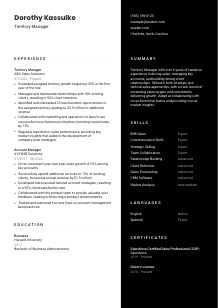
Additional languages are especially useful when your territory includes diverse customer groups or cross-border business. In the example, Spanish strengthens the candidate's ability to connect with a broader client base. That will not be equally important in every territory, but it can be a real differentiator when it matches the market.
If language is central to the territory, this section deserves clear visibility. If not, keep it concise. The main purpose is to show whether you can communicate effectively with clients and internal teams in the markets you cover.
For Territory Manager roles, languages are most useful when they support selling, relationship building, and smooth communication across the territory.
The summary should quickly establish your commercial profile. For a Territory Manager, that means years in sales, the type of accounts you have handled, and the kind of growth or retention results you tend to deliver.
Start with your title and level of experience. Mention whether your background is in territory management, account management, B2B sales, or regional business development so the reader understands your lane immediately.
A useful summary includes two or three specifics that reflect how you perform. Territory growth, client retention, new business wins, or cross-functional coordination are all relevant here. The example summary works because it ties 6+ years of experience to growth, account management, and collaboration instead of staying vague.
Aim for a short paragraph, not a career history. Every phrase should earn its place by clarifying scale, market type, or performance. Territory Manager summaries work best when they sound close to a value proposition you could defend with metrics later in the resume.
Close with a point of distinction that matters in the field. That might be consistent quota overachievement, strong retention in competitive territories, skill in opening new accounts, or the ability to turn market insight into action with marketing and operations teams.
A good summary gives the hiring team a fast read on the size of your sales background and the business results they can expect you to repeat.
A Territory Manager resume should leave little doubt about three things: you can grow a region, keep clients engaged, and report the market clearly enough to support business decisions. If those themes are visible in your title, summary, experience, and skills, the document is doing its job.
Use Wozber's free resume builder to tighten structure, improve ATS optimization, and present your experience in an ATS-friendly resume format that reflects the language of the job description. Once your resume shows territory ownership, sales results, and client depth with clarity, you are ready to apply.




